
Everyone in marketing feels that they should be providing solutions and remedies to be successful. While solutions and remedies are essential, it is also important to understand the consumer’s need before that, without which, the solutions are useless, directionless and irrelevant.
Few people in marketing and in the process of brand building have the patience to understand, identify and empathise with the consumer’s need. Everyone is in a hurry to provide solutions.
As per my ‘need shaastra’, it is important to begin with identifying and understanding the consumer’s need first. The deeper you go in understanding and identifying consumer needs, the better the process of providing solutions and remedies, whereby the chances of success increase substantially. Just jumping and leaping to provide solutions may lead to a misstep, making you fall flat on your face, failing.
Building brands and executing a proper marketing strategy requires a foundation. And, you build that foundation when you understand and identify the consumer’s need.
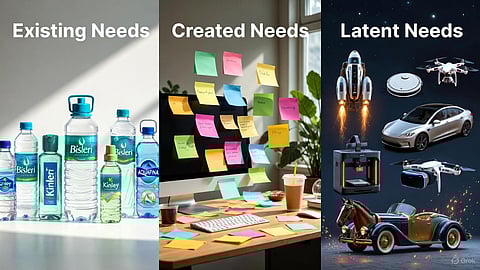
There are various types of needs. The first one is the existing need. For consumers, the need to eat, to drink water or to rest and sleep are existing needs. These basic existing needs have a huge potential. If marketing is only for commodities, the potential may be limited; but if the marketing is for brands, the potential becomes unlimited.
One example is drinking water. It is an existing need. You can obtain drinking water through various sources and through various methods. But building brands of mineral water, such as table water, natural mineral water, sparkling water, still water, flavoured water, and many other types of drinking water create an opportunity for companies to present value-added brands to meet an existing need.
There are Bisleri, Kinley, Aquafina, Himalayan, Evian and many other brands that can meet an existing need but in a value-added branded form. Brands represent trust and, hence, an existing need can be catered to by commodities or by brands. However, it is preferable to cater to existing needs through brands.
The second type of need is not an existing need that needs to be catered to. It is a created need. Just as you can cater to existing needs (the first type), you can serve created needs (the second type) too, because they come as a result of a process of innovation or fresh ideas or sometimes a simple offering that could actually make life easy for the consumer. There are plenty of examples where, instead of catering to an existing need, created needs have led to building big brands and businesses.
For over 40 years, the Post-it brand has helped people be more productive, communicate better and express themselves in a number of creative ways. Yet, as universal as these products have become, their beginnings were far from certain. Looking back, the birth of the Canary Yellow phenomenon reminds one of a valuable lesson – that creativity and perseverance or persistence can be just as important as inspiration when it comes to bringing an idea to life.
Spencer Silver, a 3M scientist, was researching adhesives in a laboratory. During the process, he discovered something peculiar: an adhesive that stuck lightly to surfaces and did not bond tightly to them. What Silver discovered was something called micro-spheres, which retained the quality of adhesion, but with a characteristic that enables the adhered object to remove itself so that it can be peeled off easily.
Meanwhile, Mr Fry, another 3M scientist, was frustrated because, on every Wednesday, while practising with his church choir at night, he would use little scraps of paper to mark the hymns he was going to sing in the upcoming service. By Sunday, he would find that they had all fallen out of the hymnal. And, so, Fry needed a bookmark that would stick to the paper without damaging the pages.
Sure enough, Fry and Silver, in partnership, began developing a product. Once they found that their writing of messages on the new notes to communicate around the office was effective, they realised the full potential of the idea. It was a whole new way to communicate!
They supplied the entire 3M company with the new adhesive notes. Employees loved them. Then, they put it in the open market. The notes became an overnight success. It was always a self-advertising product, because customers would put these notes with the documents they sent to others, arousing the recipients’ curiosity. They would look at them, peel them off and play with them and then go out and buy more of the product for themselves.
The inventor found that, like many ground-breaking innovations and creative ideas, there was a product nobody thought they needed, until they did. Thus was the Post-it brand born and became a grand success. This was a created need.
The third type of need is a latent need – a consumer’s desire to solve a problem is not currently fulfilled by the market; it is not even actively requested and, often, not recognised by the consumer. Situations such as these require deep research and breakthrough innovations to reach solutions like, for example, the automobile (in place of a faster horse) or the iPod (for portable music).
These and other articulated needs go beyond simple requests, representing fundamental problems or underlying goals that, when sold, create significant delight and competitive advantage. Unlike existing needs, here, users can easily describe latent needs as unrecognised, unserved and dormant.
To identify latent needs, you need to listen, observe and look for dissatisfaction points or unfulfilled needs. These hidden needs or desires that consumers have but do not realise or express often because they lack information or available product/services to fulfil them. These are large market gaps which, when addressed, can build big brands.
Understanding, creating and discovering needs are important elements in marketing, because only if there is a need, there will be a market.
Many companies have come up with wonderful products and services, but many of them do not succeed – one reason for such an eventuality is that the need was not understood, created or discovered. That led to a mismatch between the solution and the need. Maybe, there was no need at all! In situations such as these, a lot of effort, time and money get wasted and wealth destroyed. Therefore, starting with the need cannot be overemphasised.
There are many cases where existing needs have been ignored, opportunities for creating needs have been missed, and a lack of observation and patience has led to latent needs remaining undiscovered. The deeper the marketer goes into the domain of needs, the better prepared he is to launch and succeed.
You should also have the sensitivity to be able to avoid the areas of ‘no need’, because that would help you avoid wasting time and thereby escape frustration. The lesson here is: the natural process of listening and observing consumer behaviour is important for identifying and understanding consumer needs.
To summarise, the three types of needs are as follows: existing needs, which can be catered to; new needs that can be created; and latent needs that can be discovered. These three types of needs can build big brands, based on relevance. So, in marketing, you must pay HEED to the NEED!