
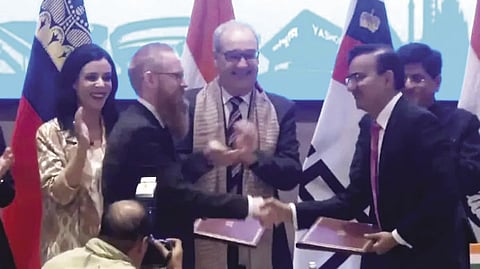
With the much-vaunted and long-delayed FTAs with the United Kingdom and the European Union nowhere in sight, India has finalised a trade deal with the four-nation European Free Trade Association (EFTA) grouping – comprising Iceland, Liechtenstein, Norway and Switzerland. The Trade and Economic Partnership Agreement is perhaps the only FTA India will sign before the Model Code of Conduct kicks in.
EFTA countries re-started their negotiations for a free trade pact with India in October 2016. The various chapters contained in the proposed pact include trade in goods, rules of origin, trade in services, investment promotion & cooperation, trade & sustainable development, and customs & trade facilitation.
Another FTA with Oman is in advanced stages with legal scrutiny underway. As for the India-UK FTA, it has been taken up at the highest level, with the Prime Minister’s Office (PMO) reviewing the deal late last month. According to a report, UK Secretary of State for Business and Trade Kemi Badenoch has said that an India-UK FTA “is possible” before the Indian elections, but that the UK does not want to use that as a “deadline”. Indian sources say there is no “tearing hurry”. Other trade deals – the comprehensive agreement with Australia and the FTA with the 27-member EU – are also being negotiated but are expected to be concluded only after the general election. Both deals involve the agriculture sector, a sensitive subject for India especially amid the farmers’ unrest.
The deal with EFTA would see the European bloc committing an investment of $100 billion in India over 15 years in sectors including pharma, food processing, engineering and chemicals. The investment commitment, the first of its kind in an FTA, would largely come from provident funds in EFTA countries. These include Norway’s $1.6-trillion sovereign wealth fund, the world’s largest pension fund which posted a record profit of $213 billion in 2023 on the back of strong technology stock returns.
Officials estimate that the commitment of $100-billion investments from the four-country bloc into India over the next 15 years would generate at least 1 million jobs.
Diversification of imports
The JV areas that the countries have short-listed mainly include areas where there is no competition from India. “EFTA has agreed to the condition of investments being made in India because they are getting market access. Also, they are not our competitors in the identified sectors. For instance, in India most of the medical devices are being imported from China. The pact will lead to diversification of imports which is absolutely necessary,” an official explained.
The official clarified that India had not gone against the interests of its generic drugs industry in any of the FTA it is negotiating with its partner countries, and had rejected the demand for `data exclusivity’ provision in the free trade pact with the EFTA bloc.
The investment commitment, however, may not be legally binding. The commitment falls under “investment promotion” and that India and EFTA are not signing a Bilateral Investment Treaty (BIT), as is being negotiated with the UK and the EU.
An investment commitment is crucial as India-EFTA trade is largely in favour of the European grouping as far as goods are concerned. Trade experts say India runs a high trade deficit with Switzerland, which could widen after India eliminates duties as part of the deal. During FY23, India’s imports from Switzerland stood at $15.79 billion in stark contrast to its exports of $1.34 billion, leading to a substantial trade deficit of $14.45 billion.
Trade agreements have historically helped India’s partner countries because of high average tariffs in India. India, therefore, is looking to attract investments and get better market access for its service sector workforce. Trade experts pointed out that the investment commitment could be a crucial gain for India.
After the India-EFTA deal, India could see higher imports of machinery, pharmaceuticals and medical instruments as there would be a sharp reduction in Indian tariffs which hover around an average rate of 18 per cent, among the highest in the world.
India’s main imports from Switzerland in FY23 included: gold: $12.6 billion, machinery: $409 million, pharmaceuticals: $309 million, coking and steam coal: $380 million, optical instruments and orthopaedic appliances: $296 million, watches: $211.4 million, cotton: $81.3 million, soybean oil: $202 million, chocolates: $7 million. u
Rakesh Joshi
rakesh.joshi@businessindiagroup.com