
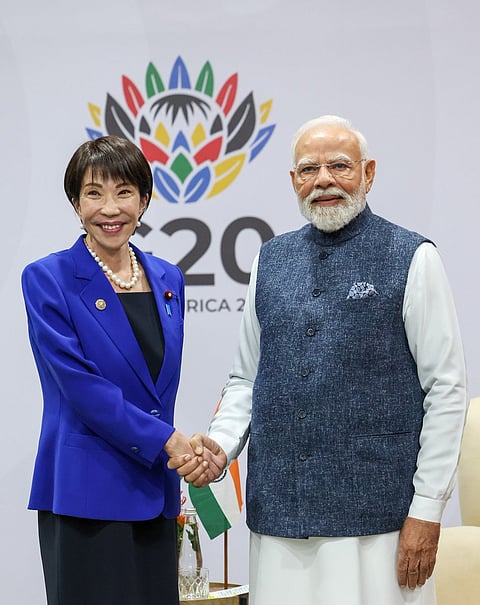
India & Japan: The strategic axis tightens
The maiden visit of Sanae Takaichi, Prime Minister, Japan, to India coincided with the 16th India-Japan Summit. Prime Minister Narendra Modi addressed PM Takaichi as his `younger sister’, and she reciprocated the sentiment by saying that she would develop this relationship as brother and sister. The two leaders held talks on trade, Indo-Pacific affairs, threats of terrorism and also increasing investments by Japan.
Japan is India’s fifth-largest source of foreign direct investment (FDI), contributing a cumulative $48.17 billion in equity inflows during April 2000-March 2026. After the summit, Japan formally doubled its funding commitment to a 10 trillion yen ($68 billion or Rs5.5 lakh crore) investment target over the next decade. Also, more than 120 new corporate memorandums of understanding (MoUs) – worth roughly ₹1 lakh crore ($12 billion) – have been signed.
"Both India and Japan are among the world's largest economies,” affirmed PM Modi. “A free, prosperous and rule-based Indo-Pacific is our shared priority. As the region's largest democratic and market economies, we have undertaken several significant initiatives today. Together, these will pave the way for peace, stability and progress across the entire region”.
India and Japan share a ‘special strategic and global partnership’ that covers advanced technology, economic infrastructure and defence co-development, besides deep-rooted cultural ties. "At our small meeting before the big meeting, we confirmed that we are on the same page and will enhance exercises in the Indian Ocean, promote naval maintenance, repair and overhaul co-operation, while also strengthening equipment co-operation under the ‘Make in India’ framework,” said PM Takaichi.
Bilateral trade between the two nations at present stands at $27.48 billion. Japan's exports of $21.44 billion to India include heavy machinery, electronic items, steel products and automotive components, while India’s exports to Japan ($6.04 billion) include organic chemicals, marine products (fish/crustaceans), vehicles and refined aluminium.
The year 2027 has been designated as the ‘India-Japan Year of Shared Horizons’ to mark the 75th anniversary of formal diplomatic relations, promising further expansion across digital, defence and spatial co-operation. While political relations between India and Japan have been robust, there is potential for increasing growth between the two nations. For instance, there are only 1,434 Japanese firms in India, as against over 6,000 in Thailand.
India and Japan also have partnerships in strategic defence and maritime security. The two nations have launched their first defence co-development project to jointly build the Unicorn naval radio antenna system. Both nations are members of the Quad, along with the US and Australia and also have regular bilateral and multilateral military operations, which include the Malabar naval exercises.
Japan is funding the Mumbai-Ahmedabad High-Speed Rail corridor, one of India’s flagship endeavours, utilising its signature Shinkansen system through exceptionally low-interest loans from the Japan International Co-operation Agency (JICA). Over 4,900 Japanese business establishments operate in India. A prime example is Suzuki Motor Corporation, which makes nearly two-thirds of its global automotive output in India. Areas like Neemrana, Rajasthan, have even been dubbed ‘Mini Japan’ due to the presence of integrated Japanese industrial zones. And, in the technology sector, companies like Renesas Electronics are investing heavily in India's semiconductor assembly and testing ecosystems to secure tech supply chains.
During the summit, the two leaders condemned cross-border terrorism, specifically emphasising the threat emanating from Pakistan-backed proxy groups, demanding immediate and irreversible action against terror safe havens. The global and regional challenges highlighted by Prime Minister Modi and Prime Minister Taikaichi included talks about Maritime Overreach and Territorial Coercion in the East and South China Seas. They also opposed any unilateral attempts to alter the regional status quo by force or economic coercion.
Rising threat
There was talk about the rising threat to free, open and unhindered navigation. The two leaders flagged vulnerabilities regarding critical bottlenecks like the Strait of Hormuz, where safe transit is vital for global energy flow. They also identified the extreme risks involved in modern economic inter-dependencies. They explicitly pointed out the challenge of high dependence on single-source countries (namely China) for essential industrial inputs.
The two prime ministers also spoke about the strategic importance of India’s North Eastern Region (NER). PM Modi appreciated Japan’s support in enhancing connectivity in the region through road networks, bridges, healthcare and disaster risk reduction. “Towards a shared goal of a resilient and prosperous Indo-Pacific, the two leaders reiterate their commitment to advancing co-operation amongst like-minded countries and welcome the progress under the Quad framework. They are also advocating an early convening of the Quad Leaders Summit,” read their joint statement.
The two prime ministers also highlighted the significance of co-operation with ASEAN member states to strengthen regional resilience and promote peace, stability and prosperity. In this context, they concurred on initiating preparations to hold the inaugural trilateral 1.5 track policy dialogue with the Philippines.
Box
Major corporate agreements & multi-state projects
1. Green Hydrogen, Ammonia and Energy Transit: IHI Corporation and ACME Group (Odisha) have inked mega-deals valued at Rs67,000 crore to build a 0.4 mtpa green ammonia plant at Gopalpur, a 0.8 mtpa project at Paradip and a green methanol plant to supply Mitsubishi Gas Chemical.
Itochu Corporation and L&T (Gujarat) are partnering on a Rs18,900 crore green ammonia production hub at Kandla Port.
A ¥80 billion (about Rs4,400 crore) loan agreement has been signed by the Japan Bank for International Co-operation to expand India's high-voltage direct current (HVDC) renewable energy transmission systems.
2. Advanced Automotive and Next-Gen Mobility: Toyota (Maharashtra) will be setting up a new Rs20,000+ crore mega-plant in Bidkin to make 100,000 vehicles annually, focusing heavily on hybrid and EV tech.
Suzuki Motor Corporation (Pan-India) plans to invest Rs5,000 crore in fresh land acquisitions for manufacturing, alongside specialised biogas plant rollouts in Assam.
3. Semiconductors, AI, and Digital Infrastructure: Fujifilm and Toho Koki plan to launch new semiconductor material production pipelines and ecosystems in collaboration with IIT Guwahati.
NTT Data will be pouring Rs3,800 crore into undersea submarine cable networks and telecom software integration with Persistent Systems.
4. Heavy Industry and Banking Consolidation: JFE Steel and JSW Steel will inject an additional Rs32,000 crore into their integrated steelworks joint venture, to push capacity past 10 million tonnes per year.
Re: financial stakes, a major entry into the Indian banking ecosystem is highlighted by Mitsubishi UFJ Financial Group’s (MUFG) placing Rs40,000 crore with Shriram Finance and SMBC deploying Rs17,000 crore via Yes Bank.
Core investments by Japan in India
The private FDI/JITs include 1,434 active companies, eight Japan Industrial Townships and also ‘Plug-and-play’ SEZ Infrastructure, while the public sector ODA covers the Mumbai-Ahmedabad Bullet Train, dedicated freight corridors and metro systems (Delhi, Mumbai)
Japan Industrial Townships (JITs): India hosts eight dedicated JITs (including Neemrana in Rajasthan and Sri City in Andhra Pradesh). These offer Japanese companies translation desks, domestic tax exemptions, and plug-and-play logistics.
Official Development Assistance (ODA): Handled via the Japan International Co-operation Agency (JICA), Japan continues to fund India’s largest infrastructure projects through ultra-low-interest loans, including the Mumbai-Ahmedabad Shinkansen Bullet Train and urban metro expansions.