
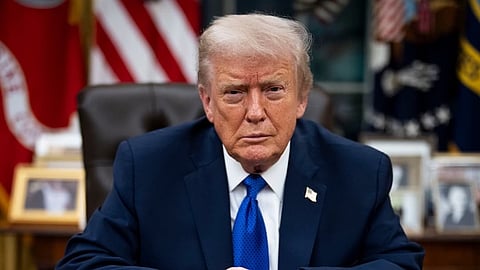
A lot has been said about the India-US trade agreement ever since a phone call between US President Donald Trump and Prime Minister Narendra Modi took place on 2 February, touching on a trade deal. “It was an honour to speak with PM Modi,” said President Trump, after his phone call with Modi. “He agreed to stop buying Russian oil and buy more from the US and potentially Venezuela. This will help end the war in Ukraine”.
Interestingly, there is a difference in perception on this agreement. While the Indo-US trade framework is being hailed in Washington as a breakthrough, it’s being defended as a work in progress in New Delhi. In truth, it’s neither a finished pact nor a settled understanding – unlike the meticulously negotiated India-EU FTA agreements, signed down to the last clause and scheduled for implementation from January 2027.
“The US framework remains structurally ambiguous, politically sensitive and strategically fluid,” says an academic, not wishing to be identified. “At its core lies a contested premise. Has India agreed to phase out Russian oil in exchange for tariff relief? Or, does it retain full sovereign discretion to buy crude from wherever market logic dictates? The US claims commitment. India speaks of diversification and national interest. Between those positions lies a grey zone – one that the Opposition has rushed in to fill with allegations of capitulation.”
“Yes, the reality is more complex,” the academic adds. “This is not a surrender document. It is an evolving instrument of recalibration. And the unanswered questions may matter more than the headlines”.
After speaking with President Trump, PM Modi affirmed that he was happy that the US has reduced tariffs to 18 per cent. “Big thanks to President Trump on behalf of the 1.4 billion people of India for this wonderful announcement. When two large economies and democracies work together, it benefits our people and unlocks immense opportunities for mutually beneficial co-operation,” said PM Modi.

This trade arrangement has been explained by former ambassador Anil Trigunayat. “When we look at the Indo-US Strategic Partnership, there are many verticals and trade happens to be one of them,” he remarks. “If you look back, you would notice that President Trump has always referred to tariffs. Tariffs have been imposed on nearly all countries by Trump. This is a transactional agreement.”
Interim agreement
“This is a framework for an interim agreement,” adds Randhir Jaiswal, spokesperson, ministry for external affairs (MEA). “The India-US joint statement touching upon reciprocal and mutually beneficial trade was issued on 7 February. And it remains the basis of our mutual understanding in the matter. Both sides will now work towards implementing the framework and finalising the interim agreement”.
The joint statement that was released by the White House on 6 February says that the US and India have reached a framework for an interim agreement that reaffirms their commitment to broader US-India Bilateral Trade Agreement (BTA) negotiations, which were launched by the two leaders on 13 February 2025. “During the call between the leaders, President Trump agreed to remove the additional 25 per cent tariff on imports from India in recognition of India’s commitment to stop purchasing Russian Federation oil. Accordingly, the President signed an Executive Order removing that additional 25 per cent tariff,’’ reads the statement issued by the White House.
Given India’s willingness to align with the US to confront systemic imbalances in the bilateral trade relationship and shared national security challenges, the US will lower the reciprocal tariff on India from 25 per cent to 18 per cent, clarifies the statement. The US is one of India’s largest trading partners, with bilateral trade reaching $132.2 billion in 2024-25, as against $119.71 in 2023-24.
One of the issues that India hasn’t officially commented on is the import of oil from Russia. It has maintained that it would buy oil from across the world, based on what benefits its 1.4 billion population.
Reacting to the US urging India to stop oil imports from Russia, Russian Foreign Minister Sergey Lavrov said that he hadn’t heard anyone else supplement Trump’s statement. “You mention that Donald Trump has announced India’s agreement to not purchase Russian oil any longer,” said Lavrov. “I have not heard such a statement from anyone else, including Prime Minister Modi and other Indian leaders”.
Will India continue to import oil from Russia? Or, will it stop buying under pressure from the US? Only time can tell. Until then, it’s good news to have the interim trade deal with the US back on track.
Box
What has been agreed on
The White House has shared the key terms of the agreement, as follows:
• India will eliminate or reduce tariffs on all US industrial goods and a wide range of US food and agricultural products, including dried distillers’ grains (DDGs), red sorghum, tree nuts, fresh and processed fruit, soybean oil, wine and spirits, and additional products.
• India intends to buy more American products and purchase over $500 billion of US energy, information and communication technology, coal and other products.
• India will address non-tariff barriers that affect bilateral trade in priority areas. The US and India will negotiate rules of origin that ensure that the agreed benefits accrue predominantly to the US and India.
• India is committed to negotiating a robust set of bilateral digital trade rules that address discriminatory or burdensome practices and other barriers to digital trade.
• The US and India are committed to strengthening economic security alignments to enhance supply chain resilience and innovation through complementary actions to address non-market policies of third parties, as well as cooperating on inbound and outbound investment reviews and export controls.
• The US and India will significantly increase bilateral trade in technology products and expand joint technology co-operation.
The prosperous path forward. President Trump continues to advance the interests of the American people, enhancing market access for American exporters and lowering tariff and non-tariff barriers to protect our economic and national security.
• India has maintained some of the highest tariffs on the US of any major world economy, with tariffs as high as an average of 37 per cent for agricultural goods and more than 100 per cent on certain autos.
• India also has a history of imposing highly protectionist non-tariff barriers that have banned and prohibited many US exports to India.
• In the coming weeks, the US and India will promptly implement this framework and work toward finalising the interim agreement with a view to concluding a mutually beneficial BTA to lock in benefits for American workers and businesses.
• In line with the roadmap set out in the terms of reference for the BTA, the US and India will continue negotiations to address the remaining tariff barriers, additional non-tariff barriers, technical barriers to trade, customs and trade facilitation, good regulatory practices, trade remedies, services and investment, intellectual property, labour, environment, government procurement and trade-distorting or unfair practices of state-owned enterprises.
Liberating the US from unfair trade practices. President Trump has challenged the assumption that American workers and businesses must tolerate unfair trade practices that have disadvantaged them for decades and contributed to their historic global trade deficit.
• On 2 April 2025, President Trump declared a national emergency in response to the large and persistent US goods trade deficit, caused by a lack of reciprocity in the bilateral trade relationships, unfair tariff and non-tariff barriers and US trading partners’ economic policies that suppress domestic wages and consumption.
• President Trump continues to advance the interests of the American people by removing tariff and non-tariff barriers and expanding market access for American exporters, including in the agricultural sector.
Today’s announcement provides a tangible path forward with India that underscores the President’s dedication to realising balanced, reciprocal trade with an important trading partner.