
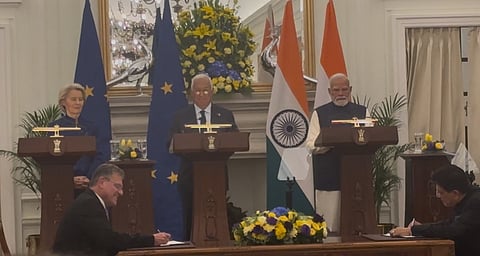
Ursula von der Leyen, president, European Commission, calls the India-EU FTA the ‘mother of all FTAs’, the historic deal of which was signed in India on 27 January and will come into effect next year (2027) after it gets ratified. Negotiations for this trade deal began 19 years ago, in 2007.
“We have created a free trade zone of two billion people, with both sides set to benefit,” affirmed Ursula, “This is only the beginning. We will grow our strategic relationship to be even stronger”.
This agreement is expected to reshape trade flows and increase opportunities for small- and medium-scale enterprises, and increase investment possibilities. A larger and more visible impact of this trade deal will be seen in 2028.
“The deal signed on 27 January incidentally concerns 27 nations in the EU bloc,” proclaimed Prime Minister Narendra Modi. “This historic agreement with the EU, which is India’s largest FTA, has substantial benefits for the 1.4 billion people of India. It will make access to European markets easier for our farmers and small industries, create new opportunities in manufacturing and further strengthen co-operation between our services sectors”.
Bilateral trade in goods between India and the EU was worth €120 billion in 2024, with EU goods imports from India standing at €71 billion and EU goods exports reaching nearly €49 billion during the same time. The EU intends to eliminate tariffs on over 90 per cent of the tariff lines and 91 per cent in terms of value. India will eliminate tariffs on 86 per cent of the tariff lines and 93 per cent in terms of value. Both sides will also partially liberalise a significant number of additional lines, thereby bringing the overall coverage of trade liberalisation to 96.6 per cent for India and 99.3 per cent for the EU.
An opportunity for EU brands
“India concluding trade negotiations with the EU indicates its continued efforts to selectively diversify trade relationships,” contends Moody's Ratings. “In effect, the FTA will be credit-positive, with lower tariffs and better market access supporting India’s ambition to develop its manufacturing sector, attract foreign investment and strengthen the export competitiveness of its labour-intensive goods. Lower tariffs on EU imports may also help ease costs, although such imports retain only a small share of India’s overall import bill. European carmakers would gain easier access to the world’s third-largest car market, allowing them to introduce more premium models under a calibrated liberalisation framework – an opportunity for EU brands but adding competition for Indian manufacturers. Ultimately, the broader benefits of the FTA will hinge on progress in complementary areas, such as improving business friendliness and streamlining regulations”.
Meanwhile, India and the European Union have signed their first Security and Defence Partnership framework, alongside a broader trade engagement. The agreement covers maritime security, defence industry and technology, cyber threats, space security and counter terrorism. The main highlights of this partnership include an annual institutionalised India-EU security & defence dialogue, negotiations on a security of information agreement, exploration of India’s participation in European defence programmes, reduction of import tariffs on aircraft and spacecraft for European companies from 11 per cent to zero, creation of an India-EU defence industry forum to promote co-development, co-production and industrial collaborations, deeper co-operation on counter-terrorism financing, prevention of the misuse of emerging technologies, online radicalisation and regional security.

The EU is increasing its defence spending from about 1.9 per cent to about 3.5 per cent of gross domestic product. It is also looking at reducing dependence on the US and Chinese suppliers.
Meanwhile, Indian defence companies are well-positioned as cost-competitive and reliable manufacturing and co-development partners. Areas of opportunity include aircraft programmes, aero structures, engines, missiles, electronics, radars, submarines and naval platforms. Existing linkages already exist with companies such as Hindustan Aeronautics, Bharat Electronics, Bharat Dynamics, Larsen & Toubro, Tata Advanced Systems, Mahindra Defence, Bharat Forge and Mazagon Dock Shipbuilders. The agreement supports a gradual shift from licensed production to co-development, engine manufacturing, platform integration and long-term participation in European defence supply chains.
The trade deal also benefits labour-intensive sectors like textiles, footwear and marine products significantly. There will be zero tariff on textile exports to European Union countries now (earlier it was 12 per cent). India has a 2 per cent share in European apparel imports (~$197 billion) and a 5 per cent share in home textiles (~$21 billion). There will be stronger competition against China and Bangladesh now.
India has about a 3 per cent share in European footwear imports, where the tariff has been reduced to zero from 17 per cent; here, India will compete with Vietnam and China. In marine products, which India’s exports are worth $1 billion to the EU, the tariff has been brought to zero.
Antonio Costa, President, European Council, who has Goan roots, got an OCI card, which he displayed during the signing of the FTA. “While I am the President of the European Council, I am also an overseas Indian citizen. And I am proud of my roots in Goa, where my father’s family came from. The connection between Europe and India is something personal to me,” said Costa.
Box
Benefits rain
There are strong benefits for key economic sectors on each side, such as:
· For the EU: agri-food, chemicals, pharmaceuticals, machinery, medical devices, avionics and automotive industries.
· For India: fisheries, chemicals, textiles, footwear and pharmaceuticals.
India will remove high duties on industrial products (which, on average, are above 16 per cent), such as:
· Chemicals (current tariffs of up to 22 per cent, to be removed mostly as the agreement comes into force);
· Cosmetics (current tariffs of up to 22 per cent, to be removed mostly after 5-7 years);
· Plastics (some as the agreement comes into force; others, after seven years);
· Car parts (most tariffs to be removed after 5-10 years);
· Textiles and apparel (most tariffs removed as the agreement comes into force);
· Ceramics (most tariffs removed as the agreement comes into force);
· Machinery (half of the tariffs liberalised as the agreement comes into force and the rest in stages of up to 10 years), and;
· Boats (mainly at entry point).
These duty reductions and eliminations will facilitate EU exports of these products, which could not access the Indian market so far, given the high tariff barriers.
In the agri-food sector, considering the high level of protection and its sensitivities in India, the agreement is balanced, because it opens market access in key export interests while preserving sensitivities.
The agreement will eliminate duties on several key EU agri-food exports, such as:
· Olive oil (current tariff of up to 45 per cent, to be eliminated as the agreement comes into force or after a five-year period);
· Non-alcoholic beer and several fruit juices (current tariff of up to 55 per cent, to be eliminated after five years);
· Processed food, such as confectionery, breads, pastry, pasta, chocolates, pet food (current tariff 33 per cent, to be eliminated as the agreement comes into force or in stages), and;
· Sheep meat (current tariff 33 per cent, to be eliminated in stages).
The agreement also offers significant market access improvement for wine, spirits, and beer, as well as fruits, such as:
· EU exports of alcoholic beverages currently subject to very high tariffs (reaching 150 per cent in some cases) will be reduced over time to 30 per cent for most wines, 40 per cent for all spirits and 50 per cent for beer;
· EU exports of fruits (such as kiwis and pears) will benefit from sizeable tariff rate quotas (TRQs), allowing to expand EU market shares in India, and;
· The agreement will establish a working group on wines and spirits, which will serve as a platform for the exchange of information and cooperation between the parties, including on oenological practices.
At the same time, the EU will protect its agricultural sensitivities, which means that no concession will be granted for sugar and ethanol, rice and soft wheat, beef and poultry, milk powders, bananas and honey; and well-calibrated quotas will limit imports of table grapes and cucumbers.
In addition, as per the SPS chapter, the EU will protect its very high sanitary and phyto-sanitary standards and the EU’s stringent rules on animal and plant health, while food safety will be maintained without exception.