
Improving trade ties
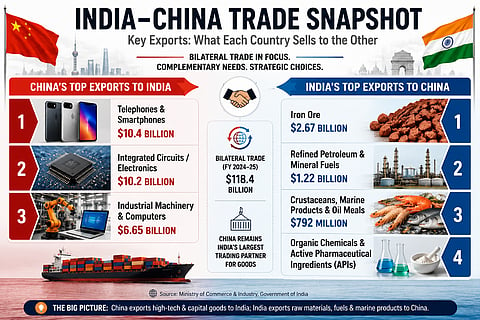
China is India’s largest trade partner, with bilateral trade touching $151.1 billion during the recently concluded financial year. India’s second-largest trade partner is the US ($140 billion), followed by the UAE. Though trade with China has increased, there is a trade imbalance, with India’s imports standing at $131.5 billion, while exports to China reach only $19.6 billion, making the total trade deficit (mid-year) about $112.16 billion.
“India’s imports from China have grown to $38.04 billion in the first quarter of the ongoing financial year (April-June 2026), which was a 28 per cent increase over the corresponding period of the previous year,” shows the trade data published by the ministry for commerce & industry. Meanwhile, the bilateral trade between the two nations touched $91.72 billion during the first half of the year (with the trade deficit touching $67.1 billion). India’s imports from China surged to $79.41 billion, while exports were $12.31 billion, according to the commerce ministry.
“China has never deliberately pursued a trade surplus with India,” says Yu Jing, spokesperson of the Chinese Embassy in India. “A large share of India’s imports from China consists of electronic components, machinery and intermediate goods that support India’s manufacturing expansion, job creation and industrial upgradation. We welcome more premium Indian products into the Chinese market”.
Greater investment from China into India will be good both for the economics of the relationship and for broader bilateral ties, says Vikram Doraiswami, India’s ambassador to China. “Obviously, we would like to be able to export more to China,” he affirmed, while speaking at a foreign policy forum in Beijing. “There is nothing unreasonable in suggesting that.”

He went on to say that trade should increase in sectors where India had a competitive advantage, like in the pharmaceuticals sector, where India is one of the world’s big exporters to advanced markets. “We hope Chinese partners will work with us to ensure that the high-quality generic medicines made by the Indian production firms – the same products that have been exported to the US and elsewhere – can be exported to the Chinese market too. We think there is a balance of advantage for both countries, including value for China and, of course, value for the relationship,” he added.
Market opportunity
Trade ties have improved after the two nations began to normalise ties over the past two years. It began with Prime Minister Narendra Modi meeting Chinese President Xi Jinping in October 2024. “Regardless of the ups and downs of the larger political relationship, India’s exports to China had also increased recently,” Doraiswami said. “That means that the market opportunity is there. We need to find ways of making it easier”.
India continues to import large amounts of electrical machinery and finished goods from China, as well as a range of intermediate goods. “We have to find ways in which India and China can be connected,” Doraiswami felt. “A widening basket of goods both sides should be able to provide each other, as also a sense that reasonable mechanisms to protect consumers can be applied in a way that enables India also to export more of the goods that it can export elsewhere in the world also to China”.
“Over the past three-four years, India-China trade has continued to expand despite geopolitical challenges, reflecting the strong economic complementarity between the two countries. While public discourse often focuses on India’s trade deficit with China, a closer examination reveals that a significant share of imports from China consists of industrial inputs, capital machinery, electronic components, active pharmaceutical ingredients (APIs), and manufacturing equipment that are essential for India’s industrial growth,” VK Mishra, India-China Trade Expert told Business India.
The policy environment has been specifically changed during the past few months to facilitate greater Chinese investment. In March, India had relaxed the restrictions on investments from China that were imposed in early 2020. “India was willing, not just to help investment happen, but also to listen to their concerns and find ways in which we can offer more handholding assistance to enable the Chinese businesses to come into India. That, I think, is good for the economics of the relationship. It is also good for the larger country-to-country relationship,” Doraiswami explained.