
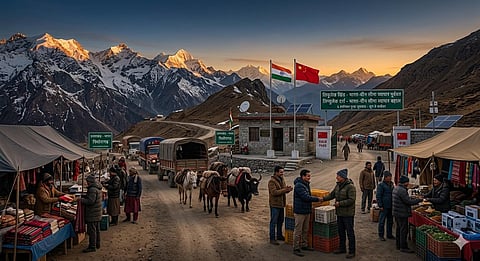
High passes, higher stakes
After a six-year hiatus, India and China have resumed border trade through the Himalayan passes of Nathula (Sikkim), Shipki La (Himachal Pradesh) and Lipulekh (Uttarakhand), marking another step in the gradual normalisation of bilateral ties following the Covid-19 pandemic and military tensions along the Line of Actual Control (LAC).
The reopening follows the 24th round of the India-China Special Representatives' dialogue, co-chaired by National Security Advisor Ajit Doval and Chinese Foreign Minister Wang Yi, where both sides agreed to progressively restore border trade. Government sources say administrative and logistical arrangements were completed ahead of the reopening, reflecting the growing momentum in diplomatic engagement since late 2024.
The move is significant both economically and strategically. Nathula, once part of the ancient Silk Route, reopened for trade in 2006 after remaining closed since the 1962 India-China war, before being suspended again in 2020. Its revival is expected to benefit more than 600 traders in Sikkim, while communities in Uttarakhand and Himachal Pradesh also stand to regain an important source of livelihood.
Trade through these passes remains limited to an approved list of goods under the bilateral agreement. India exports garments, blankets, tea, coffee and handicrafts, while imports from China's Tibet Autonomous Region include raw silk, wool, yak hair and earthenware. Though modest in value, this commerce sustains local economies and preserves traditional trading links.
Infrastructure development is accompanying the reopening. A new highway connecting Rongli and Menla in Sikkim is under construction to provide a safer alternative to landslide-prone routes. Officials believe improved connectivity will strengthen logistics, facilitate trade and boost tourism in East Sikkim.
People-to-people exchanges
The resumption of trade follows the reopening of the Kailash Manasarovar Yatra in 2025 through Nathula and Lipulekh, signalling the restoration of both commercial and people-to-people exchanges. "The decision to resume trade through these borders dates back to 19 August 2025, when both sides agreed that border trade through Lipulekh, Shipki La and Nathu La Pass would be resumed. Now, those projects are being taken forward," says Randhir Jaiswal, spokesperson for the Ministry of External Affairs.
The reopening also reflects sustained diplomatic engagement. In August 2025, Doval met Wang Yi in New Delhi for fresh boundary talks. During the visit, Wang also held discussions with External Affairs Minister S. Jaishankar and called on Prime Minister Narendra Modi. More recently, Foreign Secretary Vikram Misri visited Beijing, where discussions with Chinese Vice Foreign Minister Hua Chunying focused on maintaining peace and tranquillity along the border while expanding cooperation in trade, culture and people-to-people exchanges.
Jaishankar and Wang Yi also met on the sidelines of the ASEAN meetings in Manila, reiterating that border stability remains central to normal ties. "Since October 2024, both sides have engaged to ensure peace and tranquillity in the border areas. This will continue to need our constant attention," Jaishankar said, describing border stability as the essential precondition for a normal bilateral relationship.
While diplomatic ties have warmed, the economic relationship remains highly uneven. China continues to be India's largest trading partner, with bilateral trade reaching $151.1 billion in FY26, ahead of the US ($140 billion) and the UAE. India's imports from China stood at $131.5 billion against exports of only $19.6 billion, resulting in a trade deficit exceeding $112 billion.
The imbalance has widened further in FY27. Commerce Ministry data show imports from China rose 28 per cent year-on-year to $38.04 billion during April-June 2026. During the first half of the financial year, bilateral trade touched $91.72 billion, with imports accounting for $79.41 billion and exports only $12.31 billion, pushing the trade deficit to $67.1 billion.
Chinese officials argue that the deficit reflects India's industrial requirements rather than unfair trade practices. "China has never deliberately pursued a trade surplus with India. A large share of India's imports from China consists of electronic components, machinery and intermediate goods that support India's manufacturing expansion, job creation and industrial upgradation. We welcome more premium Indian products into the Chinese market," says Yu Jing, spokesperson for the Chinese Embassy in India.
For India, however, the challenge lies in balancing renewed engagement with economic resilience. While reopening the Himalayan trade routes restores livelihoods, revives historic commercial links and reinforces diplomatic confidence-building, it does little to address the structural imbalance in bilateral trade.
The reopening of Nathula, Shipki La and Lipulekh is therefore more than a logistical exercise. It reflects a cautious thaw in one of Asia's most consequential relationships, where cooperation is gradually returning without resolving deeper strategic differences. The success of this renewed engagement will ultimately depend not only on keeping the border peaceful but also on creating a more balanced and sustainable economic partnership.