
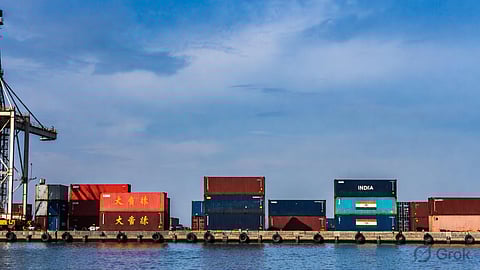
A diplomatic thaw between India and China last year led to not just the resumption of Kailash-Manasarovar Yatra, but also direct flights and improved visa services. This has also contributed to an increase in bilateral trade, which has now touched $155.6 billion. “In 2025, the bilateral trade between China and India reached a record high of $155.6 billion, registering a year-on-year growth of over 12 per cent,” affirmed Xu Feihong, China’s Ambassador to India. “India’s exports to China grew by 9.7 per cent, demonstrating the vast potential of economic and trade co-operation between the two”.
Uncertainty over tariffs and trade barriers across the world has shifted geopolitical alignments and contributed to the enhancement of trade ties between countries like India and China. “The $155.6 billion trade figure illustrates a central reality of India-China relations – that economic pragmatism often outweighs political friction,” Vijay Kant Mishra, India-China Trade & Finance Expert, told Business India. “For India, sustaining growth requires affordable inputs and capital goods, whereas for China, India remains a large and growing market at a time of slowing demand elsewhere. Indian exports to China have shown moderate growth, reflecting improved access for certain agricultural and industrial products. However, there is a trade imbalance, as India’s trade deficit with China is $116 billion, with imports continuing to far outpace exports. This imbalance highlights long-standing challenges, which include limited market access for Indian pharmaceuticals, IT services and value-added manufactured goods in China, along with India’s continued reliance on Chinese inputs for domestic production”.

However, at the core of the enhanced bilateral trade lies the structural complementarity between the two economies. China remains a global manufacturing powerhouse, supplying India with critical electronics, machinery, chemicals, active pharmaceutical ingredients, solar equipment and industrial components – essential for India’s fast-growing sectors, such as infrastructure, renewable energy, telecommunications and electronics manufacturing.
Export opportunities
“Bilateral trade between India and China is projected to grow further, driven by manufacturing demand, energy transition and shifting global supply chains,” observed Mishra. “One of the strongest drivers of future trade growth is expected to be electronics and industrial manufacturing. China remains a critical supplier of electronic components, semiconductors, telecom equipment and machinery that feed into India’s rapidly expanding electronics, mobile phone and digital infrastructure sectors. There are opportunities for Indian exports of refined petroleum products, engineering goods, and select clean-tech materials to China, as energy co-operation evolves alongside climate commitments.”
It may be recalled that during Prime Minister Narendra Modi’s visit to Tianjin in August 2025 for the Shanghai Co-operation Organisation (SCO) Leaders’ Summit, Modi had told Chinese President Xi Jinping that India was committed to improving ties with China.
“We are committed to promoting our relations, based on mutual respect, trust and sensitivities,” PM Modi had said, adding that co-operation between the two nations was linked to the interests of 2.8 billion people of the world’s two most populous countries.
Meanwhile, the chemicals and pharmaceutical sectors are projected to remain central to bilateral trade growth. China is a key supplier of chemical intermediates and active pharmaceutical ingredients (APIs), essential for India’s drug manufacturing industry. “Trade in automobile components, engineering products and industrial metals is expected to expand,” Mishra added. “With China dominating global electric vehicle production and India strengthening its auto-component base, cross-border trade in spare parts, materials and equipment is likely to increase. While goods trade is expected to grow faster, progress in services trade – including IT, financial services and professional services – will be gradual due to regulatory barriers and market access issues. For China, India represents a large and growing market. For India, China remains a critical source of industrial inputs at a time of rapid economic expansion”.
There is scope for increased investments between the two nations, although, at present, China is not a major source of foreign direct investment (FDI) to India. Between April 2000 and March 2025, the cumulative Chinese FDI amounted to about $2.5 billion, representing only 0.3 per cent of India’s total FDI inflows during the period. According to data published, China ranks 23rd among foreign investors in India.
“India-China trade is unlikely to shrink in the foreseeable future,” informed Mishra. “Instead, it is expected to grow in volume and diversify across sectors linked to technology, energy, manufacturing and infrastructure. The challenge for policy-makers will be to ensure that this growth is more balanced, resilient and strategically sustainable, even as economic inter-dependence deepens.”