
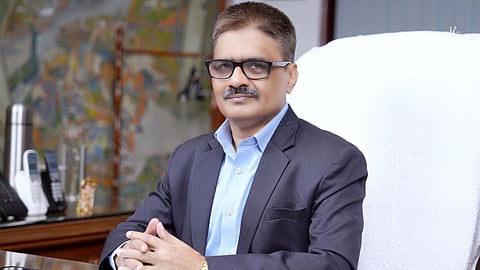
‘Towards higher operational efficiency’
What would be your priority as a new CMD, CIL?
Increased coal production and improved quality coal supplies remain our priority and core functional area in meeting the country’s energy demand. However, in response to the evolving business landscape and energy sector dynamics, we are also actively foraying into solar power, critical mineral acquisitions, and coal gasification. The company is also committed to sustainable mining practices.
What are the reasons for the plunge in production and offtake this year, after CIL’s impressive performance two years ago?
The immediate cause that impeded our production was the early onset of monsoon, by about two weeks, coupled with severe intensity in rainfall and its prolonged duration. About 95 per cent of our coal is extracted from opencast mines, and the inclement weather dampened the production pace in the mines of Jharkhand and Chhattisgarh, with sporadic rains continuing till as late as October. But our focus to increase production is steadfast and remains undiminished.
With the captive and commercial coal players gaining ground, will competition upset CIL? And, what factors do you rely on to face competition?
Rather than viewing them as competing, their role may be viewed as complementing the country’s coal sector because ramping up indigenous coal output is in the interest of the nation to arrest the expensive forex outgo. We are concentrating on higher efficiency in mining operations and lowering operational costs. The key is maximised production at minimised cost through the adoption of technologies and a higher degree of mechanisation, which we are pursuing assiduously. Our decades of core competence, HR pool of multi-disciplinary professionals, and skilled labour also give us an edge. Realistically, we have to perform in a challenging scenario, but given the rate at which thermal capacity addition is taking place in the power sector, the country needs more coal to feed these plants. So, there is ample space for all coal players to grow.
How prepared is CIL to make the transition from its core business to diversification ventures like solar, coal gasification, critical minerals, setting up coal-fired plants, PSP, etc?
For Coal India, the next 10 years will be crucial, and we have started future preparedness by stepping into non-coal sectors like solar and coal gasification. We have already aligned with BHEL, GAIL and BPCL. On critical mineral acquisitions, the company is actively participating in domestic auctions and also scouting for overseas acquisitions. We have emerged as the preferred bidder in three critical mineral blocks in India. We have also entered into a JV with Damodar Valley Corporation for a Brownfield Expansion of 1,600 MW of Thermal Power Plant at DVC’s existing Chandrapura TPS in Jharkhand, which is expected to commence commercial operation by 2031-32. In this way, we are adapting to the changing energy dynamics in the country. The diversification ventures will help generate additional revenue streams and to retain our energy leadership in the ensuing years.
What is the status of awarding the abandoned or discontinued mines on a revenue-sharing basis? What are the advantages?
Coal resources left untapped in discontinued UG mines earlier, due to technological reasons, are now being extracted on a revenue-sharing model. As many as 32 mines have been identified for re-operationalisation on a revenue-sharing basis. Work is awarded to successful bidders for 28 such mines, which, combined, have a Peak Rated Capacity of nearly 40 million tonnes per year. Two such mines have already started producing, and five more mines are likely to go operational in the current fiscal year. The advantages of this initiative, apart from increased domestic coal output, include conservation of resources and provision of livelihood to the local communities.
The country needs coal as the economy continues to grow. But there is talk about a ‘green transition’. What would be CIL’s role in this?
India’s energy economy is predominantly coal-dependent and would be so for the next decade and even beyond, till renewables and other non-fossil fuel energy sources come up in a big way to shoulder coal’s role. For now, their role is supplementing in nature rather than substituting for coal. But, gradually, coal’s share in the energy basket is bound to diminish with India committed to net zero goal by 2047.