
Maharahstra's revenue stress
Maharashtra’s fiscal narrative – long underpinned by its status as India’s premier industrial and financial engine – is increasingly being tested by a widening revenue deficit that reflects deeper structural imbalances. What appears, at first glance, as a manageable divergence between receipts and expenditure is, in reality, a layered stress shaped by political choices, expanding welfare commitments and a budgeting process that often stretches beyond its own arithmetic.
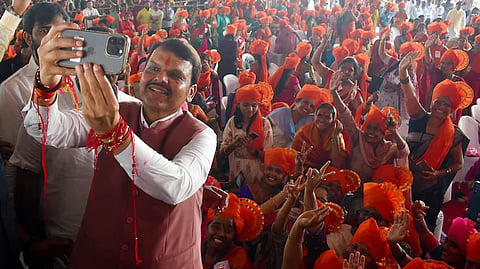
At the centre of this stress lies a familiar but intensifying mismatch aggravated by doles like the Ladki Bahin (favourite sister) scheme, which was introduced by erstwhile Chief Minister Eknath Shinde (of the Shiv Sena), costing the state exchequer over Rs40,000 crore month-on-month right before the current dispensation, now led by CM Devendra Fadnavis, returned to power in 2024. Come June 2026, and yet another farm loan waiver of up to Rs2 lakh, providing a comprehensive bailout for agriculturists in the state, will further precipitate the fiscal stress on Maharashtra’s resources.
“We are committed to spending money that we do not have to finance the farm loan waiver that was a pre-poll freebie announced by the then state government,” a senior finance department official told Business India on condition of anonymity. “But these are political decisions.”
The stress is also more evident with private infrastructure builders in Maharashtra openly expressing their angst over unpaid bills for the currently ongoing projects. About four months back, contractors based out of Nagpur held a public protest metaphorically raising empty katoris (bowls) over the issue. Only a month ago, one more contractors’ association based out of Pune city passed a resolution threatening to desist from bidding for any further projects in Maharashtra unless an astounding Rs90,000 crore in pending payments were not released by the state government.
“Are these the true representative bodies of all the contractors in the state?” Maharashtra’s additional chief secretary (finance department),” asks O.P. Gupta, unfazed. “The fact is that not a single tender issued by Maharashtra since the threat was apparently made has gone unpurchased by infrastructure builders. All bids are being successfully tendered with no halt in infrastructure development as committed to by the state government.”
The CM’s budget speech cited the gross state domestic product to consolidated debt statistic, with the latter pegged at 18.5 per cent, even while Maharashtra is permitted to borrow up to 25 per cent of its GSDP to allay any fears of a foreseeable fiscal stress.
Fadnavis also noted that the debt to GDP ratio was under check, even while capex expenditure would also reflect a 21 per cent increase in 2026-27, going up from Rs93,000 crore last year to Rs1,12,000 crore. “While the growth rate of the government of India stands at 7.3 per cent, Maharashtra registered a 7.9 per cent growth rate, which could have been higher if the expected 7-8 per cent agricultural growth had not been stunted to three to 3.5 levels in the previous fiscal.”
Yet, former finance minister Jayant Patil strikes a note of caution, situating Maharashtra’s trajectory within a broader national trend. “The popularity attraction schemes are going to prove a huge problem for the Indian economy — all governments in the Indian states are following the same model. Now the BJP has also announced a Rs3,000 dole for every woman in West Bengal, where state assembly elections have just concluded,” he says. “They may be able to give the dole out, but it will impact other public welfare schemes that will be bereft of funding. The Rest of the development and public welfare programmes will be hampered consequently.”
Patil also flags a less visible dimension of fiscal stress: off-budget borrowings. “Under the Maharashtra Fiscal Responsibility Bill's framework, the loans-to-GSDP ratio is capped at 25 per cent — we are apparently at 18–19 per cent today. But they are raising huge loans from subsidiaries like MMRDA and MHADA. Combine all these loans and state government guarantees, and effectively the ratio is closer to 21–22 per cent,” he notes, adding bluntly, “They are simply offering sops to win elections.”
The deeper concern, he suggests, is systemic. “Many other states are already bogged down by huge loan burdens, and yet, the same freebies are being disbursed to win elections.” With courts increasingly scrutinising such practices, he adds, “slowly within a year, courts will likely order the stoppage of freebies. Nobody has the guts to stop these sops.”
If Patil offers the macro critique, Chitkala Zutshi, former ACS, Finance, provides the institutional memory. Recalling a cabinet discussion from 2003–04, she recounts raising objections to a plan size that far exceeded available resources. “A senior political leader categorically ticked me off, saying it was the prerogative of the ruling government to decide the plan size… If the treasury did not have adequate finances, one was not compelled to release the funds,” she says.
The conscientious finance administrator of Maharashtra promptly dictated a note for the then finance minister Jayant Patil and CM Sushilkumar Shinde, pointing out that this was akin to taking the people of the state ‘for a ride’. On subsequent occasions, Zutshi refused to release Rs1,000 crore for contractors of the infamously exploited Maharashtra Krishna Valley Irrigation Development Corporation (MKVIDC) due to paucity of funds and even Rs400 crore to finance the pre-election dole of free electricity announced by the Congress-led government in the state.
Needless to say, Zutshi was promptly transferred out of the finance department and her note carefully relegated to the cold storage, although the state government subsequently discontinued the free electricity dole owing to fiscal constraints and a burgeoning consolidated debt burden that ballooned to Rs1,10,000 crore at the commencement of 2004-05. Maharashtra was forced to enact the Maharashtra Fiscal Responsibility Bill to keep its financial profligacy in check. Even the Union government, then led by BJP Prime Minister Atal Behari Vajpayee, imposed constraints upon states to resort to open market borrowings to finance projects, particularly like the MKVIDC that had turned into a cash cow for the unscrupulous political-contractors cartel back in the day.
As Zutshi explains, the problem is best understood in simple terms: “If your income is Rs100 and you plan to spend Rs150, the gap has to be bridged by borrowing.” In practice, she adds, the situation is more severe – revenues frequently fall short of projections even as expenditure exceeds budgeted levels. “This exasperated mismatch… plays havoc with the budget.”
This ‘havoc’ is not merely theoretical. It manifests through a cycle in which budget estimates are overtaken by in-year decisions, particularly through supplementary demands for grants. These additions – often announced during legislative sessions following the budget session – expand expenditure without a commensurate increase in revenue streams. What begins as a contained deficit at the start of the fiscal year can, by its close, widen substantially.
A clear example of this is evidenced through figures for 2024-25 in Maharashtra that registered an actual revenue mop-up of Rs4,81,906.43 crore, as against the revised estimate of Rs5,36,463.25 crore – a resultant revenue deficit of Rs54,556.82 crore. Similarly, the expenditure estimated at Rs5,62,998.52 crore actually fell to Rs5,11,901.19 crore, resulting in an expenditure reduction of Rs51,097,33 crore. While a revenue deficit of Rs26,535.27 crore was estimated, an actual revenue deficit of Rs29,994.76 crore was registered.
This would not reflect the actual cut-outs and curtailed expenditure during the year that was resorted to keep the financial accounting books of Maharashtra within acceptable limits. As another finance official says, “The students whose scholarship stipends, or even the cows and buffaloes for whom designated injections were withheld, have no voice to demand their promised payouts.”
A senior finance department official at the state secretariat, speaking candidly, underscores the underlying driver of this pattern. “These are political announcements,” the official says, referring to a range of expenditure decisions. “They are not always aligned with available resources.” The admission points to a deeper political economy dynamic, where fiscal planning is frequently subordinate to electoral imperatives.
It is within this context that recent welfare initiatives – most notably the ladki bahin scheme and the proposed farm loan waiver – acquire significance. These are not isolated policy measures; they represent a broader shift towards recurring, consumption-driven unproductive expenditure that places sustained pressure on the revenue account.
The ladki bahin scheme, positioned as a major social support initiative, has introduced a continuing financial obligation that extends well beyond a single budget cycle. While initial allocations may appear manageable within annual estimates, the scheme’s design ensures that its fiscal footprint compounds over time. “The provision may not fully reflect this year, but it will carry forward,” the finance department official notes, indicating that future budgets are already being encumbered.
Such schemes create what economists describe as ‘sticky expenditure’ – commitments that, once introduced, become politically and administratively difficult to reverse. “Once you start a dole, doing away with it becomes very difficult,” Zutshi observes. “People get used to it.” The result is a gradual but persistent expansion of the state’s committed expenditure base, leaving diminishing room for discretionary or developmental spending.
The proposed farm loan waiver adds another layer to this dynamic. Expected to be rolled out in the coming months, it is likely to impose a significant additional burden on the state’s finances. While loan waivers are often justified as necessary interventions in times of agrarian distress, their repeated use raises concerns about both fiscal sustainability and behavioural incentives.
Zutshi points to the need for a more nuanced approach. Earlier efforts to balance relief with incentives – such as rewarding farmers who repay loans on time – offered a template that could mitigate some of the distortions associated with blanket waivers. Without such differentiation, she suggests, the policy risks encouraging a cycle in which repayment discipline erodes in anticipation of future waivers.
The issue of targeting further complicates the picture. Loan waivers are typically structured around landholding thresholds, an imperfect proxy for financial distress. “They go by acreage,” Zutshi notes, but acknowledges that this method can blur distinctions between genuinely vulnerable farmers and those with greater capacity to absorb shocks. The result is a policy instrument that, while politically resonant, may not always achieve optimal economic outcomes.
Together, the ladki bahin scheme and the farm loan waiver illustrate a broader trend: the expansion of welfare commitments without corresponding revenue augmentation. This imbalance feeds directly into the revenue deficit, which – unlike the fiscal deficit – captures the gap between the government’s current income and its day-to-day expenditure. A persistent revenue deficit implies that borrowings are being used not for asset creation, but to finance consumption, a trajectory that raises concerns about long-term sustainability.
The strain is not confined to headline numbers. Within the administrative machinery, it manifests through a process of implicit rationing. Faced with limited resources, departments are forced to prioritise certain expenditures over others. “They say they are prioritising,” Zutshi remarks. “But that means some sectors don’t get money.” In practical terms, this often translates into cuts or delays in lower-visibility areas such as scholarships, stipends and animal husbandry programmes – sectors that lack the political salience of flagship schemes.
The finance department official corroborates this internal reality, pointing to mounting arrears as a key concern. “I am worried about the arrears,” the official says, highlighting the growing backlog of unpaid commitments. These arrears – whether to contractors executing infrastructure projects or to departments awaiting fund releases – represent a form of deferred fiscal stress that does not always feature prominently in budget documents but has tangible implications for governance and service delivery.
The issue of contractor payments, in particular, has begun to attract attention. Reports of delayed payments and mounting dues suggest that liquidity constraints are beginning to affect the execution of projects, even as the state continues to announce ambitious infrastructure initiatives. While the government maintains that tenders are being successfully awarded, the underlying strain points to a system balancing expansion with limited cash flow.
Compounding these pressures is the practice of announcing supplementary expenditures during the fiscal year. As Zutshi explains, the government effectively has multiple opportunities to expand its spending beyond the original budget. These supplementary demands, often driven by new schemes or expanded allocations, are rarely matched by additional revenue, thereby widening the deficit further.
The persistence of such dynamics indicates that the challenge is not merely one of policy design, but of institutional balance – between those responsible for maintaining fiscal discipline and those driven by electoral considerations.
For Maharashtra, the implications are significant. As one of India’s largest state economies, its fiscal health carries weight beyond its borders. A sustained revenue deficit constrains the state’s ability to invest in infrastructure, social services, and growth-enhancing initiatives. It also raises the risk of a debt trajectory in which an increasing share of resources is devoted to servicing past borrowings.
Yet, the situation is not without avenues for correction. Maharashtra’s economic base remains strong, supported by a diversified industrial sector, a robust services economy, and a relatively sophisticated administrative framework. The challenge lies in recalibrating fiscal strategy to align expenditure with sustainable revenue streams.
This would require a combination of measures: enhancing tax compliance and buoyancy, rationalising existing schemes, and introducing greater discipline in budget formulation. Equally important is the need to improve the design of welfare programmes – ensuring that they are better targeted, more efficient, and aligned with long-term developmental goals.
In the case of farm loan waivers, this could mean incorporating stronger incentives for timely repayment by farmers and sharper targeting of beneficiaries. For schemes like ladki bahin, periodic evaluation and recalibration could help ensure that benefits remain aligned with fiscal capacity. Such measures, however, require political will—particularly in an environment where welfare expansion often yields immediate electoral dividends.
Ultimately, the question confronting Maharashtra is one of balance. The state must navigate the competing demands of growth, equity and fiscal prudence in a context where each carries its own imperatives. As Zutshi’s formulation suggests, the challenge is to ensure that ambition does not outpace affordability.
For now, the stress on the revenue deficit serves as a warning signal – subtle but persistent. It reflects not just the pressures of the present, but the cumulative impact of decisions taken over time. Whether Maharashtra can address this imbalance without compromising its developmental trajectory will depend on its ability to reconcile the demands of politics with the discipline of economics.
In that reconciliation lies the future of its fiscal credibility.