
Back on investors’ radar
Long perceived as a challenging terrain for capital, the state has now transformed into a premier investment hotspot. This commercial revival follows the victory of Bharatiya Janata Party (BJP) in the recent assembly election in the state – an event that dismantled 15 years of Trinamool Congress (TMC) governance.
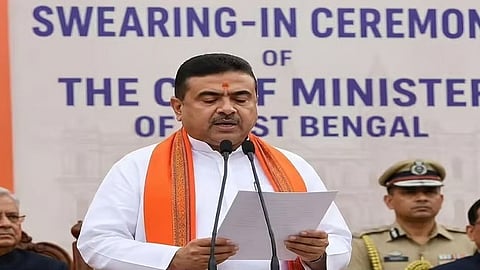
Since taking the oath of office on 9 May 2026, Chief Minister Suvendu Adhikari has prioritised economic revival to completely overhaul Bengal’s business landscape. Driven by political stability and close state-Centre collaboration, key sectors – such as infrastructure, manufacturing, electronics, clean energy, food processing, IT/ITeS, textiles, MSMEs and real estate – are now positioned for massive investment in Bengal.
Adhikari recently announced that the state is set to unveil a new industrial policy focused on seamless land acquisition and single-window clearance, as well as reintroduce the incentives for the investors in its maiden budget on 22 June. “Our aim is to generate jobs through industrial growth,” he described.
Bengal is geographically blessed but economically underutilised. It serves as India’s ultimate eastern gateway, sharing internal borders with five states: Jharkhand, Bihar, Odisha, Sikkim and Assam. Crucially, it forms an international bridge to Bangladesh, Bhutan and Nepal, with its southern flank anchored by the maritime lanes of the Bay of Bengal.
Under the previous government, corporate leaders noted that the corruption and a difficult regulatory climate prevented the state from capitalising on this unique positioning. The government’s announcement in 2025 to withdraw long-standing industrial incentives across Bengal triggered widespread backlash, leaving industry bodies deeply concerned about the trajectory of industrial development in the state.

However, the current administration is set to leverage this geography to position Bengal as the primary logistics hub for Eastern India and the broader ASEAN region. Industry leaders point out that direct alignment with the Central government in New Delhi could finally unlock long-delayed, mega-infrastructure projects – such as the deep-sea port, which are vital to making local manufacturing globally competitive.
Enters Amul
Corporates are swift to catch on. Amul has announced an investment of Rs650 crore to establish its first wholly-owned mega dairy processing plant at the Sankrail Food Park in Howrah. Expected to house the world’s largest curd manufacturing facility, this development will significantly boost the regional dairy industry and create new collaborative opportunities with the state. During a recent meeting with the chief minister, senior company executives of the company discussed the project, with the chief minister expressing optimism that Amul’s expansion will play a pivotal role in local job creation and overall economic development.
Karan Adani, MD, Adani Ports, was among the earliest to meet the chief minister in Kolkata. Later, the government unveiled a new plan for its deep-sea port project, shifting it from Tajpur, almost 10 km away, to the coastal town of Dadanpatrabar, at an alternative 1,700-acre site. The chief minister later said that it was not viable to build the mega project in Tajpur owing to severe land constraints. The decision was taken after a discussion with the Adani group.
Other major corporate entities and industry bodies – including blue-chip heavyweights like Haldia Petrochemicals and ITC Limited – have submitted extensive new investment blueprints to the state government. Navanit Narayan, CEO and whole-time director, Haldia Petrochemicals Ltd (HPL), met Tapas Roy, the state’s new industry minister. He highlighted plans to develop Haldia into a global chemicals hub backed by modern infrastructure and spoke about HPL’s proposed investments in Bengal.
ITC, the diversified conglomerate, is seeking land for three hotels and a solar power plant in the state. Also, Vikram Solar is looking for 700 acres of an integrated manufacturing ecosystem that would span the production of wafers, cells and photovoltaic modules in a phased expansion of a world-class energy transition manufacturing hub.
Also, an Indian Chamber of Commerce delegation led by president Brij Bhushan Aggarwal had met Union minister Jitendra Singh in New Delhi and outlined the chamber’s plans to facilitate investments worth Rs1 lakh crore in the state through its member companies. This sudden, multi-sector surge signals a profound shift in corporate sentiment towards a region that had long suffered from capital flight.
Singur memories
The most significant barrier to industrialisation in Bengal has historically been land acquisition. Memories of the highly publicised, volatile land disputes of 2008 – which forced the Tata group to relocate its landmark Nano automotive project from Singur to Gujarat – have hovered over the state’s investment climate for nearly two decades.
Industry minister Roy is now aiming to restore investor confidence and attract large-scale industrial investments. While many semiconductor companies have already reached out to the new government, the minister affirms that securing the return of the Tata group remains a high priority for the state. However, the group already operates in Bengal’s manufacturing, hospitality and IT sectors – with TCS employing about 55,000 people – but has refrained from major new ventures since the 2008 collapse of their Singur automobile plant.
According to Samik Bhattacharya, the state BJP president and Rajya Sabha MP, “Now, 82 per cent of the cultivated land is under small farms. The entire land is fragmented. It is not possible for any investor to come to the state and knock on every door of commerce.” While addressing the business leaders at an event, Bhattacharya stressed that structural land reform is non-negotiable. There is no future without it.
Swapan Dasgupta, Bengal’s new finance minister, faces a challenging task as he navigates a complex fiscal landscape. He stated that he was aware of the broad financial constraints and that his strategy focused on maximising revenue without raising taxes. However, he is faced with a rising accumulated state debt projected to surpass Rs8.15 lakh crore. Key financial pressures include handling dearness allowance liabilities, implementing pay commission recommendations and funding extensive social welfare schemes. The upcoming state budget is expected to reflect critical strategic adjustments to counter these fiscal pressures. Meanwhile, Union Finance Minister Nirmala Sitharaman has assured all help to the new government.
Emphasising law and order, the chief minister has vowed strict action against extortion, syndicates and ‘cut money’ practices, declaring an end to ‘the ruler’s law’. He emphasised that the rule of law will prevail and that criminals and corrupt individuals would face severe prosecution under the Bharatiya Nyaya Sanhita.
The true measure of Bengal’s economic turnaround will unfold over the next 18-24 months. Corporate executives point out that, while the volume of incoming proposals is encouraging, the immediate focus must shift to ground-level execution. Blueprints must quickly secure environmental clearances, local communities must accept the new land pooling models and infrastructure must be delivered within tight operational timelines.
For an economy that spent decades dealing with industrial stagnation and a steady exodus of local talent, the current moment represents a critical turning point. Backed by a historic political mandate, a clear administrative framework and a sharp focus on ease of doing business, Bengal is working to shed its anti-industry reputation and establish itself as a primary engine of economic growth in Eastern India. “The formation of a new government in Bengal has generated renewed confidence in the business fraternity and has energised them, unlike any time in the last 50 years,” affirms Naresh Pachisia, president, Bharat Chamber of Commerce. “The business community looks forward to working closely with the government in advancing the shared objectives of economic growth, industrial development and employment generation”.
While the corporate sector is optimistic about an aggressive pro-business approach, the Adhikari government faces a delicate balancing act. To secure its massive electoral mandate, the BJP had committed to retaining and expanding the extensive direct-benefit social safety nets established by the previous regime. Hallmark cash-transfer schemes like Lakshmir Bhandar are being rebranded as Annapurna Bhandar, with promised increases to individual pay-outs for women and unemployed youth.
Financial experts argue that funding both expanded social welfare and large infrastructure projects requires strict fiscal discipline. In contrast, the administration contends that revenue from rapid industrial growth will generate the necessary funds to sustain these public welfare initiatives.