
His suave demeanour may well belie the intent that is driving his professional life now. For Amardeep Singh, founder & CEO, Armory (a Gurugram-headquartered start-up making combat-related drones) and his team, pushing their anti-drone products to the next level with particular focus on developing the hard-kill category (interceptors that directly get into the battle with the attacking drones) is the core pursuit now. A fast-emerging name in the domain of drone manufacturing start-ups, Armory’s specialisation lies in making anti-drones (counter drone systems or C-UAV) and today it is backed by a major project from the Ministry of Defence, which is slated to drive its growth in the near and medium term.
“The world is realising the importance of drones and also anti-drones in modern warfare now,” says Singh. “And, soon, its utility will spread to commercial usage, especially as a shield to the civic infrastructure. It will be a long-haul journey for us and other players, who are joining this domain and we are gearing up for that.”
The start-up, which commenced its journey as recently as 2024, has onboarded some notable names from the private financing side (led by growXVentures) and is now getting ready to raise a fresh round of funds, which will be considerably larger than the previous rounds, as it reckons that the moment to strike in expanding business operations has arrived.
Back to the base turf
Prima facie, Singh, an entrepreneur in this domain, comes with the right credentials. The alumnus of IIT Mumbai, he was a co-founder of ideaForge, considered to be one of the preliminary start-ups in the making of unmanned aerial vehicles (UAVs) in the country for defence forces. As a fresh graduate, he had joined the firm in 2008 and was spearheading its marketing wing for six years, during which time he was exposed to the demands of customers. The segment itself was at a nascent stage, and, therefore, there was consistent modification in the demand of customers. Things got moving after the project passed through the typical trial-and-error cycle.

The period, meanwhile, also got him in touch with government defence and other public service agencies, wherein a lot of persuasion was needed to make them understand how drones would be useful for them in the future. “That was quite a learning period for us,” Singh recalls. “We did not miss out on any opportunity to go out and tell the world what we are trying to do. I remember, in 2009-10, we had taken a small stall at the Defence Expo, where we flew our drones. And it was noticed by everyone. Our stall was the smallest, but we had made the loudest noise. After that, many defence experts and government officials approached us.”
In 2014, he parted ways with ideaForge and pursued other technology-based ventures. He initiated Nextgear – an AI-powered device that was slated to compete with the GoPro device. And then, he created another technology platform for scaling personalised marketing. He ran it for six years (could not meet with the desired results vis-à-vis monetisation expectations) before switching back to the arena of drones – a forte he had developed in the early part of his career.
While he was away from the drone domain, the evolution story of drones (in utility and acceptability) had simply skipped to the other orbit. While on the commercial side, it began finding users in agriculture, land mapping, infrastructure sector mapping, etc, gradually and away from the public glare, different wings of defence and para-military forces also opened their doors for the device to gain more efficiency in their operations.
Industry insiders will tell you that they have been widely used in dealing with Naxalite challenges in some of the most affected states and have now also become an indispensable part of the border patrolling mechanism. The hard push has also come from the union government, which included drone manufacturing in its productivity-linked incentive (PLI) scheme to facilitate its easier availability and adoption in different spheres of public service.
Meanwhile, since the beginning of this decade, the geopolitical crisis has taken a new turn, beginning with the Russia-Ukraine conflict. These conflicts significantly improved the credibility of drones as the most cost-effective and efficient weapon, which can be used in modern warfare. A popular theory doing the rounds now, that a $2,000 drone can destroy a $3 million bank, says it all.
International defence experts believe that, if Ukraine has managed to survive the Russian aggression for so long, it owes it to its ability to produce 10,000 drones every day. In the brief conflict with Pakistan, India is believed to have strongly used drones and counter-drones; and, in the war between US- Israel and Iran, they have been extensively deployed by both sides. Again, Iran’s expertise and huge stockpile of drones are believed to have given it the firepower to withstand the combined US-Israel might. However, the recent conflicts, which have been played out within the realm of conventional warfare, while the utility of drones has significantly increased, the focus is now also shifting to developing anti-drone systems to counter them on a mass scale. Singh, with ideaForge experience behind him, has sensed this and that is what led to the formation of Armory in 2024.
Tapping the anti-armour
“The early phase of the Russia-Ukraine war has made it clear that drones are not only here to stay but they will soon feature in the mainstay list of conventional warfare,” Singh underlines. “And this is because of the fact that it substantially brings down the cost of attack, while the cost of damage could be significantly higher. Nothing surprising, so much is happening in making it a more potent weapon, both for attack and counterattack. India is also in the front row here”.
And the preparations are visible in critical quarters. “Every jawan must be a drone pilot,” Indian Army Chief Upendra Dwivedi had recently remarked, while emphasising his ‘eagle on the arms’ vision. The vision entails every defence personnel to be trained with mandatory drone skills and subtly absorb more advanced systems (AI-driven and others) and create a formidable counter-drone defence mechanism.
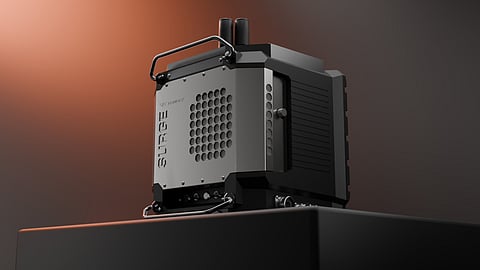
Singh and his small team of engineers (working out of a high-rise commercial complex in Gurugram right now) are intending to make a mark in precisely this segment – creating solutions to neutralise or bring down attacking drones. And the team, in its short journey, has drawn the attention of those who matter with its debut offering – Surge. It is Armory’s flagship product (evolved after several rounds of field trials with different wings of the Indian Army), which has the attributes of soft kill.
“It can detect attacking drones from a distance of 5 km and can jam their signals, thus making them ineffective to undertake the exercise programmed by the attacking side,” explains Singh. The counter soft kill drones (often compared with magicians, who hypnotise) can also send confusing signals to their attacking counterparts. Surge is already being deployed in two variants – a manpack version operable by a single soldier and a larger portable version suited for use by two to three personnel.
But the soft kill tool, Surge, is just the stepping stone for Armory. The company had recently turned heads when it announced bagging multiple contracts worth R100 crore from different wings of the Ministry of Defence. And this would enable Singh and his team to go to the next level. “Since late last year, we have bagged some sizeable contracts from agencies associated with the Ministry of Defence,” Singh affirms. “Now, our business has found a flow. We will be expanding our solution portfolio and the major focus will be to develop hard kill anti-drones.” As against soft kill drones, hard kills are those which directly attack their counterparts in the sky. They are mostly equipped with laser interceptors and are considered to be particularly useful in drone swarm attacks by the enemy.
Based on its own R&D drive, now underway, the company is expecting the hard kill drones to become part of its portfolio within a year. “Anduril (US), D-Drones (India), Droneshield (Australia) are some of the well-known anti-drone systems now,” Singh points out. “And we are working to develop solutions to their standards.”
Meanwhile, Armory is also setting up a manufacturing unit in Manesar to scale up its production. “We have reached a stage where we will be churning out products substantially, while also expanding our product portfolio,” Singh explains. “The dedicated manufacturing unit is a preparatory measure in that direction. Our order book will further swell as we have now planned to actively participate in more government tenders for our product line. Their volume is going up.”
In a not-so-distant future date, the company is looking at the possibility of anti-drones being deployed in large numbers to shield civic infrastructure like ports, airports or other big establishments. Singh cites the example of Europe, where these systems have been deployed at some of the airports and says it would be emulated elsewhere too eventually. “That would be a big-ticket opportunity for the players in this domain. You can almost count this eventuality as inevitable,” he asserts.
Meanwhile, the company, which has received funding of Rs35 crore in two rounds so far, is looking for a much larger round formalising during the course of the current fiscal. Singh hints that the ticket size would be more than R100 crore, saying that the planned scaling-up exercise for the medium term will have many dimensions. Simply put, Singh and his team are fairly confident that Surge is slated to soar much higher.