
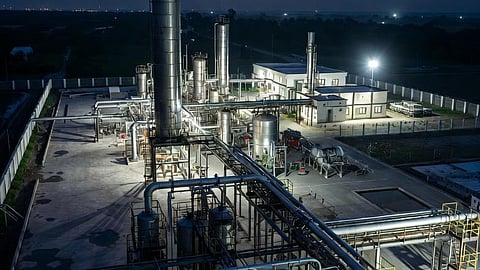
In July 2025, India successfully achieved 20 per cent ethanol blending in petrol. With that, ethanol blending in petrol jumped from just 1.5 per cent in 2014 to 20 per cent in 2025 – a nearly 13-fold increase over 11 years. The milestone was achieved five years ahead of its original target set for 2030. Besides blending with petrol, ethanol is also used by the pharmaceuticals, cosmetics and chemical industries. Yet, all does not appear to be hunky-dory, even in the ethanol business, which should also have been celebrating the occasion.
The shift towards ethanol-blended fuel has not only bolstered energy security but also led to significant economic and environmental benefits, acknowledged Hardeep Singh Puri, minister, petroleum & natural gas, speaking on the occasion. Ethanol production has surged from 380 million litres in 2014 to 6.61 billion litres by June 2025. As a result, India has saved about Rs36 lakh crore in foreign exchange by reducing its dependency on imported crude oil. At the same time, Rs1.96 lakh crore has been paid to distilleries, fuelling the growth of the domestic biofuel industry. Additionally, Rs1.18 lakh crore has been disbursed to farmers, thereby enhancing rural incomes and supporting the agricultural economy. The environmental impact, he said, has been equally significant too. Besides, the increased use of ethanol-blended petrol has helped reduce carbon dioxide emissions by 69.8 million tonnes, contributing to India’s climate goals.
On the face of it, India’s success story in the blending of ethanol, primarily derived from crops such as sugarcane, is worth emulating the world over. Ethanol blending has many votaries in the Modi government. Apart from Puri, there is Nitin Gadkari, minister, road transport & highways, who has faced the allegation that two leading ethanol companies are run by his sons. The government has also ridden roughshod over criticism that the boost to ethanol production (by giving higher prices to farmers for their crops, such as sugarcane and maize used in producing ethanol) will lead to water shortage and ethanol blending with petrol can damage vehicle engines.

The government’s stand was supported by the Supreme Court, which dismissed a public interest litigation against E20 blending. The petition had claimed that most vehicles on Indian roads were not compatible with E20 fuel, raising risks of material degradation, safety hazards, mileage loss and denial of insurance claims. Rejecting the plea, the apex court backed the government's stand, highlighting the benefits for sugarcane farmers and reduction in the country's oil imports which had resulted from the E20 programme.
Price hike
Hence, there is no shortage of incentives. Last year, the Union cabinet approved a price hike for ethanol produced from molasses for the current marketing season. The Food Corporation of India (FCI) approved an unprecedented allocation of 5.2 million tonnes of rice for ethanol production. The rice in FCI stocks was earmarked to be given to the poor at a subsidised rate.
However, the programme has spawned a plethora of problems – the main being a problem of plenty. According to the Grain Ethanol Manufacturers Association (GEMA), ethanol consumption has effectively plateaued at about 12 billion litres, though the industry is capable of supplying significantly more. As domestic consumption has stagnated despite a sharp rise in production capacity, exports are unlikely to provide a solution for surplus ethanol in India, says C.K. Jain, president, GEMA. “Today, we are capable of supplying 15 billion litres, but consumption has stopped,” he adds.
Though the industry is grappling with excess production capacity, Jain rules out exports as a solution for absorbing surplus ethanol. “How can we export when grain prices in India are among the highest in the world?” he asked. “We are just converters. About 72 per cent of the ethanol price goes to farmers.” While exports of second-generation (2G) ethanol are permitted, production remains negligible as grain-based first-generation (1G) ethanol cannot be price-competitive globally, he clarifies.
The ethanol industry expanded rapidly after strong policy signals from the government during 2020-22. But, “the government kept saying ethanol, ethanol, ethanol,” Jain clarifies. “They said we will not stop at 20 per cent; we will go beyond that.” On the back of those assurances, producers invested heavily and significantly expanded capacity across the country. The NITI Aayog biofuel policy said consumption would be at least 15 billion litres by 2025. Against that, the capacity offered was about 17.70 billion litres, but the allocation was only about 10.5 billion litres. As such, there was a mismatch between policy projections and actual procurement of ethanol.
On food security concerns, the industry believes the fears around diversion of grains to ethanol are outdated, as the diversion is limited, not more than 15-20 per cent of the total grain basket. Staples such as wheat and rice procured by FCI remain protected. Ethanol feedstock includes maize and damaged food grains. Maize is hardly a human food – only 1-2 per cent goes for human consumption.
No clarity
In fact, it was ethanol that transformed maize into an industrial crop for the first time. However, it is largely acknowledged that grain-based ethanol has played a critical role in achieving E20 blending, but without any clarity on future blending targets and higher domestic absorption, the industry faces challenges ahead.
Besides, there is another challenge that the industry faces, albeit indirectly. The export of ethanol by the US to India is expected to appreciate for the second calendar year in a row during 2025, with expectations that the cargoes in terms of volume will rise to their highest o
While ethanol is produced by fermenting sugar from biomass, corn is typically used in the US. According to the US Energy Information Administration (EIA) data, fuel ethanol exports to India stood at about 3.53 million barrels during January-September 2025, averaging at more than 393,000 barrels a month. This is just a tad lower than the volumes exported to India during the same nine-month period in 2020 calendar year at about 3.58 million barrels, which averaged almost 399,000 barrels per month.
Fuel ethanol exports to India during January-September 2025 have already surpassed the volumes shipped in the entire 2022 (1.73 million barrels) and 2023 (1.99 million barrels) calendar years. Besides, analysts and traders anticipate that the entire exports of the commodity in 2025 will surpass the exports during the years of 2020 (4.18 million barrels), 2021 (3.55 million barrels) and 2024 (4.51 million barrels).
The higher ethanol exports reflect India topping up its energy purchases, which have averaged $12-13 billion annually, from the US to balance bilateral trade. During November last year, the US EIA, in a report, noted that India is among the top three export destinations for fuel ethanol.
But, herein lies the catch. Although India’s EBP programme prohibits the use of imported ethanol to meet blend targets, India uses imported ethanol for industrial purposes, freeing up domestic product for its transportation blend targets. “With reduced production of sugarcane and rice recently, India has relied more on imports of US fuel ethanol to meet industrial sector demand and free up domestic ethanol production for EBP targets,” the USEIA report says.
The emphasis on ethanol production has also impacted the oilseed production, which has witnessed slowing growth over the years. This, coupled with rising consumption, has lifted India’s edible oil imports to 16 million tonnes by the end of 2024 from just 4.4 million tonnes two decades ago.
According to B.V. Mehta, executive director, Solvent Extractors' Association of India, there has been a consistent growth in edible oil consumption at 3-4 per cent annually, of late. The rising imports have made India the world's largest buyer of vegetable oils, such as palm oil from Indonesia and Malaysia and soya oil and sunflower oil from Argentina, Brazil, Russia and Ukraine.
New Delhi aims to boost domestic edible oil production to 25.45 million tonnes by 2030-31 from 12.7 million tonnes now – enough to meet 72 per cent of projected demand, an effort that Mehta feels is being hindered by the surge in DDGS supply. The industry expects imports to rise above 20 million tonnes in 6-7 years, due in part to the DDGS disruption and given the tightening global supplies of edible oils.
As the global No. 3 importer and consumer of crude, India had reasons to celebrate when it hit the goal of lifting ethanol blending in gasoline to 20 per cent. To achieve this, India began using corn and rice on a large scale, due to the short supply of its main ethanol feedstock, sugarcane, two years ago.
Rise in DDGS
However, aggressive ethanol production is leading to a significant rise in DDGS (Distillers Dried Grain and Soluble) output, a protein-rich animal feed byproduct. In fact, India is now a major supplier of DDGS to Africa and the Middle East, which impacts the oilseed market. DDGS exports surged to 354,110 tonnes last year from just 16,556 tonnes in 2022. Distilleries are now even targeting the markets in Bangladesh and Vietnam, long-time DDGS customers in the US. But the surplus of cheap DDGS is reducing demand for oilseed meals, putting downward pressure on oilseed prices and impacting India's edible oil self-sufficiency goals. Also, more rice and maize are being diverted to ethanol, impacting other agricultural sectors.
Even before rising ethanol production began to create excess DDGS, India struggled with surplus oil meals. Per capita demand for animal feed is much lower than the global average, as a significant portion of its 1.4 billion population is vegetarian for religious and cultural reasons. That led India to export surplus oil meals to countries such as South Korea, Vietnam, Thailand and Bangladesh.
However, oil meal exports got tougher every year as prices rose in order to support oilseed farmers. This year, some countries that import Indian meal have committed to buying more from the U.S., meaning they will buy less from India.
Shivraj Singh Chouhan, minister for agriculture, recently said the government would support oilseed farmers by procuring their harvest at a state-fixed price. But oil millers are insistent that DDGS has exaggerated the problem of surplus oil meal. And unless that problem is fixed, increasing domestic oilseed production and edible oil supplies is difficult.
Critics shudder to think of what would happen if the government were meet the demand for ethanol through corn and sugarcane in a 50-50 ratio, as outlined by Niti Aayog. India would have to bring in an additional eight million hectares of land under maize cultivation by 2030, unless there is a drastic increase in yield.
But even that could lead to problems. “If farmers replace rice or wheat cultivation with maize, that would be sustainable because we have enough surplus of these crops,” says Ramya Natarajan, research scientist, Centre for Study of Science, Technology & Policy (CSTEP), a Bengaluru-based think tank. “But we need other crops like oilseeds and pulses too."
The fallout threatens to get bigger and bigger.