
Disruptions at Hormuz
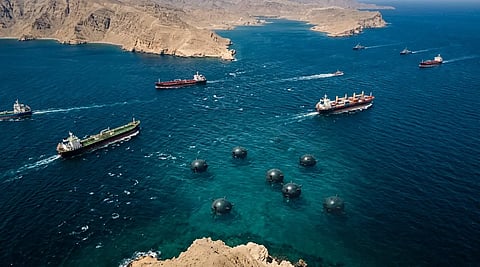
The Strait of Hormuz waterway, which reopened under a fragile and volatile US-Iran deal, still remains a risky marine corridor under ‘close watch’, after maritime authorities warned of suspected and confirmed sea mines in the dangerous area. Around one-fifth of the world’s oil passes through the Strait of Hormuz, where commercial traffic has now resumed. Although there is no independent confirmation that Iran has sea-mined the Strait of Hormuz, global maritime authorities have warned of such a possibility in this dangerous area. To add to that, cargo vessels in this region have reported seeing ‘floating objects’ too.
Sea mines or naval mines are underwater explosives designed to damage or sink ships – which are relatively cheap to produce but costly to locate and remove. They are among the most effective weapons for disrupting shipping lanes and naval operations. Clearing sea mines is a slow, high-risk operation that involves finding and destroying the explosives using specialised techniques.
The International Maritime Organization estimates that about 80 naval mines remain scattered across the waterway’s traditional shipping corridor. Norway-headquartered maritime trade association, The International Association of Independent Tanker Owners continues to advise ship operators to postpone voyages through the risky Strait of Hormuz until security conditions become more predictable and stable. The organisation also expressed apprehensions about cargo ships using the Iran-controlled transit route, saying many operational and navigation-related issues remain unresolved. Under the terms of the agreement between Iran and the US, Iran is expected to oversee sea mine-clearing operations.
However, uncertainty remains over the progress of those efforts, with Iran sending mixed signals over vessel movements. Full reopening of the Strait of Hormuz will certainly require a complex and co-ordinated sea-demining operation.

Global shipping companies facing the Strait of Hormuz disruptions are nowadays utilising a mix of risk-management strategies. During the ongoing global volatile situation, Anglo-Eastern, a Hong Kong-based shipping conglomerate and one of the largest employers of Indian seafarers, is actively co-ordinating safety measures through its ‘global security desk’ for safety and security of its seafarers and specialised cargo ships transiting through high-risk regions such as the Strait of Hormuz.
Better interpretation
The present environment demands not just more information but better interpretation of available intelligence, says Swapnodeep Mondal, group MD, operations & shared services, Anglo-Eastern. “What is required is the ability to place intelligence in context, compare it across the fleet, assess it against a specific vessel and translate it into practical and timely guidance,” affirms Mondal. Since the onset of the Strait of Hormuz crisis, the global security desk has maintained daily communication with vessels, while combining reports from its managed fleet with intelligence from naval authorities and private maritime security providers, he adds.
As a precautionary measure, Anglo-Eastern has instructed seafarers to switch off GPS location services on their personal mobile phones, as the signals could potentially reveal the location of cargo ships operating in the Persian Gulf and surrounding waters. “We focus heavily on maintaining morale, providing psychological support and ensuring regular communication with our seafarers,” Mondal explains. “They are also given operational guidance and geopolitical briefings to reduce confusion and anxiety”.
The present volatile situation thus reinforces the need for maritime trade unions, shipowners, governments and international organisations to work in close co-ordination to safeguard the lives of seafarers, contends Milind Kandalgaonkar, general secretary-cum-treasurer, National Union of Seafarers of India. These, according to him, could include enhanced emergency response mechanisms, dedicated evacuation and repatriation plans, continuous monitoring of vessel movements, improved mental health support, and recognition of the right of seafarers to decline assignments in exceptionally dangerous conflict zones like the Strait of Hormuz without fear of victimisation. Every transit of a cargo ship through a designated high-risk
area should be backed by robust risk assessments, transparent communication with crews, enhanced security measures, and the absolute right of the seafaring community to make informed decisions regarding their deployment.
The fate of sea mine clearance and international transit through the Strait of Hormuz remains highly precarious due to several intersecting operational and geopolitical factors. The main central route through the Strait remains effectively closed.