
Raintree Foundation moves beyond charity, provides long-term support
Many villages across Maharashtra have been facing a perennial issue of water shortage. In the absence of manpower, resources and a guiding force, they continue suffering the vagaries of nature. “Since agriculture is the central activity in most villages, it is utmost important that they need to conserve water for farming and domestic purposes,” says Leena Dandekar, founder, Raintree Foundation. “Once water is stored, many problems can be solved in these villages”. The foundation was set up in 2018 by Dandekar and her children, Abha and Vivek.
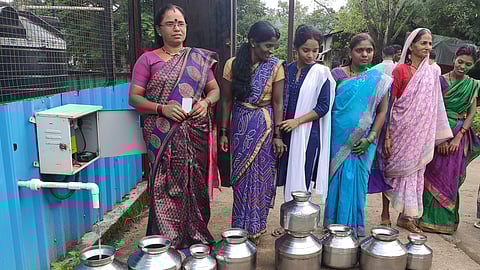
Check this. It’s 8 am in Velhe, a quiet cluster of villages in the Western Ghats. The morning air smells faintly of wet earth as a group of women gather around a bright blue kiosk in the village square. One after another, they swipe pre-paid cards, filling steel pots with 20 litres of clean drinking water – no queues, no bargaining, no uncertainty. This is one of nine solar-powered Water ATMs in the area, a community-run innovation that provides safe water for just Rs200 a month. The women who operate them are not just water managers – they are accountants, technicians and local leaders too.
A short walk away, inside a modest school building, a group of children sit cross-legged on the floor for Climate Shala – an interactive class, where science, art and local ecology come together. Here, they learn about their forests, their role in protecting the watershed and how climate change connects to everyday choices. Some of these students are also part of change-makers – a programme that works with 220 students from Classes IV-VII, of boys and girls, to rethink gender norms, share household responsibilities and carry those conversations home to their families.
Mental health is another quiet but powerful shift in Velhe. Through Manosarthi, trained community health champions offer confidential counselling sessions, coping-skills workshops, and art-based therapy for children – bridging a gap that rarely gets attention in rural India. “By linking wellbeing to environmental security, Raintree is building a support system that’s as much about listening as it is about problem-solving,” adds Dandekar.

Beyond these, the landscape itself is being cared for differently. Farmers now store rainwater in newly constructed percolation tanks, extending the growing season. Villagers have created a people’s biodiversity register and a conservation action plan to protect local flora and fauna in this biodiversity hotspot. Others have started small businesses with interest-free loans, reducing the need to migrate to cities. Under the leadership of Dandekar, Raintree Foundation has turned Velhe into a living demonstration of how conservation, community leadership and practical innovation can thrive together – achieving progress on 15 of the 17 UN Sustainable Development Goals in just a few years.
Velhe: a living buffer zone
Climate change is not only an environmental challenge – it is a deeply human one. Erratic monsoons, rising temperatures and vanishing ecosystems are reshaping lives, especially for marginalised communities in India’s rural heartlands. “At Raintree Foundation, we believe that restoring nature must go hand-in-hand with restoring dignity for the people”, adds Dandekar, whose work in the Velhe taluka in Pune district (Western Ghats) spans 2,100 hectares, nine villages, 654 households and 4,000 plus people. “Here, we integrate climate, community and biodiversity through projects on clean energy, watershed ecology, regenerative livelihoods, mental health and conservation. Velhe is more than a geographic location. It is a living buffer zone that safeguards the biodiversity-rich forests of the Western Ghats and is a model for climate-ready rural India.
Migration is emptying villages and overloading cities. “By strengthening rural enterprises, education, healthcare and climate resilience, as also promoting women-led entrepreneurship, we envision villages as thriving centres of livelihood, culture and growth.
A UNESCO World Heritage site and a global biodiversity hotspot, the ghats sustain 245 million people through rivers like the Godavari, Krishna and Kaveri. Their forests regulate rainfall, store 1.23 billion tonnes of carbon, while also are home to more than 30 per cent of India’s biodiversity. “We unite ecology, livelihoods, health, clean energy and governance into one system,” sums up Dandekar. “Our interventions are designed by natural boundaries (rivers, watersheds, forests) to maximise impact at landscape-scale”.
Dandekar is also scaling the model to the Shastri River Basin (Ratnagiri, Western Ghats) – in 400 villages across 209,800 hectares. “Our future projects will span biodiversity conservation, rural resilience, climate education, watershed ecology, green enterprises and mental health, covering all 17 UN SDGs. We move beyond charity, providing flexible, long-term support that adapts with communities and ecosystems.”