
Cognizant Foundation contributes meaningfully to society
Two decades ago, Cognizant Foundation had planted its first seed – born of a simple belief that change evolves slowly and patiently in the hands of communities, which have their own strength. Since its inception in 2005, the foundation has been committed to uplifting underserved communities, partnering with over 300 grassroots organisations and reinforcing more than 600 projects during the course of this endeavour.
“Since 2018, the foundation has positively impacted over 2.7 million lives,” affirms Vinita Bali, chairperson, Cognizant Foundation. “One of the most defining milestones came in 2010, when we expanded our arena to livelihood and skilling initiatives. This shift was not merely programmatic – it was a recognition of the evolving needs of communities and a reaffirmation of our belief in empowering individuals to shape their own futures”.
More recently, the foundation launched its flagship programmes – Health4All and Future4All – and has gone deeper into its work. “These initiatives reflect our mission to create scalable, sustainable and systemic change,” adds Bali. “Health4All seeks to strengthen primary healthcare systems and improve health outcomes in vulnerable populations, while Future4All is designed to equip youth, especially women and persons with disabilities, with the skills and opportunities needed to thrive in a rapidly transforming world.” She emphasises that each milestone in the journey was shaped by a deep commitment to listening with empathy, acting with purpose and innovating for impact.
“As we commemorate 20 years of service, our focus remains unwavering – to build resilient communities by expanding access to healthcare, education and livelihoods. These are not just programmatic pillars – they are pathways to dignity, opportunity and lasting transformation,” Bali asserts.
Beyond numbers, the foundation evaluates sustainable impact on communities, too. “At the foundation, we are guided by the belief that genuine impact goes far beyond metrics – it is evident in the meaningful transformation of lives, strengthening of communities and the sustainability of the changes we help create,” Bali informs. “While quantitative indicators are essential for accountability and transparency, our approach to impact measurement is also deeply rooted in qualitative understanding of long-term outcomes and systemic shifts”.

Every initiative the foundation supports is guided by a robust framework of key performance indicators (KPIs), tailored to the specific goals of the project. “These KPIs are not just numbers on a dashboard; they are tracked throughout the project lifecycle, with baseline and endline assessments that tell a clear story of progress and tangible outcomes,” Bali explains. “But we go further – commissioning independent, third-party experts to conduct impact assessments to ensure objectivity and depth in our evaluation. It’s how we make sure our work is truly making a difference.”
Strengthening healthcare
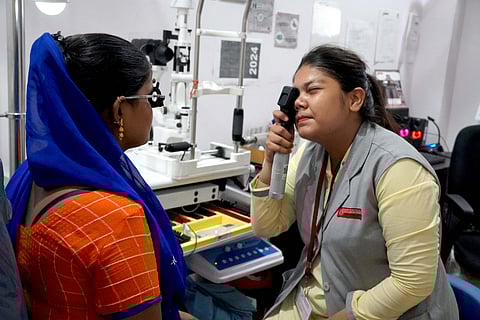
For example, the Retinopathy of Prematurity (RoP) programme in Odisha not only delivered clinical success, treating over 82 per cent of infants showing regressed or regressing RoP; it also strengthened the prevailing healthcare systems. Screening time was halved from 10 minutes to five minutes per child, while infrastructure was upgraded and neonatal care units were empowered to deliver better outcomes. Most importantly, the programme significantly reduced the risk of blindness, enhancing the future economic and social inclusion of these children.
Another example is the digital learning programme for persons with visual impairment, which helped over 90 per cent of participants to master essential digital tools like MS Word and Excel, while over 88 per cent acquired job-ready skills. The ripple effect was profound – more than 64 per cent of the previously non-earning participants reported increased income, while over 85 per cent felt the platform had met their learning needs. The programme not only fostered digital literacy but also catalysed economic empowerment and social inclusion.
“For us, sustainable impact means enabling individuals to thrive independently – financially, socially and circumstantially – beyond our direct involvement,” explains Bali. “Our guiding principle is simple yet powerful: the change we help create must outlast us. And, success, in our view, is best measured in the confidence, dignity and opportunity we help unlock in every life we touch.” She feels the foundation’s empathy is the cornerstone of the programme design.
Effectiveness is equally critical. “Every initiative is rigorously evaluated across key dimensions – relevance, efficiency, sustainability and impact – to ensure it delivers meaningful outcomes,” Bali contends. “A powerful example of this approach is our collaboration with Vision Empower Trust and Help the Blind Foundation, which is transforming STEM education for visually impaired learners.”
Creating a lasting change
Through assistive technologies, inclusive content, scholarships, digital literacy tools and employability training, the foundation is enabling students to access quality education and pursue careers in science and technology. These solutions, developed in partnership with innovative start-ups and academic institutions, reflect its commitment to combining compassion with capability – creating lasting change and strengthening the broader ecosystem.
“Leading global corporations have taught me lessons that are just as relevant in philanthropy as they are in business,” she adds. “At the core, both require clarity of purpose, disciplined execution, and a deep respect for people. In the corporate world, we are trained to think about scale, sustainability, and long-term value creation. These same principles apply to social impact, where the outcomes are measured not in profit but lives transformed, and opportunities unlocked”.
However, the complexity of social issues demands the same strategic rigour, bringing together diverse stakeholders, setting measurable goals and building systems that can deliver consistent, meaningful results. “What has truly resonated with me is the shift in the definition of success,” Bali sums up. “In business, it’s often about market share and shareholder value. In philanthropy, it’s about social equity, human dignity and the ability to empower communities to thrive independently. Leading in both spheres requires vision and accountability – but in philanthropy, it also calls for empathy, compassion, humility and a relentless focus on impact that endures.”
Looking ahead, the foundation’s focus will be on three key frontiers:
• Investing in transformative technologies such as AI-enabled eye screening and inclusive digital learning platforms that expand access and improve outcomes;
• fostering community-led development, where local voices shape solutions and drive ownership, ensuring long-term sustainability; and
• strengthening cross-sector collaboration, bringing together government, civil society, academia and industry to co-create systemic change.
The foundation’s current priorities reflect this approach: preventing avoidable blindness, promoting STEM education for visually impaired learners and enhancing employability for women and persons with disabilities. These are not isolated efforts – they are part of an integrated approach, anchored in inclusion, innovation and collaboration. The use of technology that enables all of this is fundamental to its programmes and initiatives.
Today, the foundation sees a growing alignment between CSR and core business values, where companies are leveraging their expertise, innovation and networks to address complex social challenges. The focus is shifting from transactional support to transformational change – where empowerment, inclusion and systemic impact take centrestage.
Technology and data are playing a pivotal role in this evolution, enabling evidence-based interventions and measurable outcomes. At the same time, cross-sector collaboration – between corporates, governments, civil society, and academia – is becoming essential to drive sustainable solutions at scale. What’s most encouraging is the shift in mindset: from charity to co-creation, from giving to enabling. Corporate philanthropy is now a catalytic force – building resilient communities, fostering dignity and agency and contributing meaningfully to India’s development journey.
“However, given the complexity and scale of challenges, a lot more needs to be done – by individuals, corporations and foundations – and for a diversity of causes,” Bali sums up.