
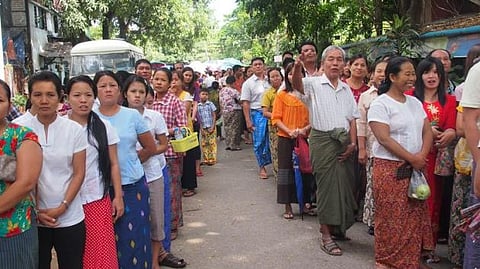
Myanmar goes to polls, will democracy survive?
The military junta-led government of Myanmar conducted the first round of elections in the state on 28 December, when India was amongst 162 election observers that went to witness the election process, happening in three phases. “Major General (Retd) Arun Kumar Sahni and strategic affairs commentator Atul Aneja went as election observers and visited polling stations in Nay Pyi Taw Council Area,” informed a source. “They met polling station officials, candidates and voters and held discussions while monitoring the election.”
India has always maintained that it supported free and fair elections and a return to democracy in Myanmar. “We had invited international election observers, including those from foreign embassies based in Myanmar, to monitor the 2025 multi-party democratic general election being conducted by the Union Election Commission under the slogan: ‘Through a credible election to a new democratic state’,” affirmed Myanmar’s Ministry of Information.
Other observers – from Russia, China, Vietnam, Belarus and Kazakhstan, amongst others – were also present on the occasion. “During their visits, the observers witnessed voters freely casting their ballots for candidates using the Myanmar Electronic Voting Machine (MEVM),” Myanmar’s Ministry of Information added. “They also observed the implementation of election procedures in accordance with international standards and best practices, as well as measures taken to ensure a free and fair election. In addition, they met voters and polling station officials and discussed matters relating to the election process.”
Nearly 24.26 million eligible voters were registered nationwide across 692 constituencies, where a total of 4,863 candidates from 57 political parties contested the election, including six parties competing nationwide and 51 parties contesting in individual regions or states. The military leadership maintained that there was a 50 per cent turnout in the first phase. However, chants of a ‘sham election’ by the Opposition had marred the atmosphere. “These elections are clearly taking place in an environment of violence and repression,” remarked Volker Turk, United Nations human rights chief, a few days earlier. “There are no provisions for the exercise of the rights of freedom of expression, association or peaceful assembly that allow for the free and meaningful participation of the people.”
The first phase of elections, held on 28 December, was organised four years after the military coup in 2021 that dissolved major political parties and jailed thousands of opponents. A key figure amongst them was former State Counsellor Aung San Suu Kyi, who is ill but remains imprisoned.
Projects at stake
It is in India’s interest to have a stable government in Myanmar, which is the gateway for India’s Act East Policy, as well as the only link to ASEAN markets. At stake is India’s ambitious Kaladan Multimodal Transit Transport Project, which involves an investment of $484 million. Once operational, this would link Kolkata to Mizoram via Myanmar’s Sittwe port. It hasn’t been completed due to the ongoing civil war between the military junta and ethnic groups of Myanmar. The India-Myanmar-Thailand Trilateral Highway (a 1,360 km project) is also held up because of the skirmish. India has also invested $1.2 billion in Myanmar’s oil & gas sector, including the Shwe Natural Gas Project, making Myanmar the largest recipient of Indian energy investment in Southeast Asia.
India shares a 1,643 km porous border with Myanmar, which is vital for the stability of India’s Northeast. India faces a challenge from insurgent groups, which maintain bases in Myanmar. There is also a refugee crisis. Since 2021, nearly 87,000 refugees have fled to India – primarily to Mizoram and Manipur. India has begun border fencing to curb illegal migration and drug trafficking.
India also needs to match China, which is developing the China-Myanmar Economic Corridor (CMEC), including a deep-sea port at Kyaukphyu that gives Beijing direct access to the Indian Ocean. India has been maintaining a policy of ‘non-interference’, even while supporting a ‘stable federal democracy ‘ in the country.