
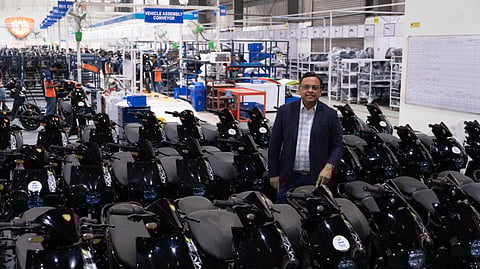
Full stack, full throttle, and Motovolt moves ahead
India sells 20 million two-wheelers a year. Roughly a quarter of them are used not for commuting or weekend rides, but for deliveries, gig economy runs and small business logistics. Almost all of them still run on petrol.
India’s electric two-wheeler market is at an inflexion point. The segment crossed approximately 1.28 million units in calendar year 2025, an 11 per cent year-on-year increase. Yet electric models still account for only about 6.3 per cent of India’s total two-wheeler market of over 20 million units. The competitive landscape is shifting fast. Currently, Bajaj, TVS Motor, Hero MotoCorp, Ather and Ola Electric, among others, are catering to the EV two-wheeler segment.
Founded in 2021, Motovolt Mobility is a Kolkata-based start-up backed by Rs200 crore in family capital and two decades of battery expertise. It is betting that the commercial segment is where India’s real EV revolution begins.
Motovolt operates as a full-stack EV commercial two-wheeler OEM. It designs, engineers, manufactures and deploys electric vehicles entirely in-house rather than assembling imported components. The company’s product line-up spans three categories: electric cycles aimed at rural and bottom-of-the-pyramid mobility – HUM and KIVO; a no-licence moped for short-range urban use – URBN; and the flagship M7 commercial scooter, a 3.3 kW vehicle engineered from the ground up to carry 180-200 kg loads and cover more than 150 km on a single charge.
Every critical component – the battery pack, motor controller, power electronics and vehicle frame – is developed in-house or through dedicated technology partnerships with VESC (Sweden), eROCKIT AG and EDAG AG (Germany), and CLIP (USA). The start-up has a workforce of 380 employees and a current manufacturing capacity of 4,000 units per month.
While its present facility is in Kolkata, it plans to set up a new Rs100 crore manufacturing plant in Hosur in 2026-27, close to its R&D team in Bengaluru. The M7 currently contributes 60-70 per cent of the company’s revenue, with the no-licence category accounting for the remaining 30-40 per cent.
“It will take 2-3 years for anyone new to enter this commercial fleet space. That is our head start, and we intend to make the most of it,” says Tushar Choudhary, Founder & CEO, Motovolt Mobility.
Industry overview
For legacy OEMs, electric mobility is just one product line within a larger portfolio; it is not the sole focus of the business. Beneath them sits a long tail of assemblers importing Chinese components with minimal in-house engineering, selling vehicles not designed for Indian road conditions, single-rider use, or long-term durability. These imports often fail under India’s demanding conditions – heavy loads, extreme temperatures and rough terrain.

In the commercial segment specifically, there is no dominant player building purpose-designed vehicles for delivery riders and gig workers who clock 100-200 km a day.
Meanwhile, the commercial two-wheeler segment – estimated at 4-5 million units annually, including delivery riders, gig workers and logistics fleets – remains overwhelmingly petrol-powered, with EV penetration in the low single digits. Government focus is increasingly shifting towards commercial electrification, where fleet economics and centralised charging make a stronger case for EVs. It is precisely this gap between the booming personal EV segment and the vast, underserved commercial market that Motovolt aims to fill.
Beyond manufacturing, the Motovolt Services arm transforms the company from a vehicle seller into a complete mobility solutions provider. This fleet-as-a-service division leases Motovolt vehicles directly to gig workers under a rental model, collapsing the traditional supply chain where fleet operators source vehicles through asset financiers at high interest rates.
By going directly from OEM to end user, Motovolt eliminates intermediary layers, captures more value and reduces costs for the rider. The company has built a network of 150 touchpoints across eastern, southern and parts of northern India.
As Choudhary states: “We want to start regional and then go global. We are ready and capable of fulfilling export orders from the commercial segment for New York with our Motovolt HUM Veloci, a light cargo bike with a powerful 500W drive system and swappable battery system designed to handle the needs of an urban delivery rider.”
Every Motovolt vehicle comes equipped with a built-in IoT device that tracks 22 data points in real time, from battery health to rider behaviour, and transmits them to a cloud server. This enables remote diagnostics, wireless software updates and a dashboard through which fleet clients can monitor vehicle uptime, maintenance costs and driver performance at a glance. It is this integrated stack – hardware, software and services under one roof – that Motovolt positions as its core competitive advantage.
Challenges and opportunities
The challenges, however, are real. Financing remains the single biggest bottleneck. Motovolt’s core customers – gig workers, small delivery operators and rural women – often lack a formal credit score or banking history, making them invisible to traditional lenders.
NBFCs and microfinance institutions are beginning to explore this space, and the government is encouraging cooperative banks to create differentiated lending products, but nothing substantial has materialised yet. Until affordable financing reaches the bottom of the pyramid, the category will grow more slowly than its potential suggests.
Charging infrastructure outside major metros remains patchy, although Motovolt has mitigated this by designing all its vehicles with removable batteries that can be charged at home. The batteries are also compatible with existing battery-swapping technologies.
Perception is another hurdle. Kolkata is not typically associated with automobile manufacturing, and the shadow of Tata’s Nano plant relocation from West Bengal still colours investor sentiment about the state as an industrial base. The opportunities, however, are structural and significant. India’s quick commerce sector is growing at 30-40 per cent annually, powered by thousands of dark stores where the cost per delivery directly determines profitability. Platforms such as Flipkart, Blinkit and Zepto are actively seeking to electrify their fleets because fuel is one of the few variable costs they can meaningfully reduce.
The economics are straightforward: an electric commercial two-wheeler delivers a total cost of ownership (TCO) that is a fraction of petrol alternatives.
China, by comparison, has 200 million gig workers with 90 per cent electric penetration, illustrating how early India is in this transition. There is growing institutional recognition of the need for commercial electrification.
For a company like Motovolt, which has already spent 3 years building a purpose-designed product, field-testing it under extreme conditions, and assembling fleet partnerships and service infrastructure, the timing could not be better.
Motovolt’s ambitions extend beyond commercial scooters. The company is targeting India’s bottom of the pyramid with electric bicycles priced at Rs20,000-25,000, designed for households earning less than Rs15,000 a month, which cannot afford an electric scooter but deserve more than a conventional cycle. The batteries are removable and easy to charge at home. In many villages, this effectively reduces mobility costs to near zero.
This strategy is backed by research. The Asian Development Bank (ADB) secured technical assistance from the Global Environment Facility (GEF) for India’s electric mobility project, aimed at enabling a transformative shift towards decarbonised transport. The study concluded that e-cycles are an ideal last-mile mobility solution for rural India, particularly for women, identifying approximately five crore potential beneficiaries.
Motovolt supplied nearly 2,000 e-cycles to a government pilot across three states, received strong feedback and now holds tenders for 8,000 more. Unlike competitors who build electric cycles for urban leisure and fitness, Motovolt builds for utility, affordability and daily livelihood.
Motovolt has deliberately avoided the conventional EV start-up playbook. There are no celebrity endorsements, no influencer campaigns and no splashy social media blitzes.
The reasoning is straightforward: its target customers – delivery riders, gig workers and fleet operators – are not browsing social media for scooter reviews. Instead, Motovolt has adopted a fleet-first go-to-market strategy, where the product proves itself on the road. Every vehicle deployed in a commercial fleet becomes a moving advertisement, visible to other riders.
As Choudhary puts it: “The customer is the brand. If the rider likes what he is using, he talks about it. If a fleet operator sees lower costs and better uptime, he orders more. This word-of-mouth loop, powered by real-world performance rather than paid promotion, is what drives demand.”
With a full order book and strong current demand, the approach appears to be working. Motovolt is not chasing demand; it is trying to keep pace with it. The company is already working with platforms such as Flipkart and is in discussions with major aggregators across quick commerce and e-commerce.
The market, by every measure, is only just beginning. Whether Motovolt can scale fast enough to dominate the category it has helped define will depend on how quickly it can expand manufacturing, unlock financing for its target customers and stay ahead of legacy players who will eventually turn their attention to this space.
For now, Motovolt is quietly building the workhorse that powers livelihoods and keeps deliveries moving across India.