
125 years of Bharat Chamber of Commerce: A legacy of resilience and progress
As the Bharat Chamber of Commerce (BCC) celebrates a milestone of 125th anniversary, its history reflects over a century of adaptability. From acting as a steady anchor during the restrictive Licence-Quota-Raj to reinventing its services after the economic liberalisation of 1991, the chamber has consistently helped local businesses upgrade, compete and survive through every major economic shift.
Today, the chamber’s ecosystem represents a substantial breadth of economic activity – spanning heavy manufacturing, steel, chemicals, IT, real estate and agro-processing. “We are serving as an apex umbrella for 38 affiliated industry and trade associations, and our reach touches over a hundred thousand enterprises across eastern India and beyond,” says Naresh Pachisia, president, BCC & chairman, SKP Securities, his boutique investment banking unit. The BCC’s core committee group ensures policy stability, regardless of individual presidential transitions, Pachisia adds.
The air of late 19th-century Calcutta was thick with the scent of raw jute, pungent spices and the heavy burden of colonial economic control. In the crowded, narrow lanes of Burrabazar, the beating heart of indigenous trade, Indian merchants and early pioneers faced constant friction under an imperial system designed to favour foreign enterprise.

Recognising that individual voices would be drowned out, a small group of visionary merchants across the Bengal Province came together in 1897 with a fierce conviction: solidarity and collective enterprise were the only ways to safeguard indigenous trade. What began as a tight-knit guild evolved formally towards the end of 1900 into the Marwari Chamber of Commerce, operating out of humble quarters on Harrison Road. Seth Hafaram Khemka, a prominent merchant and community leader of colonial Calcutta, was the founding president of the Marwari Chamber of Commerce.
Offering a collective voice
It was one of India’s earliest native business forums, born not of luxury, but of necessity. At a time when established platforms like the Calcutta Chamber and Bengal Chamber catered almost exclusively to British industrial interests, the Marwari Chamber offered native merchants, traders and emerging Indian industrialists an independent collective voice.
The timeline of the BCC is inseparable from the sweeping narrative of modern India. It lived through the partition of Bengal in 1905, the fiery fervour of the Swadeshi movement, two world wars and the dawn of Independence in 1947. In keeping with the spirit of a free India, the founding leaders broadened the chamber’s horizons beyond community boundaries, officially rechristening it as the Bharat Chamber of Commerce in 1949.
Later, some of the industry doyens like Lakshmipat Singhania, Sagarmal Haralalka, Ishwari Prasad Goenka, Rangnath Bangur, Badriprasad Poddar, Raghu Mody, H.M. Bangur and Ramesh Kumar Saraogi have served the BCC as presidents. Spanning over a century, the chamber’s commitment to preserving its legacy is no small feat. “We have meticulously safeguarded the chamber’s rich heritage and evolution through an extensive collection of archival photographs, handwritten minutes and historic records,” says Keka Sharma, secretary general, BCC. Members regarded her as a true pillar of the chamber.
“Long before businessmen ran to courts of law, the chamber provided a trusted forum for dispute resolution,” affirms N.G. Khaitan, immediate past president & chairman of the 125th Anniversary Celebration Committee, commemorating the glorious history of the BCC. “In its very first year, it successfully settled over a thousand trade disputes, reflecting the immense moral authority it commanded in public and commercial life.” Khaitan is also a senior partner at Khaitan & Co.
The chamber broke long-standing traditions by welcoming female leadership onto its governing committees. “During my tenure as president of BCC in 2001, I broke historical precedent by inducting a woman onto what had previously been an entirely male-dominated committee, despite initial hesitation from conservative members,” recalls H.M. Bangur, chairman, Shree Cement, reflecting on this milestone. This step paved the way for gender inclusivity in the chamber. Now, Bharat Chamber Ladies Forum is a dynamic wing dedicated to fostering women’s entrepreneurship, business leadership and environmental awareness.
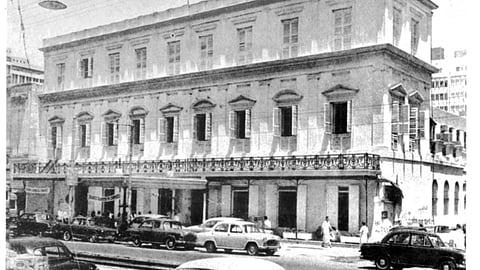
After decades of staying rooted at Hamilton House on the heritage Old Court House Street, BCC temporarily moved to Park Mansion at Park Street, a vacant office of the industrialist Jit Paul, a prominent member of the chamber. “What was meant to be a temporary arrangement in Park Mansion ended up lasting for nearly two decades. But Paul never complained about it,” remembers Bangur. The chamber realised a grand dream in May 2016, when the late Pranab Mukherjee, former President of India, inaugurated BCC’s own building at the New Park Street, which had more than 4,000 sq m of floor space, spread across six floors and a basement.
The chamber prioritised bilateral trade, foreign investment and international co-operation by signing memoranda of agreement with its counterparts in Vietnam, China, Russia, Belarus and other nations. To support the members’ business interests and expand its global footprint, the chamber increased interactions with foreign delegations and organised B2B sessions. It also sent trade delegations to the UK, Vietnam, China, Nepal, Bangladesh and several African countries.
MSME outreach
Moving far beyond local representation, the BCC has played a role in national priorities. In partnership with the Ministry of Defence, the chamber has spearheaded high-level MSME outreach conclaves and export strategy seminars from Jamshedpur to New Delhi as part of the defence indigenisation. “The recent MSME-Defence conclave in Jamshedpur, participated by 80 MSMEs, was a runaway success,” claims Pachisia.
To stay ahead of evolving business needs and bridge academia and industry, the chamber recently signed a memorandum of understanding (MoU) with IIM Calcutta. “These joint ‘knowledge series’ events will bring top-tier executive learning and sharp case-study methodologies directly to members,” says Ramesh Agarwal, senior vice-president, BCC.
The chamber claims that, unlike many insular legacy institutions, it actively cultivates a dynamic, youthful leadership pipeline. By pairing seasoned leaders with younger talent and introducing modern traditions like the Bharat Chamber Golf Tournament, it delivers immediate value to emerging professionals. “Our vibrant, multi-community network has expanded well beyond its traditional merchant base, now bringing together Marwari, Bengali, Punjabi and Gujarati business leaders,” Agarwal points out.
“It is a privilege to share a platform with industry stalwarts whose decades of experience provide invaluable guidance to the next generation of leaders,” says Prithish Chowdhary, deputy managing director, Titagarh Rail Systems, who, at 25, is one of the youngest members. “The blend of seasoned wisdom and fresh ideas is what makes BCC truly special”.
In the past, the chambers carried a powerful, unified voice. Over time, however, the landscape got fragmented – today, Kolkata alone is home to six-seven distinct trade bodies. Although there have been numerous proposals over the last 50 years to merge these groups into a single powerhouse, the idea has never materialised. Each chamber boasts a rich history that its members refuse to surrender. “Whenever another chamber suggests merging Bharat Chamber into theirs, we counter with: ‘merge into us instead’. So, our legacy is preserved. Identity is fiercely guarded,” explains Bangur. Today, meaningful national-level advocacy is achieved through strategic affiliations with apex bodies like FICCI, which helps effectively reach the government and drive action.
Maintaining an open policy environment, the chamber engages boldly with diverse political and economic leaders across the spectrum. Khaitan is hopeful that the new BJP state government, supported by the Central government, can improve investor perception of Bengal. To build interest and awareness around the ease of doing business, the chamber regularly hosts interactions between ministers, senior secretaries and the business community. “Following the state government’s recent announcement of a new industrial policy, our chamber will stay closely engaged with officials to further improve the business environment in the state,” says Khaitan.
As it looks towards its 150th year, the chamber stands firmly as what it has always been: a steadfast bridge between India’s proud industrial heritage and its boundless, tech-driven digital horizon.