
Integrating manufacturing and engineering, Nuberg expands its empire
In the engineering, procurement and construction (EPC) industry, scale often defines success. Yet, in highly specialised segments, where technology, engineering expertise and execution capability matter more than sheer size, niche players can carve out formidable global positions. Delhi-headquartered Nuberg Group is one such company that has quietly built an international reputation in chemical process engineering over the past three decades, evolving from a specialist EPC contractor into a diversified industrial group with interests spanning chemicals, industrial equipment, green energy, and advanced manufacturing.
Founded in 1996 by mechanical engineer Anil Kumar Tyagi, Nuberg today has operations across 32-odd countries, including Sweden, Saudi Arabia, the UAE, Egypt, Turkey, Algeria, Morocco, Uzbekistan and Bangladesh. The group comprises Nuberg EPC, Nuberg E&I, Nuberg Green Energy, Nuberg HFD, Nuberg GPD and Indian Peroxide Ltd, creating an integrated industrial platform that combines engineering, manufacturing and technology.
The flagship EPC business has crossed Rs1,000 crore in annual revenue, while the group generates nearly Rs1,500 crore in turnover. The EPC division alone employs about 600 professionals, including nearly 400 engineers, reflecting the knowledge-intensive nature of the business.
A mechanical engineer by training, Tyagi founded Nuberg after spending more than a decade in the private sector. His objective was to build an Indian engineering company capable of competing globally in specialised process industries. Instead of pursuing scale alone, he focused on technological competence, strategic partnerships with leading international licensors and execution excellence.
That strategy has paid off. Today, Nuberg is recognised globally for executing chlor-alkali plants, one of the most specialised segments of the chemical process industry. The company works with two of the world's three leading technology providers in this niche and ranks second globally, behind a German competitor, affirms Tyagi. Its references now span 36 countries, giving it a strong international reputation.
Overseas forays
For much of its history, Nuberg concentrated almost entirely on overseas markets, executing projects for public-sector companies in oil & gas, fertilisers and petrochemicals across the Middle East, North Africa and other regions. International business offered better margins and relatively less competition than India. The pandemic, however, prompted a strategic rethink as supply-chain disruptions and travel restrictions exposed the risks of relying exclusively on overseas markets.
"After Covid, we realised that depending only on international business was risky,” says Tyagi, founder, chairman & MD, Nuberg Group of Industries. “We, therefore, created a dedicated India business. Today, we have two business units – one for international business and one for Indian business – and that strategy has worked extremely well. Our revenue has almost doubled over pre-Covid levels".

The strategy has transformed Nuberg's business mix. About 60 per cent of revenue now comes from international markets, while India contributes the remaining 40 per cent – a share expected to increase steadily as the company strengthens its domestic credentials.
Breaking into India's refinery and petrochemical EPC market was never going to be easy. The sector has long been dominated by multinational engineering companies, such as Technip Energies, Tecnimont, Samsung Engineering, Worley, Jacobs and Larsen & Toubro. Stringent qualification norms generally favour companies with prior execution experience.
Ironically, Covid created Nuberg's opportunity. With several international contractors unable to participate during the pandemic, qualification norms were temporarily relaxed, enabling experienced chemical EPC companies like Nuberg to secure significant projects.
Among its most important assignments is the Rs555-crore Sulphur Recovery Unit package for Indian Oil Corporation's petrochemical complex at Vadodara. The company is also executing a Rs450-crore DAP fertiliser plant for FACT at Kochi. Both projects are nearing completion and are expected to significantly strengthen Nuberg's qualification credentials for larger domestic refinery and petrochemical contracts.
The company has also commissioned India's first hydrogen bottling plant for IOC and an ethanol plant at Panipat that converts agricultural residue into ethanol for fuel blending, highlighting its growing role in India's energy transition.
While the domestic business is emerging as an important growth driver, Nuberg's international operations remain its biggest competitive advantage. The company specialises in highly technology-intensive projects where engineering expertise and process knowledge matter far more than price alone.
Its leadership in chlor-alkali plants illustrates this positioning. Working alongside leading global technology licensors, Nuberg delivers end-to-end EPC solutions while assuming complete responsibility from engineering and procurement to construction and commissioning. This partnership-led model enables it to offer globally proven technologies, while focusing on execution excellence.
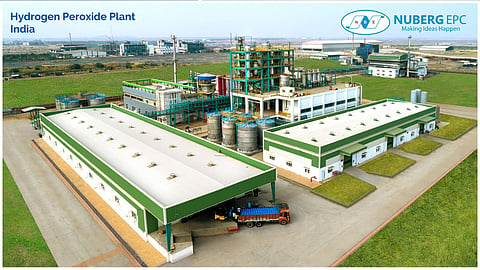
While EPC remains Nuberg's core business, the company has steadily built complementary businesses that strengthen its engineering capabilities and reduce dependence on a single revenue stream. One of its key assets is the Gujarat manufacturing complex, spread over nearly 40 acres, which produces hydrogen peroxide and is undergoing backward integration through a Rs450-crore chlor-alkali project. Besides manufacturing, the facility serves as an important research and development base, where technologies are validated before being deployed in commercial EPC projects. This integration of manufacturing and engineering gives Nuberg an advantage over contractors that rely entirely on third-party suppliers.
Creating valuable synergies
The group has also expanded through Nuberg HFD, which makes specialised process equipment and heavy engineering products and Nuberg GPD, a manufacturer of PSA-based nitrogen, oxygen and hydrogen plants, catering to diverse industrial applications. Indian Peroxide Ltd, another group company, has emerged as one of India's leading producers of hydrogen peroxide, including food-grade variants certified by BIS and other regulatory authorities. Together, these businesses strengthen Nuberg's manufacturing ecosystem while creating valuable synergies for its EPC operations.
Beyond engineering, the group has ventured into textiles with a polyester yarn manufacturing facility in Jammu. Commissioned in 2024, the plant operates about 45,000 spindles now, with plans to double capacity over time. Though unrelated to EPC, the investment reflects the group's strategy of diversifying into sectors with favourable long-term growth prospects.
Nuberg is also positioning itself for the next phase of industrial growth through Nuberg Green Energy Ltd. Rather than investing as a renewable energy developer, the company aims to leverage its engineering expertise to design and execute projects involving green hydrogen, bio-CNG and other clean-energy technologies.
Tyagi believes the transition towards cleaner fuels offers a natural extension of the group's capabilities in process engineering and hydrogen technologies. The company is also evaluating opportunities in battery chemicals, where its experience in chemical engineering could provide a competitive edge. Having already executed more than 75 greenfield projects across industries, Nuberg sees itself as an engineering partner for India's rapidly evolving clean-energy ecosystem.
Despite these new initiatives, EPC remains the nucleus, around which the group's businesses revolve. Manufacturing provides technological depth, while green energy opens new avenues for growth without diluting the company's engineering focus.
Nuberg has an EPC order book of about Rs1,000-1,200 crore, providing roughly one year's revenue visibility. Management aims to improve this to nearly two years while maintaining annual growth of 10-15 per cent over the medium term. The successful completion of its refinery and fertiliser projects is expected to qualify the company for substantially larger assignments, potentially transforming the scale of its domestic business.
To sharpen strategic focus, the group has created separate entities for its domestic and international EPC operations. While Tyagi acknowledges that the Indian business has the scale to consider an initial public offering in the future, he says there are no immediate plans to tap the capital markets.
For Tyagi, however, the company's biggest strength lies elsewhere. "Trust is the biggest differentiator in the international EPC business,” he says. “Investors commit significant capital and see the results only after two or three years. Our references across 36 countries and our successful operating plants give customers the confidence that we will deliver exactly what we promise".
That trust has been built over nearly three decades through consistent execution, technological competence and long-standing customer relationships. It has enabled Nuberg to establish itself as one of the world's leading specialists in chemical process EPC, while steadily expanding its footprint in India's refinery, petrochemical and fertiliser sectors.