
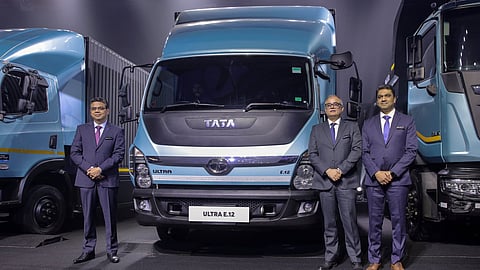
Tata Motors unveils new generation trucks with focus on safety
For over eight decades, Tata Motors’ trucks and buses have done more than move goods; they have powered economic growth, connected farms to factories, ports to cities, and enabled millions of livelihoods. Today, amid GST reforms, infrastructure expansion, rising freight intensity, and tightening regulations, the company is redefining what it means to be a commercial vehicle manufacturer in India.
At the unveiling of its next generation of trucks, Tata Motors sent out a clear message: safety is no longer a regulatory checkbox; it is the foundation of responsible growth in Indian logistics. The launch of 17 new next-generation trucks spanning 7 to 55 tonnes marks a shift in how commercial mobility is engineered, delivered, and experienced in India.
The range includes the all-new Azura series for the intermediate and light commercial vehicle (ILMCV) segment, a cutting-edge Tata Trucks.ev electric portfolio, and major upgrades to the trusted Prima, Signa, and Ultra platforms. Unified by a safety-first engineering philosophy and built to meet stringent global standards, the new range reflects Tata Motors’ long-standing commitment to ‘Better Always’.
India’s trucking industry carries nearly 65-70 per cent of domestic freight, making it the backbone of the national economy. As India’s logistics ecosystem evolves, road safety has become a growing concern. Higher speeds, heavier payloads, and longer duty cycles have raised the stakes for manufacturers, fleet owners, and policymakers alike.
In a first for the Indian commercial vehicle industry, Tata Motors has upgraded its entire truck cabin portfolio to comply with the stringent European ECE R29-03 crash norms. These standards, among the toughest globally, mandate enhanced protection against frontal impact, rollover, and side collisions. Tata Motors is currently the first and only Indian OEM to achieve this across all relevant platforms.
India-specific technology
Beyond structural integrity, the company has integrated a comprehensive suite of India-specific advanced safety technologies, with up to 23 ADAS features across select platforms. These technologies are designed to reduce fatigue, improve driver awareness, and prevent accidents. Real-time driving behaviour monitoring through Fleet Edge, Tata Motors’ connected vehicle platform, further enhances on-road safety by enabling proactive intervention through a digitally enabled ecosystem. Fleet owners gain access to real-time vehicle health data, predictive analytics, and intelligent trip optimisation.
For Tata Motors, every journey must end with the driver returning home safely. This philosophy ensures that safety is engineered into the vehicle architecture itself. Tata Motors’ safety-first approach does not compromise performance; instead, it enhances it. Structural strength, chassis stability, braking systems, and intelligent electronic controls contribute directly to higher vehicle uptime, better payload management, and improved total cost of ownership.
The latest upgrades across the portfolio deliver tangible economic benefits by improving payload efficiency, fuel economy, and vehicle uptime. The company’s latest rigid-truck upgrades in the 28-49-tonne segment exemplify this integration. By delivering up to 1.8 tonnes higher payload per trip while maintaining structural robustness and stability, these trucks are designed to deliver faster payback and returns exceeding 30 per cent in certain duty cycles, proving that profitability need not be sacrificed for enhanced safety.
Accelerating India’s transition to green logistics, Tata Motors has introduced the country’s widest range of electric trucks, spanning 7 to 55 tonnes, under the Tata Trucks.ev brand. EV-specific safety systems, including advanced battery management, high-voltage cut-offs, thermal runaway protection, and ingress protection, are integrated into the vehicle architecture. Developed through deep localisation, these technologies make electric trucking safer and better suited to Indian operating conditions.
“Electric mobility in trucking must be safe, scalable, and commercially viable. With Tata Trucks.ev built on our new I-MOEV architecture, advanced in-house battery management systems, and a deeply localised ecosystem covering vehicles, charging, and services, we are enabling India’s transition to zero-emission logistics without compromising on safety, uptime, or profitability,” said Girish Wagh, Managing Director & CEO, Tata Motors Ltd.
With this new portfolio launch, Tata Motors has reset the benchmarks by which Indian commercial vehicles will be judged.