
Strengthening partnership
Prime Minister Narendra Modi, during his recently concluded visit to Israel, reaffirmed that dialogue and diplomacy should be used to resolve the crisis in West Asia. However, three days from then, on 1 March, Iranian Supreme Leader Ayatollah Ali Khamenei was killed by an air strike. India hasn’t commented on it yet, though there have been protests in India where the Shia population live – Kashmir and Lucknow. “India has invested in Chabahar port in Iran, and with the earlier sanctions by the US, it needs to be seen whether this could remain operational, as a lot of things have changed on the ground,” said a source.
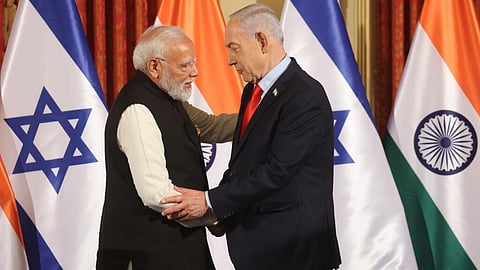
Meanwhile, India has fortified its links with Israel by elevating the bilateral relationship to the status of a special strategic partnership. ‘A special strategic partnership for peace, innovation and prosperity,’ is what a joint statement issued in Jerusalem called it. “And, this historic decision reflects the aspirations of the people of the two countries, whose relationship has been founded on ‘deep trust, shared democratic values and humanitarian bonds’,’’ said Modi in Jerusalem, adding that, his discussions with Israel’s Prime Minister Benjamin Netanyahu, had included the process of giving new direction and greater momentum to the bilateral co-operation.
The discussions included co-operation on defence & security, technology & innovation, cyber-security, trade, investment & connectivity, agriculture, water & environmental protection, combating terror & promoting peace, parliamentary co-operation, health, education and people-to-people exchanges. “We do see a role,” Modi added, when asked about what role India could play in the post-conflict reconstruction of Gaza. “What exactly that role will be depends on a little more clarity on how things will develop on the ground in Gaza. I am not going to speculate at this point on the exact areas in which we may come in, but India has specific capabilities and capacities that would be of considerable relevance in a situation like the one we see on the ground in Gaza. We do have the capacity to contribute,” he explained.
Meanwhile, several outcomes were finalised during the talks, including in the areas of technology, science, trade, financial services, artificial intelligence, cyber-security, agriculture, blue economy, labour mobility, education and culture.
Elevating the relationship
The outcomes included 17 memoranda of understanding or agreements and 10 other announcements, including one on the elevation of the relationship to a special strategic partnership. “Our ties have stood the test of time. Our economic co-operation continues to serve as an engine of growth, innovation and shared prosperity. Last year, we signed a ‘bilateral investment agreement’ to promote mutual investments. We will also finalise a mutually beneficial ‘free trade agreement’ soon,” Modi stated at the press briefing.
The leaders stressed their commitment to realising the FTA and tasked the negotiating teams to expedite negotiations for an early conclusion, the joint statement said. “We have decided to establish a ‘critical & emerging technologies’ partnership,” the PM affirmed. This will impart fresh momentum to co-operation in areas such as AI, quantum technologies and critical minerals”.
India and Israel believe that this initiative on critical & emerging technologies, led by the national security advisors of both countries, will synergise their individual strengths in niche technologies, fostering a focused and futuristic partnership. The joint statement said both leaders provided a vision and a road map for future defence co-operation, following the MoU signed last November to boost defence co-operation.
“We have enjoyed decades of trusted co-operation in the defence sector,” Modi observed. “The MoU signed last year was to add new dimensions to this partnership. Together, we will advance towards joint development, joint production and transfer of technology.” The MoU was signed in Tel Aviv last November to provide a unified vision and policy direction to deepen the already strong defence co-operation between the two countries; it will enable the sharing of advanced technology and promote the co-development and co-production of weapons and systems.
The two countries will further strengthen their co-operation in areas such as civil nuclear energy and space,” Modi said. The two leaders welcomed the ongoing collaboration between the Israel Space Agency (ISA) and the Indian Space Research Organisation (ISRO), recognising the significant potential for Israeli space-based start-ups and companies to engage more deeply with their Indian counterparts.
“They emphasised the importance of fostering greater co-operation between the two nations’ space industries, encouraging joint ventures, innovation partnerships and knowledge exchange to drive progress in the global space sector,” the statement said.
“I am pleased that an agreement has been concluded to enable the use of UPI in Israel,” Modi acknowledged. “We are also a by sharing our experiences in the field of digital health”.