
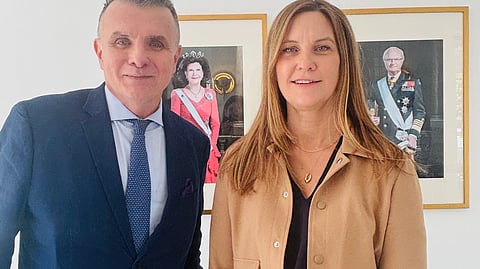
The bilateral trade between India and Sweden is expected to double by 2030, says Jan Thesleff, Sweden’s Ambassador to India, adding that this was a conservative estimate and could well exceed these projections. “Our bilateral trade today stands at €7 billion per year. Nearly two-thirds of our trade is in goods and one-third in services. I feel trade figures do not give the full picture of a trade relationship, which has to do with global trade flows and the effects of globalisation as well,” Thesleff told Business India. Due to globalisation, goods can be sourced from various plants, he added. Not only will trade double, but investments will increase too, he feels. And there will be more tourists visiting each other’s countries. The number of students will increase too.
There are about 280 Swedish companies present in India, with over 100 manufacturing units. The signing of the historic India-EU FTA has paved the way for more companies – small and medium-scale – to invest in India as the business environment has become more favourable. The Swedish companies present in India include ABB, SKF, Volvo, Scania, Ericsson, Truecaller, AstraZeneca, H&M, IKEA and Spotify.
“Reduced tariffs and fewer bureaucratic hurdles will ease doing business in India, with the new FTA getting established,” Thesleff added. “And, with reduced tariffs and less bureaucracy, the resultant ease of doing business will encourage small to medium companies to enter Indian markets”.
Third-largest trade partner
India is the third-largest trading partner for Sweden in Asia. Bilateral trade between Sweden and India has risen from $2.86 billion in 2016 to $6.96 billion in 2024, growing at a CAGR of ~11 per cent. The number of Indian companies considering Sweden as an investment opportunity has grown, too. Some 70 Indian companies have a business presence in Sweden.
“There are some 220,220 people directly employed by the Swedish companies here in India,” Sofia Högman, Trade Commissioner of Sweden in India, told Business India. “Another 2.2 million are involved indirectly. And, if you look at Swedish investments in Indian companies, that will be another 180,000 employees in those companies”.
Meanwhile, there are plans to begin direct flights connecting India to Sweden. There are walk-in facilities in VFS for those seeking to apply for Swedish visas, and the time taken is 3-4 days in the lean season. Nearly 80,000 Indians live in Sweden.
“Indian students can explore Sweden for their post-graduate programme, as there are over 900 courses in English they can choose from,” affirmed Thesleff. “Students are allowed to work while they are studying, with no restriction on the number of hours. Once their studies are over, they can apply for a work permit.” A large Swedish delegation is expected to visit India for the AI Summit that is scheduled to be held in Delhi in February, which will be led by a senior member of the Swedish government.
The Indian economy is robust today, with 7.2 per cent growth, while several countries in Europe haven’t registered even a 1 per cent growth. The India-EU FTA has come at a time when both India and the 27-nation bloc of the EU can leverage their strengths and grow.
Box
The big ones
IKEA: The Swedish furniture company is planning to source 50 per cent of its goods locally and open small-format stores in the National Capital Region of India. It is investing $877 million in this region.
SAAB: The defence major is the first company to receive approval for 100 per cent FDI to set up a manufacturing facility to produce Carl-Gustaf M4 weapon systems in Haryana. The facility would be Saab’s first facility outside Sweden for the production of Carl-Gustaf M4 weapon systems.
Trelleborg: The engineered polymer & sealing solutions company plans to open a new facility in Bengaluru and aims to invest $30 million between 2023 and 2026.
Volvo: The group has announced the expansion of its manufacturing facility at Hoskote, on the outskirts of Bengaluru, with an expected investment of $163 million.