
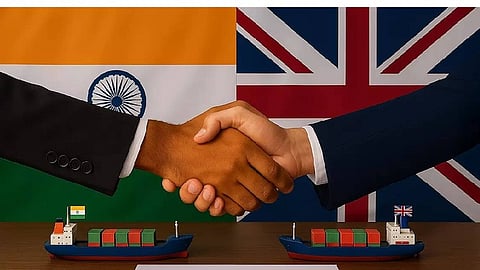
Piyush Goyal, Union minister for commerce, has affirmed that the India-UK FTA that was signed in July 2025 is likely to be implemented by mid-April. He also stated that this would be the fastest agreement ever approved by the British Parliament, following a fast-track Parliamentary approval process. However, a ratification is awaited for the same in the British Parliament. The issue that is being debated relates to specific concessions – particularly those regarding social security and immigration.
British Opposition MPs have argued that this provision, which exempts Indian workers temporarily in the UK from national insurance contributions for three years, gives them an unfair advantage over British workers. “I am sure this would be ratified soon in the British Parliament,” Lord Karan Bilimoria told Business India. “Since the Indian workers would only be working for a specified time period in the UK (on a work permit), they will be exempt from contributions to national insurance; it’s the same for British workers in India”.
There are close to 800 British companies operating in India, employing over 500,000 people. While there are close to 1,200 Indian-owned companies (turnover of close to £72 billion) operating in the UK, marking a record high, according to the 12th edition of the Grant Thornton ‘India meets Britain’ Tracker.
“This deal will raise India-UK bilateral trade to £100 billion by 2030 (double from the present £50 billion),” Bilimoria added. “India is the fourth-largest economy in the world today, and both countries have a lot to gain from each other. The UK is the sixth-largest economy, and India is its 11th-largest trading partner. I feel that should change; India should be a stronger trading partner of the UK, as there is a lot of potential for furthering trade ties between the two, now that the trade deal is in place.”

Lord Bilimoria was amongst the first proponents of the trade deal between these two nations and was a part of the negotiations that finally led to the signing of the deal. He also came as a part of the 125-member delegation to India led by the British Prime Minister Kier Starmer in October 2025.
The biggest deal
“The India-UK Comprehensive Economic & Trade Agreement (CETA) is the biggest deal since Brexit and will turn into a launchpad for growth,” said PM Starmer during his India visit. He also affirmed that this agreement would act as a foundation for significant future opportunities.
The UK is also trying to establish a foothold in the education sector, and quite a few British University campuses have come up in India. “Recognised British universities are setting up campuses in India,” said Starmer. “There are nine of them in India now – making it easier for Indian students to avail quality education on home turf. These include the University of Southampton”. He added that the trade deal would turbo-charge bilateral relations between India and the UK.
The University of Southampton is already operational in Gurugram. Other confirmed campuses include the University of Liverpool and the University of Surrey in Bengaluru and GIFT city, respectively. The one-year Master’s Degree programme in the UK is also gaining a lot of traction for Indian students wishing to pursue higher studies there.
Two years back, in 2024, the University of Birmingham and IIT Madras launched a joint master’s programme in sustainable energy systems. “Under that programme, students were allowed to study both in Chennai and Birmingham. These innovative joint postgraduate programmes offered students an opportunity to pursue a world-class education recognised by both countries,” said Lord Bilimoria, who was then the Chancellor of the University of Birmingham.
Meanwhile, India and the UK are also strengthening their defence partnership. In October 2025, the two nations signed a £350 million ($468 million) defence deal for the Indian army to procure British-made Lightweight Multi-role Missiles (LMMs) from Thales, to enhance air defence capabilities. “This co-operation marks a shift from a traditional buyer-seller relationship to a deeper, technology-driven partnership aimed at improving interoperability between the armed forces,” said Lord Bilimoria.
It may be recalled that the trade deal was signed by PM Modi in London in July last year. “This is a historic milestone between India and the UK, which will further strengthen our bilateral ties,” PM Modi had said.