
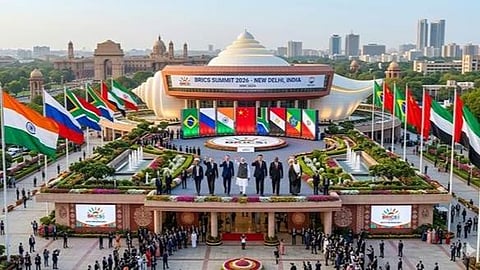
BRICS Summit: A momentous occasion
India will be hosting the 18th BRICS Summit in Delhi (on 12-13 September), with Vladimir Putin, President, Russia and Xi Jinping, President, China, being amongst the most awaited guests – not just because they are prominent members of the grouping but also because neither of them could make it to the G20 Summit in India. This is the fourth time India will host the BRICS Summit (2012, 2016, and 2021 – virtual).
Amid heavy security and traffic advisories likely to be issued ahead of the Summit, there is hope that India will be able to bring the members to sign a joint declaration. BRICS at present has 11 members (Brazil, China, Egypt, Ethiopia, Indonesia, India, Iran, Russia, Saudi Arabia, South Africa and the UAE. There are 10 BRICS partner countries, which include Uzbekistan, Belarus, Bolivia, Cuba, Kazakhstan, Malaysia, Nigeria, Thailand, Uganda and Vietnam.
Collectively, BRICS represents about 49 per cent of the world’s population and nearly 40 per cent of global GDP. “There is a strong likelihood of a bilateral meeting between President Xi Jinping and Prime Minister Narendra Modi during the occasion,” says a foreign policy expert. “Also, a bilateral meeting between Modi and Putin has already been indicated by President Putin. Interestingly, since Iranian President Pezekeshian is expected to be in Delhi too, there will be a lot of firefighting during the Summit, when he comes face to face with his counterpart from the UAE”.
Among the topics to be discussed would be energy and trade partnerships between member states. India will have a tough time circumventing the 100 tariffs that the US has threatened to impose on its purchase of oil from Russia.
It may be recalled that, after the outbreak of the conflict between Russia and Ukraine, India increased its oil imports from Russia from barely 2 per cent then to over 50 per cent now. It is unlikely that India would reduce its imports from Russia, but the presence of President Putin and President Xi is likely to irk the US, with which India has been negotiating a bilateral trade agreement.
Trading in local currencies?
BRICS nations have been actively promoting settling bilateral and inter-bloc trade in their own currencies. There has been talk of a common BRICS currency too – which India has not supported.
“Trade is taking place in local currencies between India and the BRICS nations,” the source added. “There would be talks on further fortifying this area of settlement. There will be talk of expanding the UPI network to the member states of this bloc and India would extend its expertise on the same”.
With sanctions and the US threat of tariffs, countries across the world are trying to forge bilateral partnerships and also look beyond trading in the dollar. India, Russia and China are already using direct local currency arrangements for trade flows – which includes energy purchases. India and China are also amongst the highest importers of oil from Russia. India
also exports refined fuel to China. There are proposals to link Central Bank Digital Currencies (CBDCs) to local currencies – which would be faster.
There would also be discussions on counter-terrorism. During the BRICS NSA meeting in June, discussions were focused on emerging and evolving security threats, including terrorism, cyber security, energy and food security. They also reaffirmed their commitment to strengthening co-operation, information sharing and capacity building to counter terrorism.
Meanwhile, under India’s chairpersonship this year, over 350 meetings and high-level engagements have been held in over 25 cities across India to further strengthen the BRICS strategic partnership across three fundamental pillars: political and security, economic and financial, as well as cultural and people-to-people exchanges. Through these engagements, and business-to-business and people-to-people initiatives, India’s BRICS chairpersonship has contributed to advancing BRICS co-operation through practical and development-oriented outcomes.
India is a founding member of BRICS and has previously held its Chairpersonship three times – in 2012, 2016 and 2021. It assumed its fourth BRICS chairpersonship on 1 January 2026. The year 2026 also marks a significant milestone, as BRICS completes 20 years since its coming into being.