
A necessary evolution
Across many business families, the focus is gradually moving from creating wealth to preserving and transferring it across generations. This transition brings a different set of challenges. While building wealth requires entrepreneurial drive and risk-taking, sustaining it requires discipline, structure, and clarity.
Inter-generational assets are not just a portfolio of financial instruments. They represent a bouquet of different classes of assets aggregated through years of effort, family values and long-term aspirations. As these portfolios expand across businesses, financial instruments and real estate and diversify across jurisdictions, managing them informally becomes difficult. This is where governance mechanisms become essential. They provide the structure needed to ensure that wealth is not only protected but also managed in a way that aligns with the family’s long-term vision.
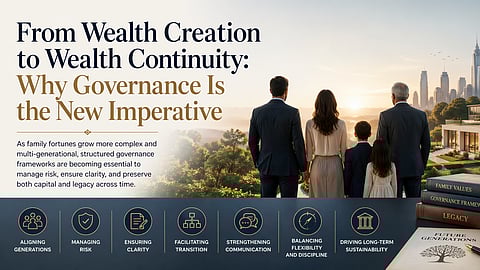
Meaning of governance: Governance is often misunderstood as a set of rigid rules or compliance requirements. In reality, it is a framework that defines how decisions are made, who is responsible for them and how accountability is maintained. In the context of inter-generational portfolios, governance mechanisms typically include clearly defined roles, decision-making processes, investment policies, compliance protocols and communication structures. These elements help bring consistency and transparency to the management of wealth.
More importantly, governance creates alignment. As families grow and include multiple generations of stakeholders, individual priorities and perspectives may differ. A structured governance framework helps ensure that these differences are managed proactively and constructively rather than leading to conflict.
The complexity of inter-generational portfolios is enhanced with the passing of wealth from one generation to another. The founding generation may have built wealth primarily through a single business. Over time, that wealth is often diversified across multiple asset classes and multiple jurisdictions. This diversification introduces layers of complexity. Different assets have different risk profiles, liquidity cycles, compliance and management requirements. In addition, family members may be located in different geographies, each with their own financial goals and responsibilities.
Without governance, managing such complexity becomes reactive rather than strategic. Decisions may be driven by immediate needs rather than long-term objectives. Over time, this can weaken the overall portfolio. Governance helps bring a long-term perspective to these decisions.
Risk through structure: Risk is an inherent part of any investment portfolio. However, in inter-generational portfolios, risk is not limited to market factors. It also includes structural risks such as ownership fragmentation, liquidity mismatches and unclear decision authority.
Appropriate governance mechanisms help identify and manage these risks early. For example, investment policies can define acceptable risk levels, diversification strategies and allocation guidelines. Decision-making structures can ensure that major investment choices are evaluated collectively rather than individually.
Governance also helps in distinguishing between business risk and family risk. When a large portion of wealth is tied to operating businesses, any downturn can affect both financial stability and family relationships. Structured oversight helps create a balance between growth and preservation.
Ensuring clarity: One of the common challenges in family wealth management is the lack of clarity around roles. As families expand, it becomes important to define who is responsible for what. Governance frameworks address this by establishing clear roles for different stakeholders. For instance, some members may be involved in managing operating businesses, while others may focus on overseeing investments. Independent professionals may be brought in to provide specialised expertise.
This clarity reduces overlap and prevents misunderstandings. It also ensures that decisions are taken by those best equipped to handle them. In the absence of such clarity, decision-making can become inconsistent, leading to delays or disagreements.
Facilitating transition: Intergenerational transfer is one of the most sensitive phases in family wealth management. It involves not just the transfer of assets but also the transfer of responsibility and leadership. Governance mechanisms play a critical role in making this transition smoother. They help define succession plans, establish leadership pathways, and create platforms for the next generation to participate in decision-making.
Early involvement of the next generation through structured roles allows them to understand the complexities of managing wealth. It also builds confidence and prepares them for future responsibilities. Without such preparation, transitions can become abrupt and disruptive.
Strengthening communication: Communication is often an overlooked aspect of governance. Many families assume that shared understanding exists naturally. However, as the number of stakeholders increases, this assumption does not always hold. Governance frameworks introduce formal communication channels such as family meetings, reporting structures and documentation of decisions. These mechanisms ensure that all stakeholders are informed and aligned.
Clear communication reduces the likelihood of misunderstandings and builds trust among family members. It also provides a platform for discussing differences in a structured manner. In many cases, effective communication is the foundation of successful governance.
Flexibility vs discipline: While governance provides structure, it should not be overly rigid. Intergenerational portfolios must remain adaptable to changing market conditions and evolving family needs. A well-designed governance framework strikes a balance between flexibility and discipline. It sets clear guidelines while allowing room for informed decision-making.
For example, investment policies may define overall risk limits while allowing flexibility in choosing specific opportunities. Similarly, governance structures may outline roles but still encourage collaborative discussions. This balance ensures that the portfolio remains responsive without losing direction.
As portfolios grow in size and complexity, families often benefit from professional support. External advisors, investment professionals, and governance experts can bring specialised knowledge and an objective perspective. These professionals can help design governance frameworks that are aligned with global best practices while still reflecting the family’s unique context. They can also assist in implementing systems that improve transparency and efficiency.
Importantly, professional support should complement family leadership rather than replace it. The goal is to strengthen the overall framework, while preserving the family’s values and vision.
Long-term sustainability: The ultimate purpose of governance in inter-generational portfolios is sustainability. It is about ensuring that wealth continues to serve the family’s objectives across generations. This requires a shift in mindset. Instead of focusing only on short-term returns, families must consider long-term impact. Decisions should be evaluated not just on financial outcomes but also on their effect on family alignment and continuity. Governance mechanisms provide the foundation for this approach. They create a system where decisions are consistent, risks are managed, and responsibilities are clearly defined.
As family wealth continues to grow and diversify, the need for structured governance will only increase. Informal systems that worked in the past may not be sufficient for the future. Furthermore, the institutions that have worked in the past may not always be effective in future, given the fact that circumstances, both internal and external, may not react in the same way.
Instituting appropriate governance mechanisms and reviewing them continuously is not about adding complexity. It is about managing complexity effectively. It is about creating clarity where there is uncertainty and alignment where there may be differences.
Intergenerational portfolios carry not just financial value but also legacy. Protecting that legacy requires thoughtful design and disciplined execution. Families that invest in governance today are more likely to preserve both their wealth and their unity in the years to come.
The author is Founder and Direcctor, Soumik Bandyoadhyay Advisory Private Limited