
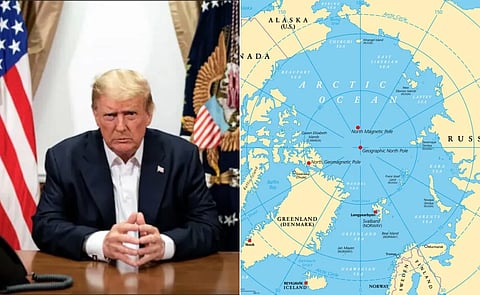
As India and the US enter the final lap of the bilateral trade deal negotiations, a new worry has cast its shadow over New Delhi. While Greenland is a non-issue for most Indians, US President Donald Trump’s Greenland-related tariffs on eight European countries have highlighted the need for greater caution on India’s part and the need to safeguard its strategic autonomy and build adequate protections into any trade agreement. The 10 per cent tariff on imports from Denmark, Norway, Sweden, France, Germany, the UK, the Netherlands and Finland was imposed after these countries backed Denmark’s refusal to allow the US acquisition of Greenland.
While an agreement with the US is important, as it remains the largest market for Indian goods, despite the imposition of 50 per cent tariffs, there is no taking Trump for granted. Industry representatives say that, while India’s exports to the US are still holding up, and so there is little need to panic, the negotiators should also aim to build in safeguards in the India-US deal to guard against the reversal of concessions.
Indeed, in the April-December period, India’s exports to the US rose 9.74 per cent year-on-year (y-o-y) to $65.88 billion. Some of this growth can be attributed to shipments in April-August, when additional tariffs were not in force. Exports to the US fell in September and October before recovering in November and December. The main driver of growth has been smartphones, with shipments to the US rising 200 per cent y-o-y in April-November to $12.5 billion. While some sectors like apparel may be suffering, for the country as a whole, the US tariffs are not a disaster, as was being made out.
Meanwhile, Indian negotiators are keenly awaiting the US Supreme Court’s long-awaited verdict on the legality of Trump tariffs. If tariffs are overruled, it will be another factor to weigh in the talks.
In the ongoing trade talks, the US is believed to have offered India relief from 50 per cent tariffs imposed through an executive order and a reduction in the regular Most Favoured Nation (MFN) tariffs. The MFN tariff concession will be of a more permanent nature.
The 10 per cent tariffs announced by the Trump administration on Denmark, Norway, Sweden, France, Germany, the UK, the Netherlands and Finland for opposing a US takeover of Greenland come despite trade deals with these countries having been signed last year. “For Europe, the message is unmistakable: even recent trade deals offer no protection from new US tariffs,” said Ajay Srivastava, founder, Global Trade Research Initiative (GTRI).
The US tariffs will take effect on 1 February and rise to 25 per cent on 1 June, remaining in place until the US secures what Trump has called the ‘complete and total purchase of Greenland’. In 2025, the UK had negotiated 10 per cent tariffs and the European Union 15 per cent after the US threatened reciprocal measures.
Relentless pressure
For India, the implications are immediate. Under sustained US pressure, New Delhi has already taken costly steps, including withdrawing from a BRICS naval exercise involving Russia, China, Iran and South Africa; halting oil purchases from Iran and Venezuela, while sharply cutting imports from Russia. Yet, despite these concessions, US pressure on India remains relentless in trade negotiations and public forums.
Srivastava believes that the Greenland episode offers a clear lesson to India: trade deals with the US are not a shield against coercion. Tariffs and sanctions can be reimposed regardless of agreements. India should therefore avoid making unilateral concessions to the US – on energy sourcing, regional projects, technology platforms or strategic alignments – in the expectation that a trade deal will buy stability, he said.
While other US partners facing similar pressure, such as Canada and Australia, are leaning more towards China, India has limited scope to pivot in that direction for strategic reasons, despite the large trade flows between the two countries. A graded opening of the economy to China is now said to be under consideration at the highest levels of the Modi government against the backdrop of a rapidly shifting global trade landscape and the looming threat of heightened US tariffs. India has already eased the business visa process for Chinese workers, and the government is now examining whether some investment-related restrictions could also be relaxed.