
After seeing its Lok Sabha numbers fall to 240 in the 2024 General Elections, the lowest since 2014, the BJP was buoyed by victories in five of the eight states that went to the polls that year. It won in Odisha, Haryana, Maharashtra and Arunachal Pradesh. Its ally, the TDP, won in Andhra Pradesh, while the Opposition won in Jharkhand, Jammu & Kashmir and Sikkim. Last year, the BJP won in Delhi by ousting the Arvind Kejriwal-led Aam Aadmi Party, and, along with the Janata Dal (United), retained power in Bihar.
Now, the BJP’s bid to script a victory in states where it has traditionally lacked support will be put to the test in Tamil Nadu, Keralam, West Bengal and the UT of Puducherry, where elections will be held soon. In Assam, which also goes to the polls soon, the party is fighting to retain power for the third time. But the polls are being held at a time when the government is facing one of its toughest foreign policy challenges. The sparks of the West Asia conflict are flying beyond the Persian Gulf, with reduced gas imports constricting the supply of cooking gas. Developments in the Strait of Hormuz have the potential of disrupting livelihoods as they may affect remittances in the long run.
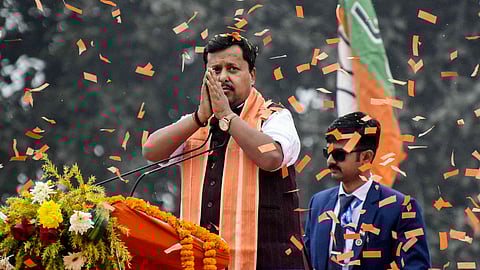
The elections, political observers feel, will be a measure of the party’s outreach, the strength of its election narrative and a crucial indicator of whether it has been able to breach the Opposition’s fortresses – Bengal, Tamil Nadu and Keralam. In some measure, it will also be a test of the BJP’s new president Nitin Nabin, although, like always, the campaign will be led by Prime Minister Narendra Modi.
In West Bengal, where the BJP is the main Opposition, the party has pitched its election narrative primarily on national security and administrative lapses. The party’s pitch is that there is rampant corruption in the state, law and order is abysmal and owing to the state government’s vote bank politics, illegal settlers have been allowed to thrive at the cost of the Bengali people. To be sure, the BJP’s election narrative was on similar issues in 2021, when it won 77 of the 294 seats on offer.
The Trinamool Congress government in the state, headed by Mamata Banerjee, has been in power since 2011, and the BJP will be hoping anti-incumbency kicks in at some point. The party, however, does not have a state leader who can take on Banerjee.
That’s true of Tamil Nadu and Keralam as well, although, in the first place, this is not important, as the BJP is a junior partner in the AIADMK-led alliance, and the Dravidian party has made it clear that, even if the alliance wins, the BJP will not be part of the government.
The AIADMK itself faces intense pressure, as the party has been riven by differences and splits since the death of its leader and former CM, J Jayalalithaa. In the 2021 assembly polls, the AIADMK won 66 of the 234 seats, while the BJP won four and the PMK won five, taking the NDA’s tally to 75, while the DMK-led alliance won 159 seats.
Building networks
In neighbouring Keralam, the BJP’s best-case scenario is to edge past the Congress to emerge as the main Opposition to the ruling LDF government headed by CPI-M’s Pinarayi Vijayan – although most analysts say that is unlikely. The party has been actively building networks with the Christian community in the state and has firmed up alliances with a bunch of smaller parties, such as the Bharath Dharma Jana Sena, which wields clout among the Ezhava community and the Twenty20 Party, launched by industrialist Sabu M Jacob. Other allies include the Kerala Congress (Democratic) and a break-away faction of the Kerala Congress led by Saji Manjakadambil. In the 2021 elections, the BJP won none of the 113 seats it had contested in the state.
In Assam, where the BJP has been in power for two terms now, the election narrative is again on issues such as demographic changes and illegal settlers. The BJP chief minister, Himanta Biswa Sarma’s image as a hardliner has both pluses and minuses. While there is resistance on the ground to illegal settlers, there is also a section of ethnic Assamese minorities, who find the BJP’s politics to be polarising.
But Himanta plans to ride to victory on a plank of his own choosing. In 2021, the BJP contested 93 seats and won 60, forming a government for the second time. There is no reason the performance cannot be repeated this time.