
Crypto-trading has gained popularity in India, with the mushrooming of crypto exchanges pointing to increased participation from users outside major urban centres. At present, crypto exchanges can operate in India after registering with the Financial Intelligence Unit, a government agency tasked with due diligence to check money-laundering risks. Taxes are imposed on gains from cryptocurrencies. Neither the Reserve Bank of India nor the Modi government has barred trading in cryptocurrencies altogether.
India has diverged from large global and regional economies, including the US, Japan and the European Union, in framing laws around cryptocurrencies, fearing that bringing the digital assets into its mainstream financial system could raise systemic risks. So far, the government has taken the view that India’s focus should instead be on strengthening central bank digital currencies (CBDCs), interoperable payment systems, and fast payment linkages, which can deliver innovation without compromising financial stability.
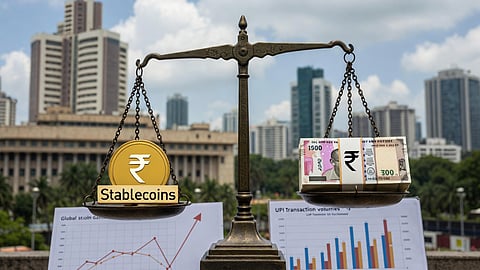
The global advent of stablecoins, however, may push the government into relooking the issue and taking a more categorical stand, enacting a law. Stablecoins are a category of crypto-assets designed to maintain a stable value by being pegged to an underlying reference – typically, a fiat currency (issued by or under the authority of the sovereign), such as the dollar. Unlike Bitcoin, which has no underlying reference and its price is driven purely by speculation, stablecoins’ value is determined by the reserves backing them. These reserves can include cash, government securities or other financial assets. The key distinction lies in the claim to value.
Stablecoins have gained global prominence after the US passed a law to create a regulatory framework for dollar-pegged cryptocurrency tokens, boosting their popularity and pushing the global market cap of such tokens above $300 billion. The first stablecoins, including Tether (USDT) and Bit$, appeared around 2014, offering crypto-convenience with dollar-backed stability.
That stablecoins are being used in cross-border payments proves that they have gained wide acceptance and trust, similar to regulated international banks. Japan has one of the clearest stablecoin regimes, having amended its payment laws to allow issuance of fiat-linked stablecoins by licensed entities. This has enabled yen-pegged stablecoin initiatives under regulatory supervision, making Japan an early mover among major economies. Other Asian financial centres, including Hong Kong and Singapore, have also introduced stablecoin frameworks or consultation-based regimes that allow fiat-backed stablecoins to be issued under licence, subject to prudential and governance standards.
Medium of exchange
But can stablecoins act as a medium of exchange in India? Sources in the government say bitcoin and similar cryptocurrencies have no intrinsic value and are not backed by any promise to pay. They have no issuer standing behind them and no underlying cash flows. Their prices, therefore, do not reflect value in the conventional monetary sense but are driven by speculative trading, which are comparable to historical assets. Stablecoins, however, claim to represent value because of the assets held in reserve and their peg to sovereign currencies. This gives them some currency-like features and allows them, in theory, to function as a medium of exchange.
“But for an instrument to qualify as ‘money’, it must involve an unconditional promise to pay at par by the issuer,” the sources added. “It remains unclear whether major stablecoins offer such a legally enforceable promise, which weakens their claim to being true money”.
The RBI’s position on the subject is said to be crystallising. Speaking at an industry summit in Mumbai recently, T. Rabi Shankar, deputy governor, RBI, said that stablecoins do not have a meaningful role in the financial system. While acknowledging that stablecoins are closer to money than unbacked cryptocurrencies, he emphasised that they still do not meet the core attributes that define modern money.
According to him, modern money is trusted because it is fiat (as a government decree gives it value and legitimacy without physical backing, relying on trust), and because it is ‘single’ – meaning that all forms of money are interchangeable at par and settled in central bank money. Stablecoins, being privately issued, violate both these principles. He also questioned the commonly claimed benefits of stablecoins. In domestic payments, he noted, systems like UPI already offer fast, low-cost and reliable transactions, leaving little room for stablecoins to add value.
In his speech, Rabi Shankar outlined a wide range of risks posed by stablecoins, spanning monetary, fiscal, banking and systemic dimensions. Stablecoins also threaten the effectiveness of monetary policy. If households and firms increasingly transact or hold value in stablecoins, changes in domestic interest rates or currency in circulation may have a limited impact on economic behaviour. Based on this speech and earlier comments from central bankers, there is no indication that the RBI is inclined to permit stablecoins within India’s financial system.