
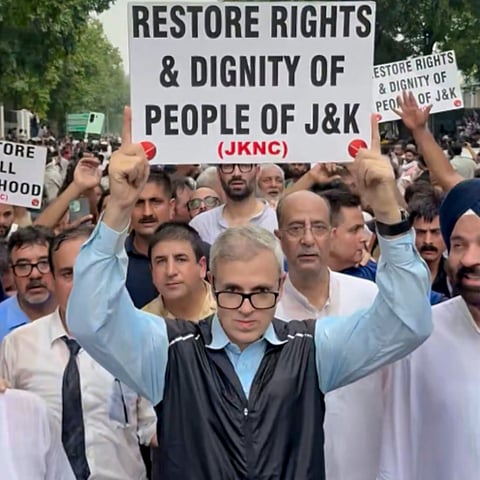
Two-and-a-half years ago, the Supreme Court of India recorded the Union government’s solemn assurance that statehood would be restored to Jammu & Kashmir. It set no timeline, but the expectation was that it would happen within a reasonable period and steps would be taken progressively. The Modi government, however, has done nothing on this front since, engendering the feeling among politicians and people of J&K that it has interpreted the lack of a timeline as a licence for the indefinite deferral of ‘statehood’. This is despite repeated assurances from Prime Minister Narendra Modi in the run-up to the J&K elections and Home Minister Amit Shah on the floor of Parliament. Political observers say that the BJP’s game plan is to leave the statehood question hanging until the political arithmetic, already sought to be reworked through delimitation in J&K, tilts decisively in its favour.
The inaction has driven Omar Abdullah, chief minister, J&K, to organise a series of agitations and rallies, culminating in a sit-in at Jantar Mantar in New Delhi on 20 July. That is why it is finding resonance in the Valley. Political observers feel that his grievance, and that of the province, is legitimate. The retention of Union Territory status even after popular elections subordinates the elected government to an unelected Lieutenant Governor, who retains preponderant authority over the bureaucracy, the police and other institutions. There is no principled justification for perpetuating this arrangement once elections have been held and a government installed.
The government’s rationale for inaction has been trite: ‘security’, invoked by the Solicitor-General before the Court late last year, citing the Pahalgam attack, in a hearing on a petition seeking restoration of statehood. But, by the government’s account, the attack was orchestrated from across the border and India responded with Operation Sindoor. “A cross-border provocation can have no logical bearing on whether J&K’s elected representatives are to be trusted with the powers of a full state,” says Abdullah. “If anything, empowering elected leaders to address local grievances is precisely how a polity assuages concerns before they turn into resentment”.
He feels that the Centre’s handling of J&K, Ladakh and even Manipur reveals a troubling pattern in how border regions with substantial minority populations are treated. Secure in its dominance across the North, the West and now the East, the BJP appears to regard the concerns of citizens in these provinces as expendable.
Redrawing the boundaries
Following the abrogation of Article 370, the government had set up in March 2020 the Delimitation Commission as per the J&K Reorganisation Act, 2019. It was headed by former Supreme Court judge Ranjana Prakash Desai. It redrew the boundaries of the assembly and the five Parliament constituencies in the Union Territory and increased six assembly seats in the Jammu region, as also one in the Kashmir Valley; it renamed several constituencies too.
The erstwhile state of J&K had 111 assembly seats, including 24 reserved for PoK. Elections were held for 87 assembly seats only. The Kashmir valley had 46 seats, Jammu 37 and Ladakh, four. After the bifurcation of the erstwhile state into two UTs, JK and Ladakh, the assembly seats were reduced to 83 seats as four seats of Ladakh got scrapped.
The commission increased by seven seats – six in Jammu and one in Kashmir – raising the total seats in J&K to 90. Nine seats were reserved for Scheduled Tribes (STs) and seven seats for Scheduled Castes (SCs).
“J&K and Assam are victims of the delimitation process held in 2022,” says PDP leader Naeem Akhtar. “In J&K, the Kashmir division, with 1 million more votes than the Jammu division, was brought at par. Areas with 20,000 voters in the Jammu division were made constituencies compared to the Kashmir Valley with lakhs of voters, which got one”. Abdullah has cautioned against the delimitation process being manipulated to favour the ruling Bharatiya Janata Party (BJP), which has a stronghold in the Hindu-dominated Jammu region.
The Delimitation Bill, which the Modi government is now trying to push again in Parliament, will authorise the Delimitation Commission to decide on the revised strength of the J&K assembly to increase the seats from the current number. It will also authorise the commission to increase the number of Parliament seats from the present number of five to possibly two more. It also proposes the nomination of three women – three Kashmiri migrants and one PoJK refugee – from the present provision of five. Therein lies the story!