
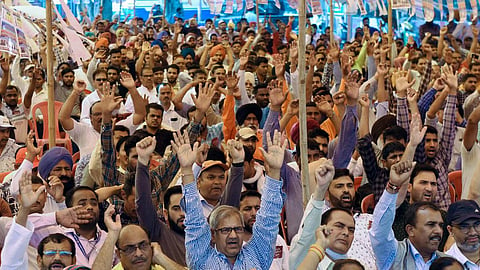
Over 5.02 million Central government employees and about 6.9 million pensioners were on the tenterhooks ever since the Modi government notified the Terms of Reference (ToR) of the Eighth Central Pay Commission (CPC) on 3 November. The Central government employee unions and representative bodies – including the Staff Side of the National Council of Joint Consultative Machinery – expressed their dissatisfaction regarding certain aspects of the ToR. Their grouse was that the government intentionally did not put the implementation date in the ToR for the eighth pay panel.
Besides the implementation date, employees have also been apprehensive about the government not mentioning ‘pension revision’ in the ToR. They said the ToR had excluded pensioners and lacked clarity on key aspects like DA merger and pension revision.
The Confederation of Central Government Employees & Workers (CCGEW), the All India Defence Employees Federation (AIDEF) and the Bharat Pensioners’ Samaj (BPS) have written to the Prime Minister urging immediate amendments. The unions claim the current ToR lacks clarity on pension revision, pension parity and the structure of future pension schemes. The unions have criticised the ToR’s reference to the ‘unfunded cost of non-contributory pension schemes’, calling the term inappropriate, insensitive, misleading and insulting to pensioners. The pensioner groups saw it as a signal that finances might be prioritised over social security.
The unions stressed the need for a thorough evaluation of existing pension schemes. About 2.6 million employees who joined after 1 April 2004 are dissatisfied with the New Pension Scheme (NPS) and Unified Pension Scheme (UPS), says the letter to the PM. They demanded the restoration of the Old Pension Scheme (OPS) and urged the 8th CPC to recommend the most beneficial options.
Constitutional right
They emphasised that pensions are a constitutional right under Article 300A and a matter of socio-economic justice, not a fiscal burden or a ‘bounty’. The Eighth CPC notification, they argue, fails to explicitly address pension revision for existing retirees—a provision included in the 7th CPC.
The government tried to address these concerns in Parliament recently, but many questions remain largely unanswered. Replying in the Lok Sabha, Pankaj Chaudhary, minister of state for finance, avoided committing to an implementation date, stating that the date ‘shall be decided by the government’. This single line has become the crux of employee concerns.
With the CPC’s recommendations valid till 31 December 2025, TUs expected that the ToR would mention 1 January 2026 as the official implementation date for revised pay and pension benefits. The ambiguity in this regard has now triggered anxiety over whether the rollout may take much longer.
Historically, pay commission recommendations take about two to three years to actually be implemented. However, the government has always applied these changes retrospectively.
Given this past pattern, many still hope that even if implementation gets delayed, benefits may eventually be paid from 1 January 2026. But without an official date mentioned anywhere in the ToR or the minister’s reply, uncertainty continues to loom.
One of the questions asked in Parliament was whether pension revision was covered under the Eighth Pay Commission. The government replied in the affirmative. It turns out that the exclusion of the term ‘pension revision’ in the ToR was a drafting omission. So much for the thoroughness of this government!
On queries about budget allocation for salaries and pensions, the minister said funds would be provided for implementing the accepted recommendations. But no estimate or timeline was shared as to whether provisioning would be reflected in the next Union Budget cycle.
Another parliamentarian asked whether the commission was consulting employee unions, pensioners’ groups and states. The government responded that the Commission would devise its methodology and process. This means stakeholder consultation will happen, but its scope and timelines are still unknown.
The only concrete timeline shared in Parliament is that the Eighth Pay Commission must submit its report within 18 months from its constitution. This suggests a report around mid-2027. What happens after that – including Cabinet approval and rollout – remains uncertain.
With 12 million employees and pensioners eagerly awaiting, the pressure on the Centre to clarify the implementation date is growing.