
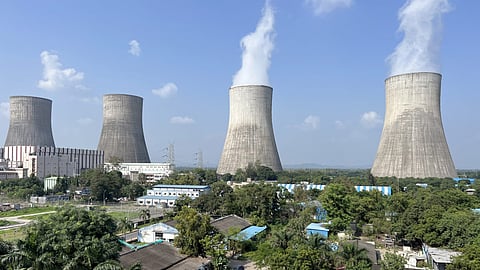
The government’s Sustainable Harnessing & Advancement of Nuclear Energy for Transforming India (SHANTI) Bill, passed in Parliament, will finally open India’s nuclear power sector to private and foreign players. But will it spark investor interest? Experts caution that investor interest will ultimately depend on whether nuclear electricity can be delivered at prices the Indian market can absorb.
The Nuclear Energy Bill, tabled and passed in Parliament, seeks to dismantle the state monopoly in nuclear power by allowing private participation and permitting up to 49 per cent foreign direct investment. It proposes a unified legal framework to replace the Atomic Energy Act of 1962 and the Civil Liability for Nuclear Damage Act of 2010, with the broader aim of scaling India’s nuclear capacity to 100 gigawatts by 2047. The legislation also seeks to encourage newer technologies, such as small modular reactors, which the Russians have been plugging, at a time when global electricity demand is rising sharply.
Currently, the state-run Nuclear Power Corporation of India owns and operates the country’s fleet of nuclear power plants that have a total capacity of 8.8 gigawatts, accounting for nearly 3 per cent of total power capacity. The country is targeting 100 gigawatts of nuclear power by 2047, with plans to scale this to about 300 gigawatts by 2070, positioning nuclear energy as a key base-load source supporting India’s net-zero ambitions. It is expected that SHANTI will be a step in that direction.
Under the new law, private companies would need to obtain licences to operate nuclear power plants, while foreign firms can participate through partnerships with Indian companies. However, analysts say policy reform alone will not be enough to draw overseas capital. Everything would now hinge on the final price of power. “The proof of the pudding will be in how much capacity actually gets deployed,” says Karthik Ganesan, director, strategic partnerships, Council on Energy, Environment & Water (CEEW). If nuclear electricity is priced well above existing alternatives, foreign participation could still remain limited.
Liability had long been the biggest hurdle to foreign participation, particularly after the India-US civil nuclear agreement signed in 2008. The SHANTI Bill caps operator liability at Rs3,000 crore and limits supplier exposure, bringing India closer to international practice. Ganesan said this alignment was overdue, noting that most countries restrict liability to specific entities and maintain a capped pool to cover damages in rare disaster scenarios. He argued that India would also benefit from advances in reactor design, where passive safety systems reduce the risk of accidents seen in the past. Even so, he stressed that cost competitiveness remains central, as electricity pricing is ‘a politically sensitive commodity’.
Failed to take off
Earlier attempts at civil nuclear co-operation with foreign partners had failed to take off for multiple reasons. Discussions with US and European companies ran into hurdles, ranging from complex ownership structures to high project costs that made proposed plants commercially unviable for India. The prices were much higher than the Indian market could absorb, and therefore, it would have been non-viable. Foreign suppliers had been reluctant to localise manufacturing or enter technology partnerships that could have brought costs down.
The bill comes amid a global resurgence of interest in nuclear power. The nuclear industry is expected to switch on 15 reactors globally in 2026 – a big jump after total capacity actually shrank by 1.1 gigawatts this year. Just two new reactors went into service this year through November, while seven shut down. About 12 gigawatts of fission power will be added in 2026.
According to the International Energy Agency, electricity demand is set to grow strongly through 2030, with India among the fastest-growing markets. Power consumption from data centres and artificial intelligence-driven computing is expected to more than double by the end of the decade, putting additional strain on grids. Reflecting these trends, the International Atomic Energy Agency has raised its nuclear power growth projections for the fifth year in a row.
Despite this backdrop, experts caution that expectations from the SHANTI Bill should remain measured. Foreign participation, they feel, is important because India has not yet shown the appetite to finance nuclear projects at the scale required, though private players such as Tata Power, Adani Power and Reliance Industries have shown interest in entering the sector. But whether global players step in will depend on India’s ability to negotiate long-term contracts, value energy security over decades, and ensure that costs reflect the true economics of the technology.