
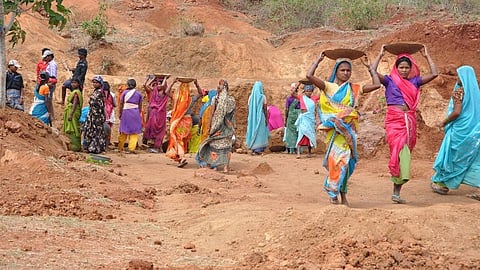
During its first term, the Modi government showed that it was not above appropriating ideas that were incubated under the predecessor UPA government. Now, into its third term, the BJP-led dispensation has shown that it will not only replicate a UPA idea under a different nomenclature but also change its fundamental character. The Viksit Bharat-Guarantee for Rozgar and Ajeevika Mission (Gramin) or VB-G RAM G, which seeks to replace the Mahatma Gandhi National Rural Employment Guarantee Act (MGNREGA), is a case in point. The very fact that the Modi government decided to retain the scheme, albeit in a diluted form, is significant as Prime Minister Modi was once a trenchant critic of MGNREGS, saying he would retain the scheme only as a ‘monument to UPA’s failure’. He had mocked the scheme, saying that, under it, the UPA government was deploying ‘people to dig pits 60 years after independence’.
Indeed, after Modi took over in 2014, MGNREGS found itself in the midst of controversy, with activists and Opposition parties accusing the government of trying to dilute it. The scheme’s budgetary outlay came down, and many states periodically held the Centre guilty of holding back the allocations.
The overhaul of MGNREGS has kicked off another controversy. Leading the charge is Jean Dreze, development economist and one of the brains behind the scheme. He argues that the new scheme is not an employment guarantee due to a switch-off clause that gives the Centre discretionary powers. “With MGNREGA, India set an example for the world. VB-G Ram G destroys that legacy.”
Toeing the RSS line?
Unsparing critics say that the only plausible reason for the name change is the fact that the BJP’s ideological master, the RSS, had strong differences with Gandhi. The use of Gandhi’s name in the 20-year-old scheme signified the link to his Gram Swaraj concept that gives importance to democratic decentralisation. But the new act, by making the Union government virtually the sole decision-maker in the proposed law, will not make any positive contribution in this direction.
Under MGNREGA, the government guaranteed 100 days of work in rural areas and even offered to pay unemployment allowance, in case work cannot be provided. The new scheme proposes to raise the 100-day guarantee to 125 and keep the other conditions the same.
But, under it, employment is meant to be generated through pre-approved plans, which, critics say, shifts the focus of the programme away from people’s needs. Earlier, workers could apply to the gram panchayats if they needed work, now they will get work only if there is any. The new bill also proposes work under four categories – water security, core rural infrastructure, livelihood-related assets and climate resilience. While this is a more focused approach, it curtails the scope of the work, which was earlier decided by panchayats according to local needs.
The new law is in line with Gandhi’s sentiments, affirms Shivraj Singh Chouhan, minister for rural development. His ministry claims the increase in the days of work to 125 in a year as a major benefit for people in rural India. But the data on employment given to households under the MGNREGS reveal that it was only during 2020-21, the Covid-19 pandemic year, that 9.5 per cent (nearly 7.2 million) of households actually worked for 100 days. Over the last two years, only about 7 per cent of families could get the full quota.
The change, critics say, marks yet another attempt by the Centre to reduce the size of the development space by passing the financial burden to the states. By calling the VB-G RAM G “a centrally sponsored scheme,” the Union government has done away with the special status the MGNREGS had enjoyed, wherein it had been absorbing the entire cost of wage payment for unskilled manual labour. In the proposed scheme, the fund-sharing pattern between the Centre and the states generally would be 60:40. With the change, the bottom-up, demand-based scheme will be replaced by a supply-driven framework, wherein allocations will be capped, as decided by the Union government. Tamil Nadu, West Bengal and Kerala have opposed the new law, citing an undermining of states’ interests.
A feature of the bill, which is meant to ensure that work does not clash with farm work during sowing/harvesting, may be included explicitly in the MGNREGS, after consultations with the states. Interestingly, this was a point which Sharad Pawar, former minister in the two UPA governments, had raised in seeking dilution of the scheme, but was overruled.