
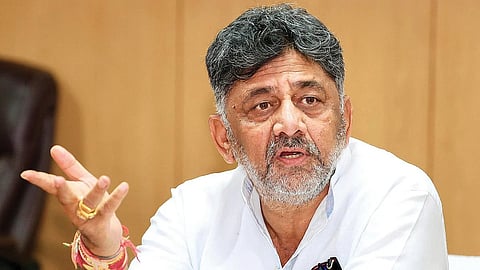
Struggling to match up to the Bharatiya Janata Party’s overwhelming capacity and political skills in the rest of the country, the Congress now finds itself in a pickle in Karnataka, one of the few states it had managed to wrest from the saffron party in the recent years. The BJP is waiting in anticipation and cannot hide its glee at the unfolding power tussle between Chief Minister Siddaramaiah and Deputy Chief Minister D.K. Shivakumar. The deputy wants to replace the leader, who is in no mood to oblige.
When Siddaramaiah and Shivakumar assumed their current positions in 2023, it was reportedly based on a mutual agreement, which also provided for a mid-term change of guard. Only the central functionaries of the Congress and these two leaders know the exact details of the power-sharing arrangement that was agreed upon then. It appears the agreement was brokered by the Gandhi family. Two-and-a-half years later, Shivakumar is demanding his pound of flesh and his supporters say as there was an agreement then he should be handed over the baton.
Shivakumar has remained loyal to the party through difficult times, facing cases and imprisonment and accused of corruption by central agencies. While he is valuable for the Congress for his organisational and managerial skills, which inspire confidence among party workers even beyond Karnataka, Siddaramaiah is valuable for a different reason. Besides being a seasoned administrator, his standing as a champion of social justice has enabled the Congress to widen and consolidate its acceptance among the subaltern communities in the state.
It is a familiar story playing itself out for the Congress. In Rajasthan, not long ago, Sachin Pilot, as the head of the party’s state unit, drove the Congress to power but the top job went to Ashok Gehlot. Pilot was made deputy CM. This created bitterness in the Congress during the five-year term of the party government, as Gehlot dug in his heels. Ultimately, the Congress was ousted from power in the state.
Caste rivalries and factors have also come to the fore in Karnataka. Shivakumar belongs to the dominant Vokkaliga community and is not an easy choice for the party, which swears by social justice. A Vokkaliga at the top can create a rupture in the Congress’s social base in Karnataka and that works against Shivakumar. That appears to be the deadlock.
The power play is taking its toll on the state administration, giving a handle to the opposition. R. Ashoka, Opposition leader in the legislative assembly, recently alleged: “Companies like Google have taken their investments to neighbouring states. Due to this squabble, garbage and pothole problems in Bengaluru persist and entrepreneurs are not coming here.”
‘Historic loss’
Google’s announcement of a Rs1.33 lakh crore investment to build an Artificial Intelligence (AI) infrastructure hub in Andhra Pradesh has, in fact, sparked a political storm in Karnataka. H.D. Deve Gowda, former PM and belonging to the Janata Dal (Secular), has held the Congress government responsible for what it called a ‘historic loss’ to the state’s tech legacy. The AI hub, to be set up in Visakhapatnam, will be Google’s largest investment in India and is expected to generate 30,000 jobs and an annual revenue of R10,000 crore. The company signed a memorandum of understanding (MoU) with the Andhra Pradesh government to execute the project. The Opposition in Karnataka has demanded that the Congress government release a white paper detailing why the project slipped away, calling the development a major setback to Bengaluru’s global tech standing.
It is against this deadlock that various options are being talked about in the upper echelons of the Congress party to defuse the crisis. One option is for the party to use the tussle in Karnataka to shuffle its deck nationally. Congress president Mallikarjun Kharge is also from the state. If the social dynamics of the state make it risky to make Shivakumar the chief minister, the Congress could consider Kharge, a Dalit, who has lost out in the race for the post more than once in the past. Kharge might be acceptable to all factions and, most importantly, to the party’s social base.
Clearly, the Congress is in desperate need of a leadership overhaul, as the Bihar electoral fiasco showed. Party leaders concede that it needs a mix of people with various skills – experience of running the party and contesting elections, ideological clarity and realpolitik – to steer it out of the current logjam. Any of these would be possible only if key leaders are willing to make some personal sacrifices for the good of the party, they say.