
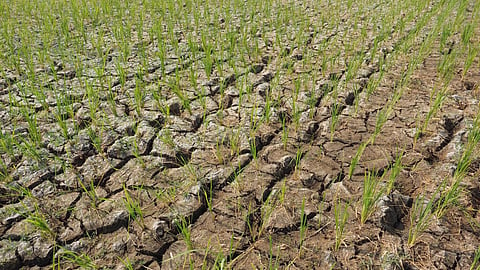
The 1972 drought is perceived as the worst calamity that led to massive crop loss and an acute shortage of food grains in Maharashtra. It also caused a massive fodder shortage, adversely affecting cattle, goats and other animals. With drought being declared in nearly three-fourths of its tehsils, the state’s Chief Minister Devendra Fadnavis feels that the situation could be worse than the 1972 drought.
About 30 per cent of the land area in India was under different degrees of drought in the first week of September 2023. At least 11.5 per cent of the area was under ‘severe’, ‘extreme’ and ‘exceptional’ dry conditions, while 18.9 per cent was under ‘abnormal’ to ‘moderate’ dry conditions, according to data from the Drought Early Warning System (DEWS). DEWS is India’s first real-time drought-monitoring platform, run by IIT Gandhinagar’s Water and Climate Lab.
The key to mitigating the situation will be Centre-state coordination. With Fadnavis and CMs of Karnataka, Telangana and Andhra Pradesh also pressing the panic button, the Centre is gearing up to meet the challenge. The flagship Pradhan Mantri Fasal Bima Yojana and VB-G Ram G schemes – in terms of expeditious indemnity claim payouts to farmers and the taking up of rural relief works – are expected to be deployed to the optimum levels. The agriculture ministry is chalking out contingency plans to be shared with the states soon.
Agriculture and Farmers’ Welfare Minister Shivraj Singh Chouhan and Home Minister Amit Shah are regularly reviewing the situation regarding below-normal rainfall and its impact in certain parts of the country due to El Niño. At a recent meeting, the two ministers emphasised the need to ensure adequate electricity supply to farmers, closely monitor water levels at all reservoirs and promote crops that require less water. States will be asked to replicate the Fadnavis administration’s activation of the Drought Management Code, undertaking of crop loss assessment and concessions, such as waiver of land revenue and restructuring or pausing recovery of agricultural loans by farmers in the affected areas.
Issuing directions to states is the easy part. The Centre and the states will have to deal with the politics of drought relief that often breaks out in such situations. Already, in Maharashtra, after the state administration declared a drought across 265 of 358 talukas, the Congress party questioned the government’s push for industrial data-centre expansions that could divert water resources away from farmers. Leaders from the Shiv Sena (UBT) criticised authorities for delaying the drought declaration and relying on procedural concessions instead of providing immediate, direct cash assistance to grassroots farmers.
Karnataka’s water woes
D.K. Shivakumar, chief minister, Karnataka, has warned that his state could face a shortage of drinking water and electricity amid declining rainfall and, so, the people should be ‘mentally prepared’ for the emerging drought situation. He shot off a letter to Prime Minister Modi urging the early release of 50 per cent of the Rs3,705 crore assistance requested by the state, along with the advance release of Central disaster relief funds.
Realising that there is an equal need for supply-side management in anticipation of food shortfalls. It has already allowed imports of arhar and urad at nil duty. Imports should be made duty-free for all other pulses like yellow peas, chana and masoor.
The Centre’s worry stems from the fact that it isn’t just Maharashtra alone, which is at a disadvantage. India overall has reported rainfall at 11.9 per cent below the historical average during the current Southwest Monsoon season from 1 June to 27 September. Also, 23 of the country’s 36 meteorological subdivisions have recorded cumulative deficits in excess of 10 per cent.
El Niño has entered a strong phase. Global climate models point to it becoming ‘very strong’ in October through January-February, before gradually receding into a moderate-to-weak event towards April-May. El Niño’s impact on the monsoon has been felt since August. There will be some effect of that on the kharif yields, even if their acreage hasn’t fallen much. The real brunt will be borne by the crops grown during the upcoming rabi (winter-spring) season.
Deficit monsoon rains may leave little water in wells, ponds, reservoirs or underground aquifers. That, plus the prospect of a relatively warm and short winter (El Niño is known to suppress rainfall as well as raise temperatures), could translate into a poor rabi harvest on top of a not-so-bountiful kharif.