
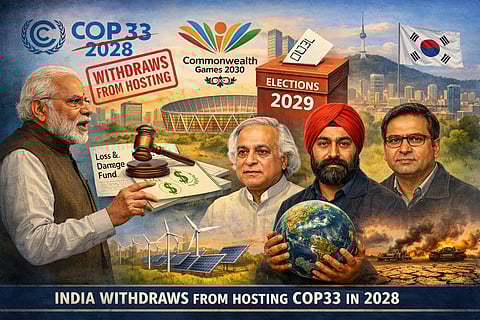
India has pulled back its offer to host the Conference of the Parties (COP33) in 2028. The offer was formally announced by Prime Minister Narendra Modi at a global meeting in 2023 and received the backing of several frontline countries. Apparently, the matter had been under government consideration for some time, and only recently was the formal decision on withdrawal conveyed.
The government has yet to assign any reason, but officials informally say that, in the present context, it is a wise one. “For one, who cares about the Global South, except the Glocal South? The Loss and Damage Fund, intended for the Global South to recover from the ravages of climate change, has barely taken off, as the developed world has not contributed enough funds,” says a source.
Besides, the government apparently has a plan to organise a few other big-ticket events during the time, about a year before the next parliamentary election. It does not want to get embroiled in organising the COP, which is a major global event that spreads over two weeks, involving nearly 200 countries and close to 75,000 participants from around the world. The next Commonwealth Games is also slated to be held in 2030 at Ahmedabad, which will be a big-ticket event.
Environmentalists, however, are dismayed and surprised. “It was high on PM’s agenda, especially since 2029 will be the year of the Lok Sabha polls. So, atmospherics could have been created,” says Jairam Ramesh, Congress leader and former Union environment minister.
“India’s withdrawal from the COP33 bid is a strategic missed opportunity,” points out Harjeet Singh, global climate activist & founding director, Satat Sampada Climate Foundation. “Having proven it can green its economy at a record pace, India has now forfeited the home stage to showcase its renewable energy triumphs, electric mobility revolution and more” … By stepping back, New Delhi also loses a critical platform to champion the Global South.”
“India’s leadership consistently reminded developed nations of their responsibilities on mitigation and finance,” points out Sanjay Vashist, director, Climate Action Network South Asia (CANSA). “Its withdrawal from the nomination is therefore a setback for the global effort toward an ambitious and equitable climate agenda”.
Hotbed of climate change
Climate experts, who have been following global climate negotiations for close to two decades, point out that South Asia is a hotbed of climate change. The summit in India would have highlighted the concerns and vulnerability of the region. The COP could have brought more support for the region.
India’s decision leaves uncertainty over the host of COP33, which will follow COP31 in Türkiye and COP32 in Ethiopia. It means that South Korea is now the only country having expressed interest in hosting the 2028 summit, with a final decision expected later this year. The right to host the annual climate COP negotiations rotates between the UN’s five regional groups, and COP33 is scheduled to be organised by a country from the Asia-Pacific.
Official sources, however, say that, despite India’s strides in renewables and the government’s efforts to reduce the current pain, the most vulnerable are still suffering. Also, the UNFCCC has significantly weakened after the US left, although this body is all that is left. Hosting a UNFCCC negotiation without key polluters won’t help the developing world; it is a waste, say sources.
Third, the West Asia war is a live lab for energy security and its impact on India. Who will pay India for its losses from a war it has nothing to do with? Who will pay countries for the emissions and environmental impact beyond the warring nations that the war is sure to have in the coming years?
Fourth, guesstimates are that the war has crossed the combined annual emissions of 84 countries. So, why host a semi-functional COP when geopolitics snubs climate?
In the face of such concerns, the environment ministry is of the view that India should stay focused on holistic, green, low-carbon development at home and participate in the UNFCCC as part of the global community. The last decade of climate negotiations has shown us it is important to keep up a good negotiation. Also, India has to fight the problem at home before it starts assuming a global role.