
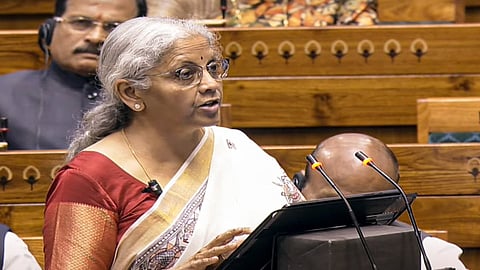
Nirmala Sitharaman’s ninth budget is said to be a record-breaking event of sorts. No finance minister has achieved the feat of presenting so many budgets. But it is anything but spectacular. Her last budget was dominated by income tax rate and slab relaxations. It got her the headlines. To boost household consumption and aggregate demand, she had announced that incomes up to Rs12 lakh would be exempt from income tax. Effectively, under the new tax regime’s standard deduction of Rs75,000, the limit was revised to Rs12.75 lakh. Simultaneously, she revised the tax slabs and proposed measures for the rationalisation of tax deducted at source and tax collected at source structures to ease difficulties for the benefit of small taxpayers.
Last year, the budget came at a time of unprecedented global uncertainty and a flagging domestic economy. The real GDP growth was estimated at 6.4 per cent for 2024-25 and 6.3-6.8 per cent for 2025-26 – a far cry from the 8 per cent growth required annually to make India a developed nation by 2047. This year, amid the continuing global uncertainty, growth has touched 7.4 per cent. This should have been used as a platform to attempt another policy disruption of the 1991 variety. Politically and electorally, the BJP was never in a better position. Alas, Sitharaman has decided to play it safe again and has even done away with any headline-grabbing measures.
STT hike scares the market
In fact, the major headline on Budget Day was the surprise hike in the Securities Transaction Tax (STT) on futures and options, which caused a severe downturn in the stock market with the Sensex and Nifty crashing over 2-3 per cent during the session. PSU banks and metal stocks were the hardest hit. Beyond the STT hike, market sentiment was pressured by high government borrowing figures (R17.2 lakh crore), persistent Foreign Institutional Investor (FII) outflows and disappointing corporate earnings.

Overall, Budget 2026 has disappointed the common man, looking again for what matters to him most – tax relief, subsidies and hope for a better future. There were no major tax cuts in the budget for India Inc either, though there are indirect tax relaxations for the promotion of marine, leather and textile products exports and speeding up India’s energy transition.
Economists aren’t too enthused and feel she has missed a chance. Even the pro-Modi Surjit Bhalla, freshly minted from the IMF, has slammed the budget for bowling a googly in the form of yet another retrospective tax: starting April 2026, there will be a new tax on capital gains made via the purchase of SGBs or sovereign gold bonds. As for political rivals, P. Chidambaram, former FM, says that Sitharaman has followed an American colloquialism, ‘If it ain’t broke, don’t fix it’. That is why it is a ‘lazy budget’, he remarks. Clearly, caution in the face of geopolitical turmoil has guided the finance minister’s hand.
Senior finance ministry officials and supporters of the Modi government believe that the Budget takes a ‘scatter-shot approach’, through various sectoral and issue-based measures, when taken together, will hopefully propel India’s growth over the medium term. They admit that, given the level of geo-economic and geopolitical uncertainties that the Indian economy faces, one was hoping for more. But Sitharaman is perhaps betting that this diffused approach is likely a more effective policy than targeted Big Bang announcements would be. In her perception, this is not the time for disruption.
Humdrum announcements
But disruption there has never been since she helmed the finance ministry. And so, Budget 2026 contains humdrum announcements for the manufacturing sector, various services sectors, as well as particular provisions to help labour-intensive sectors such as textiles and leather. A fresh allocation of Rs10,000 crore has been made to the small and medium enterprises (SMEs) growth fund, in a bid to give fresh incentives to lakhs of small businesses and enterprises in the country. As job generation continues to remain elusive, despite a slew of schemes, missions and ideas that have been launched over the past decade, the government has now returned to the theme of good old manufacturing as the key to the problem of unemployment.
The move to push manufacturing to the forefront of its budget is also evident in her decision to prioritise emerging sectors such as semiconductor, bio-pharma, electronic manufacturing and rare earths. Semiconductor and electronics manufacturing are the few sectors that have gained from the government’s existing PLI schemes. The India Semiconductor Mission 2.0 and the increased allocation under the Electronics Component Manufacturing Scheme are follow-ups to this. These are sectors where India needs to become globally competitive. The Biopharma SHAKTI scheme is aimed at making India a global biopharma manufacturing hub with an allocation of R10,000 crore over the next five years.
In the coming months, Sitharaman will have to keep her eyes on the ball if she wants her proposals, like the integrated programme for the textiles sector and measures aimed at creating ‘Champion MSMEs’, to succeed. She would need to remember that the National Export Promotion Mission, announced in the last Budget, was implemented only by December 2025, nine months into the financial year.
Will the services sector, one of India’s brighter spots, benefit from Budget 2026? She has set up a high-powered ‘education to employment and enterprise’ standing committee to recommend measures that focus on the Services Sector as a core driver of Viksit Bharat. The dream is to make India a global leader in services, with a 10 per cent global share by 2047. The committee will prioritise areas to optimise the potential for growth, employment and exports. They will also assess the impact of emerging technologies, including AI, on jobs and skill requirements and propose measures thereof.
‘Orange Economy’
The budget has placed a spotlight on something called the ‘Orange Economy’, also known as the creative economy, which refers to industries where ideas, creativity, cultural expression and technology are the core sources of value, not physical goods. It includes sectors such as Animation, Visual Effects, Gaming & Comics (AVGC); film, music, and digital storytelling, design, fashion, and advertising; and publishing and software tools that help creators produce and distribute content – a veritable employment pipeline. AVGC content creator labs are to be set up in 15,000 secondary schools and 500 colleges across India. These labs, spearheaded by the Indian Institute of Creative Technologies, are intended to equip students with world-class creative and digital skills.
The budget has sought to cater to the election-bound states this year through several announcements, blending politics with economics. Dedicated rare earth corridors are proposed for Odisha, Kerala, Andhra Pradesh and Tamil Nadu, a coconut promotion scheme for Kerala, an integrated east-coast industrial corridor for West Bengal and the first of the new national waterways to begin in Odisha. This is different from consolidated packages of the past.
As for the Centre’s finances, Budget 2026 offers a mix of expenditure enthusiasm and revenue sobriety. The public capital expenditure push, especially with regard to infrastructure creation, has continued, perhaps in reaction to the realisation that current conditions do not encourage private investment. Overall, capex will grow to Rs12.2 lakh crore in 2026-27, amounting to 4.4 per cent of GDP, the highest in at least the last 10 years. This includes the announcement of dedicated freight corridors and training institutes for the manpower needed. These rail corridors are also to be supplemented by a Coastal Cargo Promotion Scheme to incentivise increasing the share of inland waterways and coastal shipping. However, considering that the Centre has revised its capital expenditure for 2025-26 downwards to Rs10.9 lakh crore from the Rs11.2 lakh crore initially budgeted, it remains to be seen if this year’s target will be met.
The allocations for key subsidies – a major head of expenditure – are, however, headed for a cut. The government is projecting Rs4.54 lakh crore worth of subsidies, including those on food, fertilisers and LPG – down from the Rs4.69 lakh crore it is estimated to spend (RE) this fiscal. The capital outlay for defence will increase by more than 20 per cent, given the backdrop of nationalist fervour that welled up after Operation Sindoor.
The tax revenue projections are largely sober. Corporate tax revenue is projected to grow nearly 14 per cent over the Budget estimates of 2025-26. This is broadly in line with the revised estimates for 2025-26, coming in 12.4 per cent higher than the actuals of the previous year. Income-tax revenue has been budgeted to grow 1.9 per cent over the BE of 2025-26 – an expected outcome following last budget’s substantial rate relaxations. Gross GST revenue has been projected to contract 13.5 per cent in 2026-27, a reflection of the September 2025 rate rationalisation and the end of the Compensation Cess. Taken together, the Centre’s fiscal deficit – which tracks the shortfall between income and expenditure in a year – has been projected at 4.3 per cent of GDP in 2026-27, down from 4.4 per cent estimated for 2025-26.
While the Centre’s fiscal consolidation path since the Covid-19 pandemic has been decent, continued aggression in reducing the deficit has come in for some questioning. Even the Economic Survey argued for some fiscal flexibility for the Centre, given the geo-economic and geopolitical conditions. But who cares? As long as the voters keep on expressing their support for the BJP!