
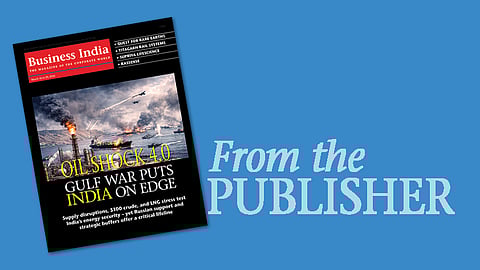
War without end, oil without flow
The extensive bombing of Iran by Israel and the US has been met with retaliation that the Iranians had earlier threatened. In spite of the targeted killing of Iran’s supreme leader, Khamenei, followed up by targeted assassinations of military and Revolutionary Guards leaders, Iran demonstrated a distributed leadership willing to retaliate fiercely. Also, the intense bombing and destruction of alleged nuclear enrichment sites and industrial sites producing armaments and residential areas do not seem to have diminished Iran’s deadly drone capacity nor its capacity to fire barrages of ballistic missiles.
While ‘apologising’ to its Gulf Arab neighbours, Iran targeted US bases and facilities, which are located in the UAE, Bahrain, Qatar, Kuwait and Saudi Arabia. And it also hit, it claimed, in retaliation for its energy facilities, particularly the South Pars gas field. Not unexpectedly, it virtually shut down the Strait of Hormuz, through which passes 20 per cent of the world’s oil and gas supplies, causing shortages and a sharp hike in oil and gas prices, impacting Europe and Asia, including India.
More importantly, it severely dented the reputation of the Gulf States as havens of peace in a turbulent Middle East. India, with over 9 million workers in the GCC countries, has a vital interest in peace too.
As the war drags into its third week, there are no signs of any let-up, with the US, egged on by Israel, continuing its bombings, alongside Israel, with no clear objectives. Tellingly, all its NATO allies have refused to join. With Trump making conflicting statements on social media almost every day, the war continues to take its terrible and unnecessary toll; there seems to be no end in sight. Most impacted by Iran’s retaliation are the Gulf States and Saudi Arabia. While so far, the civilian toll has been minimal, Iran has threatened not only their energy facilities, but even their desalination plants. Moreover, almost 80 per cent of the food requirements of the Gulf also have to pass the Hormuz Strait. The only states that can persuade Trump to stop are the GCC States. They are the most vulnerable and have the most to lose. Unfortunately, the poor Iranians who are seeing death and destruction on an unprecedented scale have no voice and no influence over the harsh and intolerant mullahs propped up by their ruthless and cruel Revolutionary Guards.
But even if the war were to miraculously stop tomorrow, it would take a long time for a return to normalcy. The energy facilities will take a while to repair, and the Hormuz Strait will not be free and open to all for quite a while. Also, it is difficult to predict the route back for the Gulf States to re-establish their reputations as safe havens of peace and prosperity. They will also have to reconsider relying only on the US as their guarantor of safety and will, in the longer term, have to work on new relations with Iran. All this is a daunting task.
In India, as elsewhere, the stock markets may well bounce back sooner rather than later, and the inflationary forces that have been triggered may come under control, albeit a little more slowly. But we will also have to reconsider the safety of our energy supplies and our supply chains for industrial inputs. In particular, there has to be radical new thinking on what is holding back local exploration of oil and gas, and what has made us so dependent on imports of fertilisers, which impact the whole of agriculture. Without such rethinking, an Atmanirbhar Viksit Bharat will be pushed much’ further back to the future.