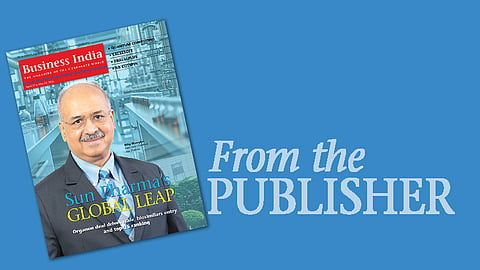
Dilip Shanghvi has every reason to feel happy. When asked his reaction to the successful $11.75 billion bid for Organon, a US-listed company, he said he felt “happy, excited and a little anxious,” which is just the reaction to be expected from the low-key Shanghvi.
Happy because it is a successful bid, at the right time and at the right price. Excited as Sun enters the global big league, with a world of opportunities globally that Organon opens up for Sun as the deal virtually doubles its turnover. And naturally a little anxious given the size of the deal, the borrowings it entails and the need to integrate Organon and derive the available synergies. But while this is the biggest acquisition by far, Shanghvi is no stranger to acquisitions; this is Sun’s seventh major acquisition, of a total of over 16. And even Sun’s earlier acquisition of Ranbaxy had almost doubled its size. While several of the biggest global pharma companies like Pfizer, Eli Lilly, J&J and GSK have grown to be the biggest over the years by acquisitions and mergers, few Indian pharma companies have grown by acquisitions. The M&A strategy is one big reason, but by no means the only reason, that Shanghvi became and has stayed the leader in Indian pharma.
There is little doubt that our pharma industry has come of age. Focusing on generics (and more than 90 per cent of all medicines are off-patent), our companies have become global leaders accounting for over 20 per cent of generics sold in advanced markets like the US and Europe. This has led many to boast about being the low-cost pharmacy to the world. But there are two major concerns.
It is true that India is the lowest-cost producer of generic medicines, complying with the highest quality standards. But unfortunately, our companies have, over the years, abandoned producing APIs, leaving themselves hopelessly dependent on China for the basic ingredients to produce formulations. The other concern is that Indian pharma companies (with two exceptions: Sun through its subsidiary SPARC, and Wockhardt) have just not entered the field of discovery of new molecules. Drug discovery is a capital-intensive, high-risk business, with the time taken to go to market running into years. And at each stage of the trials, there is more than just a chance that the new drug will fail to live up to expectations, leading to writing off all the expense and effort spread over several years.
There are many reasons why Indian companies have stuck to generics. And one of the main reasons is that, till recently, Indian pharma companies (like most Indian companies) were very small in terms of available capital. It is only in the last few years that some of our companies have had the financial heft to enter the field. The larger issue is that we don’t have an active university research system, which in turn has thrown up many, many companies around Cambridge and Oxford in the UK and Stanford and Harvard in the US
In 2011, Business India selected Dilip Shanghvi as the Businessman of the Year. At that time, we had written that earlier the choices reflected their past and present achievements, and there was a sense of mission accomplished. But now there was also the sense that the awardees would also rewrite future history.
We are now seeing a new chapter of history being rewritten.

- Home
- From the Publisher
- Editorials
- Cover Feature
- Special Report
- Focus
- MAGAZINE
- AUTOMOBILES
- AVIATION
- AGRICULTURE
- BRANDING
- BUSINESS NOTES
- COMPANY FEATURE
- CORPORATE REPORTS
- COVER FEATURE
- EDITORIALS
- F & B
- FEATURE
- FINTECH
- FOCUS
- GOVERNMENT
- HEALTHCARE
- HOSPITALITY
- INFOTECH
- INTERVIEWS
- MARKETING
- MARKET NEWS
- MILESTONES
- NICHE BUSINESS
- REAL ESTATE
- RETAILING
- SELECTIONS
- SPECIAL REPORTS
- START UPS
- STATES
- TOURISM
- TECHNOLOGY
- SPECIAL FEATURE
- GUEST COLUMNS
- R&D
- CONFERENCES
- COLUMN
- FINANCE
- CSR
- Corporate Reports
- CSRCSR
- CLIMATE CHANGECLIMATE CHANGE
- B-SCHOOLS
- DIGITAL MAGAZINE