
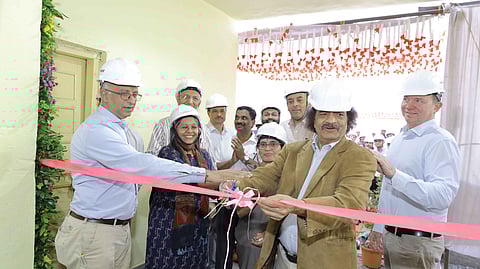
GBL's breakthrough in climate action
In a decisive stride towards combating climate change, Godavari Bio-refineries Limited (GBL), under the leadership of CMD Samir Somaiya, has announced the launch of a ground-breaking pilot project that transforms greenhouse gases into a sustainable, clean fuel. It will convert industrial carbon dioxide (CO2) emissions directly into dimethyl ether (DME) – a low-emission, eco-friendly energy carrier, which is a clean-burning fuel capable of effectively replacing conventional energy sources, such as liquefied petroleum gas (LPG) and diesel. It, therefore, contributes towards reduced emissions, improved environmental performance and decarbonisation. In addition to its role as a fuel, DME serves as a versatile chemical feedstock too, supporting a wide range of industrial applications and chemical synthesis processes.
GBL, a listed entity is the flagship company of the Somaiya group and a leading integrated bio-refinery specialising in bio-based chemicals, ethanol and sugar & power production. It is one of the largest producers of ethanol and a pioneer in manufacturing ethanol-based chemicals in India. The company operates facilities in Sakarwadi, Maharashtra, and Sameerwadi, Karnataka, as also three advanced R&D facilities in Mumbai and plant locations.
“Living sustainably and being one with nature is the only way forward,” emphasises Somaiya. “There is no alternative if we are to preserve our planet for future generations.”
Shaping the future Meanwhile, the company is partnering with the Institute of Chemical Technology (ICT), Mumbai, to develop this innovative process, which will address the urgent need to reduce greenhouse gases and create value from waste. Shaping the future by addressing the challenges India is facing – finding itself at the crux of three defining challenges: securing energy in a volatile geopolitical context, addressing the global imperative of climate change and ensuring rural prosperity by securing the income and dignity of its small farmers. “India’s strength lies in its soil, the sun and the small farmers,” adds Somaiya. “Our nation’s energy transition must use these inherent assets to secure and improve farmer incomes, boost energy security and combat climate change together”.
India has progressed swiftly in blending fuel and ethanol (from 4 per cent to 20 per cent in just eight years), which exemplifies the nation’s bold approach. “Recent offers in response to the tenders floated by the OMCs can further increase the ethanol blend to 30 per cent – which is equal to 17.75 billion litres, outstripping the current tender of 10.5 billion litres,” informs Somaiya. “This surplus availability has to be seen as an asset, as it is an opportunity to incentivise all forms of clean-energy vehicles – EVs, flex fuels, CBG and, in the future, DME. Our path is clear: there is no real alternative but to transition from fossil to renewable. The only way to live – one with nature, sustainably and make this planet a beautiful place to live in”.
This pioneering technology was introduced by G. D. Yadav, professor, ICT, Mumbai, and his research team. Yadav is recognised for his outstanding contributions to chemical engineering and sustainable processes, and he is supported by a team of experts dedicated to cutting-edge catalyst development and process optimisation.
On the industry side, the team at GBL has played a crucial role in steering this project towards practical, scalable implementation, ensuring alignment with industrial standards and commercial viability. “We already have a presence in global supply chains and, with increasing investments in technology and innovation, we can take the lead in offering sustainable solutions,” explains Sangeeta Srivastava, ED, GBL. “The focus on clean energy, environmental responsibility and circularity in India is driving the industry forward, making India an attractive player in the global biochemicals market”. GBL is one of India’s largest integrated bio-refineries, servicing clients across 20 countries.
Somaiya’s unwavering faith in ‘living in harmony with nature’ drives GBL’s commitment to sustainability, regenerative agriculture and circular economy principles, not to mention the contribution to India’s farmer economy. This partnership with ICT underscores a shared mission: innovation for society and the planet, not only limited to GBL and India but also for the world at large.