
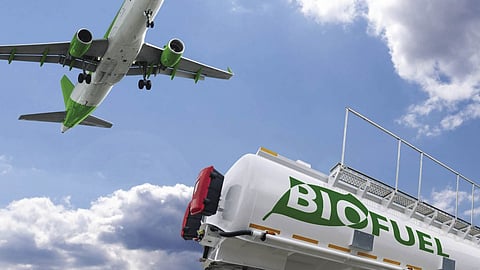
The International Civil Aviation Organization (ICAO) has set stringent goals to reduce aviation greenhouse gas (GHG) emissions. The long-term target is to reduce aviation net CO2 emissions to at least 50 per cent of 2005 levels by 2050. Sustainable aviation fuel (SAF) has been used in aircraft, including on regular commercial flights, since 2016, and airports are adding infrastructure to distribute SAF at an accelerated pace. Many European countries like France, Finland, Norway, Sweden, the Netherlands, etc, are already blending 0.5-1 per cent Bio-ATF in ATF.
In India, CSIR-IIP Dehradun has developed a Bio-ATF technology using non-edible vegetable oils as feedstock, including used Cooking Oil (UCO) at a pilot scale. CSIR-IIP Bio-ATF technology produces SAF with high aromatics (maximum 15 per cent of mass) and would not require additional blending of aromatic streams to meet the minimum 8 per cent aromatics criterion. CSIR-IIP SAF meets IS 17081:2019 specifications for HEFA-SPK.
SpiceJet had operated a test flight with 25 per cent Bio-ATF blended SAF in one engine provided by CSIR IIP. Indian Air Force (IAF) has also taken 65 hours of flying with 10 per cent blended SAF (using CSIR IIP product). The above test operations with SAF have been found satisfactory with encouraging results.
The ongoing war between the US, Israel, and Iran has led to a radical disruption in the global oil and energy ecosystem, severely impacting demand-supply efficiencies and placing aviation turbine fuel (ATF) under acute stress. For an industry where fuel constitutes a dominant share of operating costs, such volatility is not merely cyclical – it is existential. Airlines are already recalibrating fares, revisiting routes, and hedging aggressively against supply shocks.

For India’s aviation sector – among the fastest growing globally – the implications are particularly stark. With fleet expansion plans accelerating and passenger traffic expected to surge sharply over the next decade, the sector’s dependence on fossil-based ATF is deepening at precisely the moment global supply chains are turning fragile. The vulnerability is structural: aviation remains almost entirely reliant on a single, geopolitically sensitive energy source.
It is in this context that SAF is no longer a distant climate ambition – it is emerging as a strategic necessity. “Sustainable aviation fuel must be viewed not merely as a decarbonisation tool but as a hedge against fuel price volatility and geopolitical disruptions,” says S.K. Jain, CEO & chairman, Saga Global Consultants. “The current crisis only reinforces how exposed the aviation sector remains to conventional fuel supply chains.”
Advantage of SAF
Globally, SAF is increasingly being positioned as the most viable near-term alternative to conventional jet fuel. Its key advantage lies in its ‘drop-in’ capability – meaning it can be used in existing aircraft engines and fuelling infrastructure without requiring costly technological overhauls. This makes SAF uniquely suited for immediate adoption, unlike hydrogen or electric propulsion, which remain in developmental stages.
Equally compelling is its environmental profile. SAF can reduce lifecycle greenhouse gas emissions by up to 80 per cent, depending on feedstock and production pathways. But beyond emissions, its strategic value lies in diversification. Derived from a wide array of sources – including used cooking oil, agricultural residues, municipal waste and even captured carbon – SAF offers the possibility of decentralised, locally anchored production ecosystems.
For a country like India, heavily dependent on crude imports, this presents a significant opportunity. “India has a natural advantage in feedstock availability – from surplus biomass to used cooking oil – and this positions it uniquely to emerge as a global SAF production hub,” notes Jain. “However, the success of this transition will depend on building a resilient and sustainable supply chain, which remains one of the most critical challenges.”
Indeed, feedstock logistics remain a key bottleneck. Biomass availability is often fragmented and geographically dispersed, making aggregation and transport complex. Without a robust supply chain architecture, scaling SAF production to commercially viable levels will remain elusive.
Encouragingly, early groundwork has begun. India has already demonstrated technical feasibility through pilot projects, including successful test flights using blended bio-ATF developed domestically. Regulatory standards are also evolving, with specifications aligned to global benchmarks enabling the blending of SAF with conventional ATF.
Yet, the transition from pilot to scale is fraught with economic constraints. The most immediate challenge is cost. SAF remains significantly more expensive than conventional jet fuel today, largely due to high feedstock and processing costs, as well as limited production scale. For airlines operating on thin margins, absorbing this premium without policy support is untenable.
“Unless supported by targeted policy interventions – such as viability gap funding, tax incentives, and long-term regulatory clarity – SAF will struggle to achieve commercial scale,” Jain cautions. “The economics at present are simply not viable for widespread adoption.”
This places the onus squarely on policymakers. Globally, governments are accelerating SAF adoption through blending mandates, subsidies and carbon pricing frameworks. India, while making initial moves, is yet to articulate a comprehensive SAF roadmap that aligns stakeholders across the value chain – from oil marketing companies and refiners to airlines and investors.
The urgency, however, is unmistakable. India’s aviation market is projected to handle hundreds of millions of passengers annually in the coming decades, alongside a sharp rise in cargo traffic and fleet size. If this growth is powered solely by fossil fuels, it will not only intensify carbon emissions but also deepen exposure to precisely the kind of geopolitical shocks currently unfolding.
Historically, energy transitions have often been catalysed by crises. The oil shocks of the past reshaped global energy strategies; the current disruption could play a similar role for aviation. The shift to SAF is therefore no longer optional. It represents a convergence of environmental responsibility, economic prudence, and strategic resilience.
In an increasingly uncertain geopolitical landscape, the future of aviation will depend not just on how efficiently it flies – but on how sustainably it fuels that flight. SAF is no longer the fuel of tomorrow; it is, unequivocally, the need of the hour.