
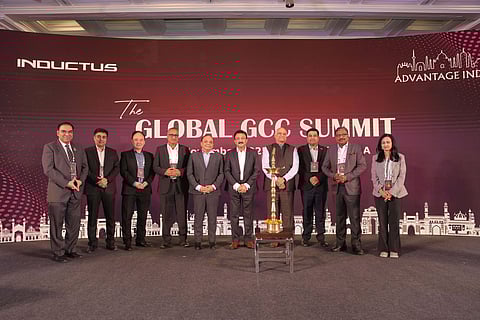
Those who are in the habit of keeping a regular tab on new developments in the economy and business spheres in the country would not have missed this point. In recent months, the buzz about Global Capability Centres (GCCs) has shown clear ascendent trends. “After ‘Make in India’, if there is anything that has been talked about so much in the last 10 years, it is GCCs,” a senior IT sector leader recently commented – a remark which seems to be bang on target. And much of this buzz is based on concrete developments such as the commencement of new units rather than just lofty projections.
Even outside the IT and digital world, the perception is gaining ground that GCCs are not merely extensions or advanced versions of BPOs (business process outsourcing) or KPOs (knowledge process outsourcing), which grew exceptionally towards the end of the last century and made meaningful contributions to India’s services-sector boom post-liberalisation. GCCs are rather something else. Conceptually, in this new era of the digital economy – more demanding and challenging in many ways – GCCs are quintessentially seen as research and innovation hubs served by a well-qualified talent pool delivering advanced solutions to the world. They are driven by leading global corporations who have begun relying on these centres to sustain their competitive edge in global markets.
India takes the lead
The good news is that among global GCC markets, India seems to have taken a decisive leadership position. Speaking at a summit in Andhra Pradesh this September, Finance Minister Nirmala Sitharaman maintained that nearly 50 per cent of all Fortune 500 companies have set up their GCC units in India. Referring to data indicating that India’s share in the global GCC business (in terms of the number of units) has reached a dominant position, Sitharaman promised full support to the sector and stakeholders to attract more global business giants.
Industry insiders will tell you that the grand scene now playing out on the GCC front actually began in the 1980s when Texas Instruments opened (in Bangalore) the preliminary version of the GCC model, which now seems to be growing by leaps and bounds in the post-Covid digital age. “In volume terms, the total number of GCC units across the world would be in the 3,000-plus trajectory. India has nearly 1,800 of them. It has become one of the most important markets,” says Alouk Kumar, Founder and CEO of research and consultancy firm Inductus (specialising in GCC enablement), which recently hosted the first GCC Global Summit in the national capital. “GCCs across the world are taking well-structured shape wherein large-scale hubs are emerging in specific pockets. In our part of the planet, it is India and the Philippines. In Europe, it is Poland, and in South America, Mexico is becoming the major hub. But on an overall global basis, it is India which has taken a pole position,” adds Pallavi Jayaswal, VP – Industry Engagements & Services, SSF Group.
And here are some recent projections which underline a grand take-off for GCCs in India after the creation of what seems to be a solid base. ‘India’s Global Capability Centres (GCCs) are emerging as strategic hubs reshaping the Indian corporate landscape while influencing global business dynamics. The number of GCCs in India has grown from approximately 1,430 in FY19 to over 1,700 in FY24. As of FY24, GCCs in India employ nearly 1.9 million professionals, the Economic Survey tabled early this year underlined. In the previous edition, it had estimated GCCs’ contribution to GDP to cross 3 per cent by 2030.
Inductus’ latest research-based projections indicate a scenario for the next 15 years. By 2030, it projects the number of GCC units rising to 3,500 and then touching 9,000 by the end of 2040. According to this research, the segment will lead to a major surge in employment creation – 3.5 million in the next 5 years and 8 million by 2040. Furthermore, the sector’s total share in GDP is projected to reach 7.1 per cent by the end of the next decade. With India maintaining a modest growth trajectory, the national economy is expected to more than double (from the current base of nearly $4.5 trillion) by 2040.
Micro trends
Experts cite three critical reasons for the surge witnessed in the GCC business: India’s IT talent strength remains at the fulcrum; the cost of operations in India is 50-60 per cent lower than in any developed country; and R&D-led innovation is growing rapidly in global growth pockets. “Talent is available in this country. And capability is the new curve wherein businesses will be led by companies that believe in developing rather than merely adopting,” commented Dr Kishore Jayaraman, President, Rolls-Royce India and South Asia.
The fast-growing GCC business in India has developed distinctive traits. Nurturing new digital capabilities built on Artificial Intelligence (AI) and Machine Learning (ML) is clearly the main pursuit of these centres. In terms of physical presence, while Bengaluru, Mumbai, Hyderabad, Pune, Delhi/NCR and also Ahmedabad (GIFT City) remain the leading locations for such units, the segment is swiftly expanding its wings. In a recent presentation, Ashish Aggarwal, VP & Head of Public Policy, NASSCOM, highlighted the changes underway. “India’s GCC story is no longer about one city. Many GCCs that started in one city are now expanding to other locations with a different role. India’s multi-city grade is taking shape,” he pointed out. For instance, companies like Medtronic (Hyderabad) and Boeing (Bangalore) have a single-location presence. But Goldman Sachs and Walmart have developed twin hubs for their GCC operations in India. Mercedes is now adding Pune to its Bengaluru GCC hub. JP Morgan, American Express and BlackRock are at the forefront of expanding beyond two cities.

There are indications that, as India further strengthens its positioning in the GCC business (many analysts are already calling it the GCC capital of the world), the story is likely to extend beyond leading metro hubs. “More GCCs will be coming in the next 5 years and they will become smaller. Organisations will ultimately need to become AI-fluent,” said Achuyta Ghosh, HFS Global (GCC Strategy). Inductus’ latest industry research also points to possible compositional changes in the coming years. For instance, the current ratio of large to mid-market GCCs in the country is estimated at 40:60. This equation is projected to shift to 30:70 by 2030 and 20:80 in 15 years. In the process, the average workforce per unit will come down from 1,050 to around 900 in the medium term. Centres will become smaller but more specialised: a trend many analysts foresee.
Another major trend pertains to the strong push the segment has begun receiving from several states. A select group of them see a big-ticket opportunity in this business and have entered a competitive mode via dedicated policy interventions – similar to what has been seen in the EV sector. Karnataka (the first state to adopt a specific policy), Maharashtra, Gujarat, Telangana and Andhra Pradesh are considered frontrunners, with more expected to join soon. Andhra Pradesh (which recently bagged a massive Google data centre project worth a staggering $10 billion) is reportedly determined to make a major mark in the GCC segment too and has constituted an advisory council to pave the way for significant moves.
Current scene
The opening of new centres has become a regular feature, signalling a major growth phase in the making. Some of the recent openings include those of Vanguard (global investment firm), Sonoco Products, Carlsberg Group, Rolls-Royce, and McDonald’s. And it is not only American or European firms arriving in India in large numbers to set up or expand their GCC base: conglomerates from the Middle East have also begun taking the same route. On 20 November, DAMAC Group, a leading UAE-based conglomerate with an extensive international footprint, made its debut in the segment by opening a centre in Delhi/NCR (to be followed by another unit soon). The centres will play a critical role in core business functions, including finance, operations, sales, marketing, HR, projects, commercial, digital and others. They will serve as innovation-driven hubs designed to accelerate efficiency, digital adoption and customer-centricity within DAMAC’s international operational landscape. “We are here for the long haul and our intent is clear: India will be our global GCC hub,” MP John, Chief Human Capital Officer at DAMAC, told Business India. Known as a global real estate powerhouse with a diversified portfolio, DAMAC has in recent times made some aggressive investment moves in the data-centre business.
The expanding wings of the GCC business have also made it a leading contributor to the recent surge in the commercial real estate segment in major cities. A sectoral note issued by rating agency ICRA in October projects GCCs to ‘incrementally lease 50–55 million square feet (msf) of Grade A office space during FY26-27, potentially contributing 38-40 per cent to the top six markets’ (Bengaluru, Chennai, Delhi National Capital Region (NCR), Hyderabad, Mumbai Metropolitan Region (MMR), and Pune) overall office demand’. The note underlines, in no uncertain terms, that the rapid expansion of GCCs has emerged as one of the key growth drivers for India’s commercial office real estate sector in recent years. And the incremental demand for leased space by global enterprises shows their strong long-term commitment.
While India’s rapidly expanding GCC business benefits from the presence of a deep talent pool, there is also a perception in industry circles that major conglomerates have limited alternatives. “They can’t do it in China for obvious reasons. Plus, the success they tasted with BPOs and KPOs in the past has convinced them that they can put most of their eggs in the Indian basket for GCC operations,” an analyst points out.
While this remains the early stage of the growth trajectory, industry stakeholders are identifying certain measures that will be needed to streamline the business as it gains scale. A consistent supply of talented manpower aligned with digital value systems (“techno-functional executives”, as another analyst describes them) will be imperative. According to Prof Mahadeo Jaiswal, Director, IIM Sambalpur, the emerging scenario will require an upgraded architecture for GCCs that focuses on redefining skills, curriculum and collaboration models between industry and academia in building the future workforce. There are also stakeholders calling for a more proactive advisory role from the Centre. “Currently this segment is primarily driven by state policies. It would be more effective if a central agency played an advisory role, especially for new players,” says Alouk Kumar. He also notes that the central government should look into prevailing ambiguities concerning double taxation for companies (over 50 per cent of those present in India with GCC units are from the US) amidst India’s GCC growth story. But these points remain minor suggestions rather than serious complaints at this stage.