
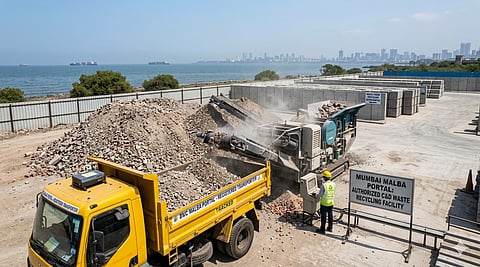
The business of rubble
Mumbai is set to become the second major Indian city after Delhi to deploy a dedicated digital platform for monitoring construction & demolition (C&D) waste, as the Brihanmumbai Municipal Corporation (BMC) prepares to launch the beta version of its malba (debris) portal this week, ahead of a public rollout scheduled from 1 July. The initiative comes at a time when India’s financial capital is witnessing one of the most intensive redevelopment cycles in its history.
From ageing housing societies and slum rehabilitation schemes to metro rail corridors, transport infrastructure projects and large-scale urban renewal programmes, Mumbai’s landscape is being transformed at an unprecedented pace. But every structure demolished to make way for a new one generates a less visible challenge: what happens to the rubble left behind?
The answer is increasingly becoming a matter of policy, compliance and business opportunity. Moreover, environmental sustainability and pollution and health hazards caused by particulate matter floating around in the air breathed have become an urgent societal plague that needs to be addressed sooner rather than later.
The Malba portal seeks to bring transparency and accountability to a segment of urban waste management that has historically remained fragmented and poorly monitored. Designed to connect waste generators, transporters, recycling facilities and regulators through a single digital interface, the system will enable civic authorities to track construction debris from the point of generation to authorised recycling centres.
Yet, the portal itself is only a small part of a much larger story unfolding across urban India. The management of construction debris is rapidly emerging as a significant challenge for cities undergoing large-scale redevelopment. While urban authorities have traditionally focused on creating new infrastructure and housing stock, increasing attention is now being directed towards managing the waste generated in the process. What was once viewed merely as demolition waste is increasingly being recognised as a resource capable of being recycled into aggregates, paver blocks, road-building material and other construction inputs.

The shift is being driven by a combination of environmental concerns, evolving regulations and the growing recognition that India’s urban future will require a circular approach to resource utilisation. “Every city faces a different manifestation of the same problem,” says Sridhar Pandya, CEO of the agency that has secured the mandate to develop the Malba platforms. “In Delhi, the focus is on reducing dust and air pollution. In Bengaluru, authorities are concerned about dumping in lakes. In Mumbai, the emphasis is on preventing debris from finding its way into mangroves and creeks. The technology framework is similar, but the environmental priorities differ from city to city.”
Dumping debris
For decades, construction debris has often found its way into vacant plots, roadside stretches, water bodies and ecologically sensitive zones. The consequences vary sharply across cities. In Delhi, construction waste has long been associated with dust pollution and deteriorating air quality. Bengaluru has struggled with illegal dumping around lakes and water bodies. Mumbai faces a challenge of its own, with environmental groups and civic authorities repeatedly highlighting the dumping of debris into creeks, coastal stretches and mangrove ecosystems.
For the real estate sector, the shift is part of a broader sustainability agenda. “The basic point is simple,” says Niranjan Hiranandani, chairman, NAREDCO. “We have to work towards sustainability in all aspects of development. You cannot isolate one aspect and ignore the others – whether it is water, air, building materials or waste. This is one important area where we have to improve if India’s growth story is to remain sustainable.”
Delhi’s malba portal, operational since March this year, is increasingly being viewed as a proof of concept for technology-enabled debris management. Mumbai is expected to become the next major deployment, while Hyderabad and Bengaluru are also under active progress. Together, these initiatives could lay the foundation for a broader national framework governing the monitoring and recycling of construction and demolition waste.
The operating model is straightforward. Waste generated at a construction or demolition site is digitally recorded. Transportation is monitored. Delivery to authorised recycling facilities is verified. Regulators gain visibility over the movement of debris, while developers receive documented proof of compliance.
For municipal authorities, the attraction lies in enforcement. For developers, it offers a structured compliance mechanism. For recyclers, it promises a more organised and predictable supply chain. “The challenge is not merely disposing of debris but creating an ecosystem that connects waste generators, recyclers and regulators through a single platform,” explains Pandya. “The objective is to ensure that every tonne of construction waste generated can be tracked, monitored and channelled towards authorised recycling facilities.”
Also, the economic implications could prove substantial. India is entering a decade of unprecedented urban transformation. Redevelopment projects, industrial corridors, metro rail systems, affordable housing initiatives, smart-city programmes and transport infrastructure investments will collectively generate millions of tonnes of construction waste. Managing that waste is rapidly emerging as an industry in its own right.
A new ecosystem is beginning to take shape around debris collection, transportation, processing, recycling and compliance management. Technology providers are building monitoring platforms. Recycling companies are expanding capacities. Developers are increasingly being encouraged to integrate sustainable waste-management practices into project planning. Municipal bodies, meanwhile, are searching for mechanisms that combine environmental protection with operational efficiency.
Industry participants believe that progressively higher recycling requirements and growing environmental scrutiny will accelerate investment in this segment over the coming years. The current roadmap envisages scaling recycled debris utilisation from low single digits to nearly 50 per cent by 2030.
Green construction
Hiranandani believes such targets, while ambitious, are necessary. “When we spoke of green buildings years ago, people laughed,” he says. “Today, green construction has become mainstream. The same thing will happen here. The question is not whether we will achieve the exact number by 2030 or a year later. The point is that unless you set targets, you don’t move in that direction.”
The challenge, however, lies in infrastructure. India lacks sufficient recycling capacity today to process the entire volume of construction and demolition waste generated by its expanding cities. Bridging that gap will require investment, policy support and wider participation from both government and private players.
“The government is an equal stakeholder in this challenge,” Hiranandani notes. “Road works, coastal roads, expressways and infrastructure projects all generate debris. Sustainability is not just a private-sector obligation. It has to be an ecosystem-wide commitment.”
The coming years are therefore likely to witness the emergence of a more organised market for recycled construction materials, supported by improved logistics networks, recycling facilities and technology-enabled monitoring systems.
The significance of Mumbai’s forthcoming portal extends well beyond municipal administration. Along with Delhi’s experience and similar initiatives under development elsewhere, it signals the beginning of a more structured approach to construction waste management across urban India.
“What is emerging is an entirely new value chain around construction and demolition waste,” says Pandya. “India’s cities are redeveloping at an unprecedented pace and the infrastructure required to collect, transport, recycle and reuse construction debris will have to grow alongside that redevelopment.”
That opportunity is already beginning to attract attention from some of the country’s largest redevelopment projects. Industry sources indicate that stakeholders associated with the Dharavi Redevelopment Project – widely regarded as India’s largest and Asia’s most ambitious urban regeneration initiative – have initiated exploratory discussions with Pandya’s agency on the possibility of establishing a dedicated debris recycling and crushing facility in Mumbai. Should those discussions progress, the project could emerge as one of the most visible demonstrations of the circular-economy model that policymakers increasingly envision for India’s cities.
For decades, rubble was regarded as an unavoidable by-product of development. Today, policymakers, developers and recyclers are beginning to view it differently. The next chapter of India’s urban growth story may well be written not only in concrete and steel, but also in how effectively yesterday’s debris is transformed into tomorrow’s infrastructure.