
Pink birds’ red signal
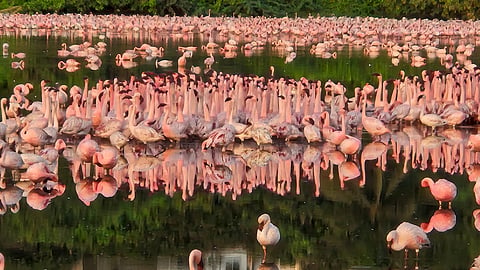
Every winter through summer, flamingos transform the Mumbai Metropolitan Region’s industrial edges into a spectacular sweep of pink. From Sewri and Thane Creek to the wetlands of Uran and Navi Mumbai, the migratory birds have long been symbolising a rare ecological miracle, unfolding by the side of one of the world’s densest urban sprawls.
But this year, environmentalists say the flamingos have arrived late, in visibly reduced numbers, amid growing signs that the fragile tidal ecosystem sustaining them is under mounting stress. For many conservationists, the concern goes far beyond the birds themselves.
“Flamingos are ambassadors of healthy wetlands,” says B.N. Kumar, director, NatConnect Foundation. “When flamingo movement changes, it is often the first visible warning that the wetland metabolism itself is under stress.” And that warning has now triggered an ambitious climate proposal that could fundamentally redefine how India views urban wetlands.
Ahead of World Environment Day, NatConnect Foundation has submitted a 10-page policy white paper to the prime minister, proposing a globally pioneering ‘Flamingo Blue Carbon Urban Complex’ across MMR – a metropolitan ecological framework linking wetlands, mangroves, mudflats, carbon sequestration, eco-tourism, biodiversity finance and climate resilience into a single economic and environmental strategy.
In an unusually swift response, the Union ministry of environment, forest & climate change (MoEFCC) has acknowledged the proposal within 24 hours and directed the Maharashtra State Wetland Authority to examine it on a ‘priority basis’. The proposal comes at a critical moment for Mumbai’s ecology. Environmental groups across MMR say many wetlands are steadily weakening under the combined pressures of reclamation, concretisation, sewage inflows, infrastructure expansion and piecemeal urbanisation.
‘Blue carbon’ systems
Globally known as ‘blue carbon’ systems, mangroves and tidal wetlands absorb and store vast quantities of atmospheric carbon, while simultaneously buffering floods, reducing heat stress and protecting biodiversity. According to the NatConnect paper, mangroves can store three to five times more carbon per hectare than tropical forests.

Instead of treating wetlands as ‘vacant land’ awaiting monetisation, the proposal argues that they should be viewed as ‘living climate infrastructure’ capable of generating recurring economic value through blue-carbon credits, biodiversity-linked finance, eco-tourism and avoided flood-damage costs. That argument directly challenges the development model dominating large parts of MMR’s coastal belt.
The white paper specifically flags CIDCO’s proposed monetisation of the 12-hectare DPS Flamingo Lake parcel. despite the site being granted Conservation Reserve status by the State Wildlife Board. Environmentalists say such moves reflect a dangerously short-term approach to urban economics.
“These ecosystems are not wastelands,” says Kumar, in the paper submitted to the prime minister. “They are living climate systems that store carbon, buffer floods, reduce heat stress and support biodiversity.”
Nandakumar Pawar of Sagar Shakti warns that wetland destruction is simultaneously increasing Mumbai’s flood vulnerability. Reclamation and disruption of natural tidal drainage systems, he says, destroy the region’s flood-buffer capacity and sharply raise the economic costs of extreme rainfall events.
Climate scientists are increasingly cautioning that future El Niño-linked weather disruptions. The NatConnect paper draws parallels with the devastating July 2005 floods, arguing that fragmented wetlands and blocked tidal systems substantially magnify disaster risks and long-term public expenditure.
Flamingos are ‘not just adding pink to the landscape’ but helping keep entire wetland ecosystems alive, says Jyoti Nadkarni, director, Swarnsrishti Habitat Restorer Foundation. The proposal also seeks to reposition MMR globally as a model for climate-resilient urban development. It envisions an integrated ecological corridor stretching across Thane Creek, Sewri mudflats, Uran wetlands, Panvel Creek, mangrove belts and estuarine systems – functioning not as isolated land parcels but as one interconnected tidal ecosystem.
Mumbai’s long-term economic security lies not in endless concrete expansion but in preserving the ecosystems protecting the city from climate shocks, argues Shrikant Patki, convenor, Palm Beach Greens.