
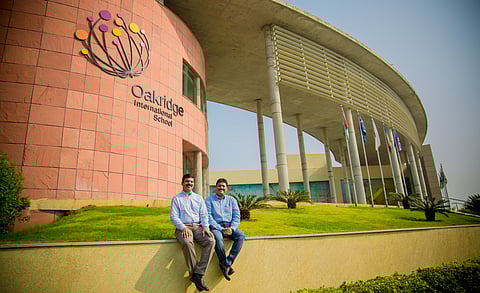
Education with a difference
One is reminded of tales that come straight out of a storybook – this tale is of two illustrious young men, today in their 50s, childhood friends turned edupreneur-partners with shared interests: education with a difference. Their entrepreneurship, which began in 1993, was built on mutual trust, complementary strengths, and shared values. They still believe that technology is the most significant enabler of education, come what may. They have achieved so many firsts on their journey that they have remained successful serial edupreneurs.
Business India met up with the duo, Naga Tummala, Co-founder & CEO of Coschool, and Co-founder & Chairman of ARISE – an initiative driving transformative reforms and policies in India that impact the K-12 education sector. Naga also serves as National President of CEO Clubs India, a platform dedicated to creating value and impact for Indian corporate leaders. Additionally, he authored Shomie Das: The Man Who Saw Tomorrow, honouring one of the most outstanding educationists – his mentor – and his visionary contributions to education.
His co-founder is Raj Yarlagadda, the leading strategist and an expert in sales and marketing across all the businesses they have built together. They are also the proud founders of 7 Midway Plaza (an iconic food destination on the Hyderabad-Vijayawada Highway, NH-65), the Feast House, and Honey Harvest.
Speaking to Naga and Raj at their beautiful new premises – the ‘People Combine’ office in Hyderabad, their very first headquarters (started 33 years ago) – they candidly admit that in all these years of hard work, they never once thought of themselves; it was always about work and delivery. There was never any money, even for the basics, because they were always in growth mode. Proof of the pudding lay in the fact that they shared one car (a second-hand Maruti 800) for many years. The very ownership of the car was only to put them in a good light while Naga sat in the office doing the convincing for admissions, and Raj was out there selling.
Today, the variety of cars in their garage is enviable. Both agree that the first thing they enjoyed with the money they made was the entire housing complex they live in now, including their headquarters – all built around their work lives and home lives. Even in their homes, the architects were clearly given a mandate: the feel had to be rainforest-like, comprising water bodies, streams and plants. The landscape was the only luxury that both insisted on.
Humble Beginnings
Both came from rural backgrounds where existence revolved mainly around the earth and its produce. But the seeds of education were well planted, since Naga’s father ran a small school in Nuzvid (Andhra Pradesh). It was an eventful childhood, but uninspiring teachers left them with a forgettable experience. In their twenties, Naga did try for the Civil Services, but was unsuccessful because he was simply not cut out for a government job. Raj, in the meantime, after completing his engineering, started a floriculture and poultry business.
A friendship that endured time – with ambitions intact – took them to the next level, where continuous intense conversations led them to move to Visakhapatnam, a burgeoning town. They were small-town lads with big-boy dreams. Today’s youth in a similar scenario may be more educated but also less confident. They both felt they could win the world. But hard choices also meant mounting debts.

They succeeded in borrowing Rs3.5 lakh from friends and family, treating the advances as mere loans to be repaid with interest. Even at such a young age, they were clear that they should not dilute their stakes in the business. With the support of friends and family, and a bit of acumen, they mustered the courage to start Vikas, a residential junior college, which went on to become one of the top institutes of its time.
How did they know that proper positioning would do the trick? Naga remarked: “We studied the market to perfection, going into the absolute DNA of residential junior colleges, understanding what made them the best, and then opened right next to them. Yes, it was a risk we took, but we knew people would not compare us to the mediocre, but to the best.”
Instead of students receiving coaching only in the final leg before competitive exams, Vikas offered coaching throughout the 2 years, giving students the time and energy to do it on their own; creating a space where this kind of integrated coaching later became mainstream. This philosophy helped them become the first to offer such an approach in the country. They slowly expanded into nearby areas until 2000.
An income-tax raid on their business in July 1994 caught them entirely by surprise, as they had not even filed their first returns. Unaware of income-tax dos and don’ts, simple-minded lads who did not even have chairs to sit on, let alone homes (both were still living in hostels, so to speak), faced the most gruelling day of their lives. Looking for the cash, the officers had come to collect, they finally found Rs2 in Raj’s pocket and Rs5 in Naga’s.
Yet, the raid experience had a positive impact on them. They promised themselves that they would always adopt proper business practices and would never entertain tax-exemption schemes. They realised they would rather pay tax on their hard-earned money. This attitude became a core strength for everything that followed.
Since Naga was more academically inclined, he frequently asked teachers about students’ progress and realised that most students scored perfectly in one subject or another, but never 100 per cent across all. Soon, that persistence led a Vikas student to actually top the medical entrance examination in 2000 – for the first time in history. That was an honour in itself.
Now, both Naga and Raj understood that, at a business level, they were dependent on marks and ranks. They also began to observe questionable practices in the space – ‘all-in’ and ‘deep pockets’ games. They realised that bigger players would eventually dominate and smaller institutions would be pushed out. The reality was stark: how many meritorious students could they offer free coaching to, or pay higher salaries to capable teachers? Bigger players often used money as a competitive weapon.
As time once again stalled and unrest set in, they began to find Visakhapatnam restrictive to their growth, prompting another move: this time to Hyderabad. They also understood that the education systems they had grown up with were far too ordinary and needed significant change. They abhorred rote-learning processes. Armed with new ideas, they decided to travel across the country as part of exploratory school visits.
The fact that they had already spent 7 years (1993-2000) exclusively in the same field did not deter their resolve; instead, it prepared them to undertake a challenge of a different scale. At the dawn of the new millennium, they thought of actually building a school – unheard of by most at the time. They knew the goal would be gargantuan, but they dreamed of changing the landscape of education in India.
Point to note here: they were at the absolute peak with Vikas when they came up with the idea of starting a school. The edupreneurs never let success stop them from moving on; they were always ignited to do more. In this case, it was the dream of creating their own school with the kind of education they believed in. Did they even know the difference between CBSE and the International Baccalaureate? Of course not. They were armed only with a dream and the knowledge that they needed a mentor.
They went ahead despite knowing that the masses were not ready to embrace this change. They set out in pursuit of a revolutionary mind who would help them live out their dreams, knowing it was the right thing to do at the right time. After checking out many schools across the country and making four stops in Dehra Doon, they understood that even though Doon was a veritable spectacle and had produced the intellectual crème de la crème, it still left them with only a memory. They still needed something more.
Their Mentorship
In Doon, they heard that a former headmaster, Shomie Das, still lived in the vicinity. They soon learnt that Das was someone to be revered, as his grandfather, Satish Ranjan Das, was the founder of The Doon School. Educated at Cambridge, he had also taught King Charles III at Gordonstoun School in Scotland. Apart from his superlative background, he proved to be a true intellectual who articulated the failings of the Indian education system and, in turn, positively identified areas for scholastic reform. This seasoned academician could see tomorrow.
They told Das that they earnestly wished to engage his services as their advisor because he possessed the knowledge and experience they clearly lacked. But Das initially dismissed the thought lightly. He was trying to assess whether their coaching mindset would fit with his educational insights. The duo did not raise any commercial terms, as they clearly did not have the money even in 1993, let alone now. Their aspirations had always been bigger than their pockets.
What struck him about the two was their resilience and doggedness. Eventually, he came around. Connecting with him and bringing him on board to share their vision changed their lives exponentially. Das insisted that they move away from their ‘teaching shop’ attitudes and adopt a more holistic approach to education. This aligned well with the IB framework, which was enquiry-based. It was neither British nor American, but offered a globalised learning experience and helped develop well-rounded, critical thinkers.
“The reason I can speak about what children miss in their education is that I was that child growing up – without any teacher to inspire me. I was that backbencher, struggling. That’s why I am here: to help children and actually solve their problems,” Naga added in agreement.
Das insisted on a more student-centric system, where a child’s success should not depend on scoring 100 out of 100, and where the teacher is a facilitator rather than the end-all. In Das’s world, the search for good teachers followed a very different philosophy: he looked for people who loved children and their subject, enabling them to adapt to different situations. This was rare. He also encouraged the system to send teachers abroad to understand the International Baccalaureate framework.
He suggested that the duo start the country’s first IB school. Since they were a clean slate – a tabula rasa – with no preconceived ideologies, they readily agreed. This was how Oakridge International School in Hyderabad (in present-day Telangana) was born. Das gave shape to their dream. He became their inspiration and the guiding force behind a system that imparted not only education, but a unique experience.
The Oakridge journey
Naga and Raj returned to a familiar approach, this time taking on shareholders and pitching their bold idea to different people. Oakridge eventually had 65 shareholders, raising about Rs3.5 crore (with some contribution from their own funds as well). The project ultimately cost them over Rs80 crore. Undeterred in their decisions and backed by a mentor, they were ready.
They announced the launch of Oakridge International, purchased 5.5 acres of land, and aligned the project with the government’s master plan. However, they soon ran out of money and were fortunate to receive support from vendors to continue construction. Securing 200 admissions in the very first year, they rented portions of the required buildings. Determined to succeed, they once again set up next to the city’s best institutions, staying true to their strategy.
Banks were eventually approached, though they faced resistance due to the scale of their numbers. Finally, four banks came together to form a consortium and extended Rs10 crore in funding. In 2002, when then Chief Minister Chandrababu Naidu inaugurated the school, he was visibly impressed. At a time when even government offices were not fully internet-connected, Oakridge stood out. The timing, fortuitously, was after the dotcom bust, and the duo was chasing education, not technology.
Naga and Raj then developed an Indian model of the IB school aligned with local fee structures. At the time, annual fees at IB schools across India typically ranged from Rs 2-3 lakh per annum (2001-02). They capped fees at under Rs50,000, with variations depending on campus, grade, and curriculum (IB/CBSE). Even today, after Oakridge International has changed hands, it continues to feature among the top IB schools in Hyderabad and Bengaluru.
In the 1970s, Kodaikanal School was the first in India to offer IB education. In 2000, only eight schools across India followed the IB curriculum – Oakridge International was one of them. By 2011-12, the number had grown to 100, and today it stands at 245.
Why they made news
The Indian K-12 education sector was increasingly seen as large and fast-growing, attracting substantial foreign investment. By February 2019, North Anglia Education (NAE), a premium global school operator backed by the Canada Pension Plan Investment Board (CPPIB), acquired the Oakridge group of international schools for a significant sum: around Rs 1,200 crore.
This landmark deal, the first of its kind in India, represented the most significant foreign direct investment in the education sector. The agreement involved Nord Anglia purchasing People Combine Education’s five Oakridge K-12 schools in Hyderabad, Bengaluru, Mohali, and Visakhapatnam. It marked Nord Anglia’s first foray into the Indian market – a strategic move by a global education giant entering a promising landscape.
Even after the sale, Naga and Raj were not ready to step back. For them, education remains an unfinished mission. Today, Naga is widely recognised as a visionary shaping how AI can strengthen schools by empowering teachers rather than replacing them. A consistent challenger of entrenched schooling models, his move into AI-led education is structural, not incremental. Together with Raj, he co-founded Coschool, where he serves as CEO, with a clear purpose: closing learning gaps while learning is still in progress.
What does Coschool stand for?
Coschool stands for learning that functions as a system rather than in fragments. Its flagship platform, SchoolAi, is built as a closed-loop learning system connecting teachers, students, parents, and school leadership into a continuous cycle. At its core is Vin, India’s first school-integrated AI tutor.
Aligned with each school’s curriculum and teacher intent, Vin supports learning 24/7, enabling deeper understanding. Teachers gain real-time visibility into learning progress, parents are meaningfully involved, and students build confidence through genuine comprehension. Schools using SchoolAi have reported improved class averages and earlier identification of learning gaps.
When asked about pricing strategies and commercial models, Raj, the business mind behind operations, said: “Our prices were always 5-10 per cent higher than the best, whether it was Vikas, Oakridge, or now Coschool. We wanted excellence at any cost, and therefore had to deliver it.”
Recognition
Coschool was recognised as a LinkedIn Top Startup in 2025 and 2024, and is the only AI education startup to feature on the list.
The People Combine Group was ranked among the 15 best companies to work for in India, across all sectors, in 2019 by Great Place to Work and The Economic Times. It was also ranked 17th in Asia in the category of companies with more than 1,000 employees that year. People Combine was listed among the top 10 best companies for working women in India across all sectors in 2016 and 2017 by Avtar and the Working Mother Group. The Times of India recognised them as ‘Game Changers’ of Andhra Pradesh (2009). India Today acknowledged Naga and Raj as ‘Business Wizards’ of Andhra Pradesh (2010).
As socially conscious individuals, Naga and Raj have pledged to donate one-third of their net worth to philanthropy.