
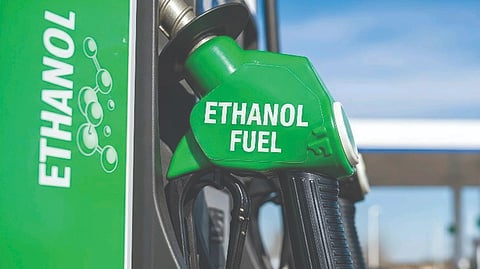
India’s energy transition is entering a decisive phase. As the country balances sustained economic growth with the need to reduce import dependence, the transport sector remains central to this transformation. Liquid fuels will continue to play a critical role in enabling mobility, even as the broader energy mix evolves.
Over the past decade, ethanol has emerged as one of the key pillars in India’s energy transition. What began as a policy intervention to address surplus sugar production and reduce dependence on crude oil imports has evolved into a nationally integrated ecosystem linking agriculture, industry and the fuel distribution network. The achievement of E20 (blending increased from 1.5 per cent in 2013-14 to 20 per cent in 2025-26) reflects not only strong policy intent but also the country’s ability to execute complex, multi-stakeholder transformations at scale.
Due to rising mobility demand, India’s biofuel landscape is entering its next phase of growth beyond the 20 per cent ethanol blending milestone. In this context, KPMG, in its latest report, Ethanol: Beyond E20 – Repositioning Ethanol as India’s Transport Energy Backbone, outlines a pathway for building a more diversified, sustainable and resilient ethanol ecosystem. The report highlights key opportunities and challenges across feedstock availability, supply chain efficiency, infrastructure readiness and policy alignment.
Cleasss
Looking ahead, the report underscores the need for greater emphasis on second-generation ethanol, expanded adoption of alternative feedstocks such as maize and agricultural residues, and improvements in production efficiency. It highlights the importance of addressing challenges related to feedstock availability, the food-fuel balance, pricing mechanisms and supply-chain logistics to ensure a stable and reliable ethanol supply. The report also emphasises the role of coordinated ecosystem development, including scaling up flex-fuel vehicle adoption, strengthening blending and distribution infrastructure, enhancing storage capacity and ensuring policy coherence.

From a sustainability perspective, the report examines ethanol’s role in supporting emissions reduction in the transport sector, while drawing attention to lifecycle emissions, water-use efficiency and resource-intensity considerations. It highlights the importance of embedding sustainability across the value chain to align production growth with broader environmental objectives.
Anish De, Global Head of Energy, Natural Resources and Chemicals (ENRC), KPMG International, said: “As energy systems undergo structural transformation globally, India’s ethanol programme stands as a compelling demonstration of how aligned policy frameworks, industry coordination and scale can decisively shift the needle on import dependence while sustaining economic momentum. Having achieved the E20 milestone ahead of schedule, the imperative now is to move from scale creation to system intelligence, where ethanol transitions from a blending mandate to a foundational pillar of a resilient, flexible and future-ready transport fuel ecosystem.”
As global energy markets remain volatile and import dependence continues to influence macroeconomic outcomes, domestically produced fuels assume greater strategic importance. The focus is no longer limited to the extent of ethanol blending in petrol; it is shifting towards the role ethanol can play in strengthening the resilience of the transport fuel system. Early developments, including the introduction of flex-fuel vehicles and the rollout of higher-blend fuel infrastructure, indicate that this transition is beginning to move from policy intent towards implementation. This report examines how ethanol can be repositioned within India’s transport energy landscape and identifies pathways for a central and sustained role.
“India’s ethanol journey has evolved from a targeted blending directive to a structurally significant component of the nation’s transport energy architecture. As the sector advances beyond E20, the strategic priority must shift towards feedstock diversification, demand-side flexibility and infrastructure alignment at scale. This inflection point presents a defining opportunity: to reposition ethanol not merely as a compliance instrument, but as a sovereign energy lever capable of reinforcing long-term energy security and accelerating India’s low-carbon transition,” added Vivek Rahi, Partner and National Head, Oil and Gas, KPMG India.
Huge savings
Ethanol blending has saved approximately R1.67 lakh crore in foreign exchange, displaced around 283 lakh metric tonnes of crude oil, avoided nearly 851 lakh tonnes of CO2 emissions, and supported rural incomes through the ethanol value chain by paying R1.47 lakh crore to farmers. It has also strengthened the linkage between agriculture and energy, increasing the domestic share of transport fuel value creation. Recent developments, including the launch of flex-fuel vehicles across the two-wheeler and passenger vehicle segments, are expected to further strengthen the ecosystem.
Despite this progress, India’s transport fuel economy continues to face structural exposure to global crude price volatility. The challenge extends beyond import dependence to the broader macroeconomic effects of price shocks, reflected in inflation, fiscal pressures and fuel-price variability. India has already established one of the world’s largest ethanol ecosystems. The challenge ahead lies not in incremental scale-up, but in system-level evolution. The opportunity is to transition ethanol from a successful blending programme to an integrated component of the transport fuel system, enhancing resilience, reducing exposure to external volatility and strengthening long-term energy security.
To support ethanol usage on a mass scale, Maruti Suzuki recently introduced India’s first mass-market flex-fuel car, the popular WagonR hatchback. Hero MotoCorp unveiled its flex-fuel motorcycles: the Splendor+ and HF Deluxe. Marking the arrival of India’s first flex-fuel motorcycles in the 100cc segment, the launch represents a significant milestone in the country’s transition towards cleaner and more self-reliant mobility. All these vehicles run on 100 per cent pure ethanol.
The All India Distillers’ Association (AIDA), representing the ethanol, bioenergy and potable alcohol sectors, has welcomed the launch of India’s first mass-market flex-fuel vehicle by Maruti Suzuki, calling it a defining moment in India’s transition towards cleaner, self-reliant and farmer-driven mobility solutions. The launch marks a major step towards mainstreaming flex-fuel mobility in India and aligns closely with the Government of India’s long-term vision for energy security, import reduction, lower vehicular emissions and accelerated adoption of cleaner transportation alternatives.
Vijendra Singh, President, AIDA, commented: “The growing participation of automobile manufacturers, fuel retailers, ethanol producers, policymakers and industry stakeholders clearly reflects the strong national momentum behind cleaner mobility solutions. The fact that AIDA member companies themselves are becoming early adopters of these vehicles sends a strong signal of confidence in the future of flex-fuel mobility in India.”
Ms Bharati Balaji, Deputy Director General, AIDA, added: “India today is not only focusing on ethanol supply expansion, but is also actively working towards creating robust demand-side adoption through initiatives such as flex-fuel mobility. This balanced ecosystem approach is critical for the long-term success and scalability of the ethanol programme.”
The Centre’s decision to exempt E22, E25, E27 and E30 fuels from excise duty will accelerate India’s energy transition. For the distilling industry, this is a powerful demand-side signal; it creates a clear commercial pathway to deploy surplus ethanol production capacity, which currently stands well above E20 programme requirements. AIDA has long advocated that fiscal incentives must keep pace with blending ambitions. Increased ethanol adoption also creates stronger domestic demand for agricultural feedstocks such as maize and sugarcane, thereby supporting farmer incomes, rural employment and agricultural value chains.
At the recent Sugar Ethanol Bioenergy India conference, Nitin Gadkari, Union Minister for Road Transport and Highways, said India is steadily moving towards higher ethanol usage in transportation and reiterated the government’s intention to promote flex-fuel technology across vehicle categories. Farmers, he noted, will play a key role in India’s energy transition.
Over the past decade, the ethanol blending programme has established this foundation, achieving scale ahead of schedule while delivering measurable gains in foreign exchange savings, rural income support and emissions reduction. The question now is how this asset can be strategically leveraged going forward. Early developments, including the introduction of flex-fuel vehicles and the initial rollout of higher-blend fuel infrastructure, indicate that this transition is beginning to take shape. The central issue is no longer the extent to which ethanol can be blended, but how its role can be structured within the transport fuel system to reduce the impact of future crude-price shocks on inflation and fiscal balances.