
Russian oil keeps India’s energy engine running
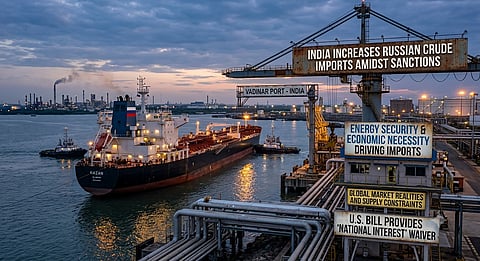
Notwithstanding the US threat of imposing sanctions on imports of Russian crude, India’s imports have increased since the conflict in West Asia. While the international market is volatile, with the cost of crude increasing to $90 per barrel after the escalation of conflict between the US and Iran in the recent past, Russia has been a steady supplier and has no shortage.
“From India’s perspective, Russian crude has become the country’s strongest energy security hedge, particularly since the Strait of Hormuz disruptions,” informs Sumit Ritolia, manager, modelling and refining & data provider, Kpler, while briefing Business India. “Russian barrels have enabled Indian refiners to maintain high refinery run rates, ensure uninterrupted fuel supplies and avoid the disruptions experienced by several other Asian refining systems (excluding China). This growing importance is reflected in import trends: Russian crude imports rose to about 2.6 mbd in June, accounting for more than 50 per cent of India’s crude imports and have been steadily increasing since March. July arrivals are also tracking at healthy levels and could match or even exceed June’s volumes”.
“We will import our energy requirements from wherever they are available, as we need to cater to the needs of our 1.4 billion population,” reiterates Randhir Jaiswal, spokesperson, ministry for external affairs (MEA). Russian crude has acted as a stabilising force for the global oil market. The original sanctions framework was re-designed to keep Russian oil flowing, because removing millions of barrels per day from the market would have significantly tightened global crude balances and pushed prices higher, which the US wouldn’t want.
“If secondary tariffs of 100 per cent or give any number to it were implemented in a way that materially reduced purchases of Russian crude, the market would first need to answer a simple question: where would the replacement barrels come from?” asks Ritolia. “With spare production capacity limited, Strait of Hormuz risks still elevated, and alternative supplies constrained, replacing Russian volumes at scale would be extremely challenging without triggering a sharp increase in oil prices”.
For India, at present, there are few alternative suppliers to replace Russian crude. Russian crude remains the most practical and competitive source of supply for Indian refiners and, under current market conditions, it is difficult to see those volumes disappearing from the system in the near term.
“While the tariff proposal raises geopolitical uncertainty, its practical implementation and ultimate impact on crude flows are far less straightforward than the headlines suggest,” Ritolia contends. “Any policy that materially disrupts Russian exports would risk tightening an already constrained global oil market, with consequences extending well beyond India.” Dependence on crude from Russia has displaced traditional suppliers from West Asia, including Saudi Arabia, Kuwait, Qatar and Iraq.
Crude supply
India’s refining sector, reports suggest, has increased its intake. These include the Jamnagar Refinery, Paradip Refinery and Kochi Refinery (all BPCL), as well as Vadinar Refinery (Nayara Energy). At present, India’s crude supply is secure and nearly 70 per cent of the country’s crude imports are coming from beyond the Strait of Hormuz. “India is importing crude from 40 countries globally and oil marketing companies have secured cargoes through various routes,” says Sujata Sharma, joint secretary, ministry for petroleum & natural gas.
Meanwhile, the US introduced a bipartisan legislative bill in July to penalise supporters of Russia’s war effort, targeting primary purchasers of Russian energy. Key provisions of the bill included tariffs of up to 100 per cent on goods imported from the world’s five largest purchasers of Russian crude oil & natural gas (India, China, Slovakia, Hungary and Azerbaijan). It also imposed expanded primary and secondary sanctions on Russian officials, oligarchs, financial institutions and the Russian ‘shadow fleet’.
This bill also prohibited US persons from purchasing Russian sovereign debt, making new investments in the Russian Federation or its energy sector, transferring funds to or from the Russian government or for the benefit of Russian officials and exporting, re-exporting or transferring US origin energy or energy products to or within Russia. However, the bill contains a waiver, consistent with other mandatory sanctions bills, allowing the President to waive sanctions, restrictions or duties upon a justification and certification to Congress that the waiver is in the national interest of the US.