
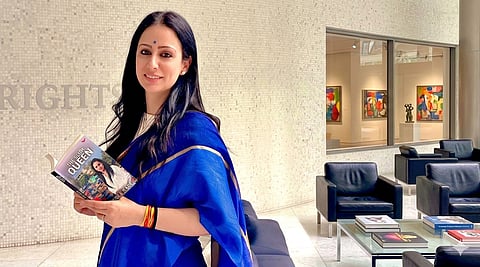
From murals to milestones: Rouble Nagi’s art-led education revolution
Winning the GEMS Education Global Teacher Prize and the UNESCO Award – both awarded by panels of global leaders in recognition of teacher Rouble Nagi’s innovative pedagogy and measurable social impact – has made our country proud. Being presented by His Highness Sheikh Mohammed bin Rashid Al Maktoum and Sunny Varkey of GEMS Education and the Varkey Foundation made it even more prestigious, as it celebrates education, compassion and service. It is not just a personal milestone but a reminder of why this journey took shape.
Nagi has redefined traditional teaching through experiential learning, demonstrating that education can serve as a powerful catalyst for long-term social transformation. What sets Nagi apart and led to her receiving such an honour is the recognition of how powerfully her work aligns with the Prize’s core criteria: measurable impact on learners and communities, innovation in teaching practice, leadership beyond the classroom, and scalability of impact. Thus, the Global Teacher Prize Judging Academy, made up of prominent individuals from the worlds of art, sport, business and education, selected Rouble Nagi as the winner of the GEMS Education Global Teacher Prize 2026.
Business India met the impressive Teacher of the Year, Nagi, in her office, where she went straight to the heart of the matter and discussed how her foundation (RNAF)'s ‘living textbook’ model has transformed neighbourhood walls into educational tools. Her environmental transformation is paired with a unique art-based system that breaks down difficult concepts through murals, dramatically increasing engagement and conceptual clarity for first-generation learners.
The only Indian artist to work in more than 40 media, Nagi is a member of the Indian Design Council and has participated in more than 150 exhibitions worldwide. She has to her credit over 800 murals and sculptures created over more than two decades. But what is even more compelling is how she has used her artistic talent for a larger social purpose. Over the past decade, her foundation has worked with more than one million children through art-based workshops across the country, and it runs 62 balwadis to promote early education. Nagi’s journey began with the Paint Dharavi movement (2016), which later evolved into Misaal Mumbai. As her model proved scalable and deeply community-driven, it grew into Misaal India, with chapters such as Misaal Delhi, Misaal Kashmir, Misaal Hyderabad, Misaal Uttar Pradesh, Misaal Rajasthan and Misaal Uttarakhand: all unified today under the umbrella of Misaal India.
How does the foundation work?
The foundation’s work thrives on collaboration – with artists, residents and local communities joining hands. Volunteers come not just from art colleges but from colleges across disciplines, and even schoolchildren actively participate in the painting efforts. Many of these young volunteers are later trained and eventually employed. This participatory model creates a powerful sense of pride and ownership among communities for the artworks they helped bring to life.

“As an artist, my core belief has always been that art is far more than aesthetics; it is a powerful medium for change. Art can spark curiosity, encourage reflection and create a ripple effect of positivity that reaches far beyond the canvas. It can teach, inspire and open minds in ways that traditional methods often cannot. With this conviction, I envisioned using art not just as expression but as education.”
The idea was simple yet transformative: to turn the walls of dilapidated structures, slums and forgotten corners of villages into living textbooks. These painted walls became tools for learning, storytelling and community building.
What has the foundation achieved over the years?
What started as an art intervention evolved into a national model of community-based education, dignity restoration and social transformation. Today, the foundation’s work shows that when art, learning and community ownership come together, even the most marginalised spaces can turn into classrooms, and the children within them can rediscover confidence, curiosity and hope.
When RNAF first entered slums and villages across India, they quickly realised that children were not dropping out because they lacked ability; they were dropping out because they lacked engagement, support and dignified spaces to learn. So they began teaching outside, under the open sky, where learning felt less like a classroom and more like a picnic. Surrounded by nature, children absorbed lessons intuitively. They then repaired existing centres, built new ones where necessary, and worked with students to paint the walls of entire settlements – homes, lanes and community areas – transforming them into giant living canvases.
But these were not just murals; they became curriculum-based learning tools. Multiplication tables, science diagrams, grammar cues, maps and constitutional values appeared across the walls. Suddenly, the slum itself became a textbook. Learning blended seamlessly into daily life. It moved beyond the four walls of a classroom and became continuous, visual and contextual.
Alongside this environmental change, the centres offered structured academic support. Art moved from being an extracurricular activity to becoming a teaching method. Difficult concepts in mathematics, science, language and social studies were broken down through drawings, murals and creative exercises. Children illustrated scientific processes, painted historical events and visually represented abstract ideas. This approach dramatically increased engagement and conceptual clarity, especially for first-generation learners who previously struggled with rote learning and often lost interest in school. Once learning became interactive and children had mentors to guide them, attendance began to improve and remained consistent. Parents, seeing their children speak more confidently, understand their subjects better and express themselves creatively, became far more invested in their education.
These journeys – from slum and village classrooms to professional degrees, competitive examinations, military training and economic independence – are the clearest indicators of educational progress. In essence, the achievement is twofold: reducing dropout rates by making education engaging, dignified and accessible, and helping children from the most underserved backgrounds grow into confident young adults: artists, civil service aspirants, future officers and financially independent women who are now shaping not only their own futures but also the future of their communities. Nagi demonstrated leadership beyond the classroom by mobilising local communities and training volunteers. She positioned learners as co-creators and community changemakers, expanding the teacher’s role into mentorship, advocacy and social leadership.
Scalability and sustainability
Her model was designed to be replicated – community-led, low-cost and adaptable across contexts. By empowering locals to sustain projects and pass on skills, her work demonstrated how innovative teaching can scale impact without dependence on a single individual, showing that great teaching can transform not just classrooms, but entire communities.
She adds that today all the income from her art is donated directly to the Rouble Nagi Art Foundation. Over the years, RNAF has also earned the trust and support of government bodies and a strong network of CSR partners. She credits Madhav Chavan of Pratham for first initiating her into the world of early education; her journey began with Pratham nearly two decades ago. CSR partners include some of the country’s most respected institutions – BPCL, ONGC, GIC Re, Bajaj Auto, Toll Group, K Raheja Group, D’Décor and Viacom18, among several others – who continue to support large-scale art, education and skill development interventions.
The Rouble Nagi Art Foundation has also signed MoUs with municipal bodies across multiple cities under the Mahaparivartan initiative, a public-NGO partnership launched during the previous tenure of Chief Minister Devendra Fadnavis. Through these collaborations, successful models like Misaal Mumbai were replicated in other cities, ensuring that the transformation of neglected settlements into vibrant, learning-friendly environments could be scaled effectively.