
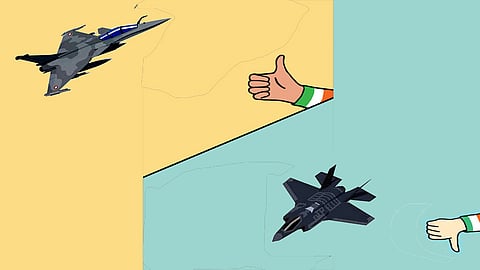
In resisting US efforts to sell its F-35 stealth fighter, India has decided to buy 114 Rafale aircraft from Dassault Aviation of France for Rs3.25 lakh crore, 96 of which will be manufactured in India. Typically, the decision was announced on the eve of French President Emmanuel Macron’s visit to create a feel-good atmosphere for other bilateral dealings. But this is a deal of considerable significance for several reasons.
For one thing, India has scored a geopolitical point in choosing the French aircraft over the controversial F-35. While India had firmly signalled its disinterest in acquiring the F-35 stealth fighter jet some time back, Donald Trump used Prime Minister Modi’s last visit to Washington to advocate for the sale. But that pitch fell flat after India decided to pivot towards boosting domestic defence manufacturing and collaborative development, in line with its “Make in India” policy. Besides, high-profile American military hardware normally comes without co-production guarantees and technology transfer.
While the F-35 is the world’s only mass-produced 5th-generation stealth fighter, priced at approximately $80 million per unit, it also poses interoperability challenges with India’s Russian-origin platforms. Russia had offered India co-production of its fifth-generation Su-57 stealth fighter, a proposal aligned with India’s industrial goals and strategic autonomy. However, India refused the Su-57 offer amid Trump’s announcement of punitive tariffs on Indian imports from Russia. Reinvesting in a Russian platform with a history of incomplete systems and opaque upgrade paths would not only have been a strategic gamble but could also entrench the Indian Air Force in a long-term dependency on a defence ecosystem increasingly isolated and under strain due to global sanctions.
The choice of Rafale is also guided by the fact that India has deepened ties with France. Domestic production of Rafale fuselages (an offset from the earlier deal) will begin by 2028 at a rate of up to two units per month. India’s growing defence relationship with France is viewed as stable, forward-looking, and aligned with its strategic objectives. Unlike Russia, France has demonstrated openness to technology transfer and joint production, pillars of our self-reliance agenda. For instance, French engine manufacturer Safran, which makes turbofan engines for the Rafale, is already scaling up its presence in India, tying up with DRDO to design and make engines for the indigenous advanced medium combat aircraft (AMCA), a project gathering momentum but unlikely to be operational within this decade. That is where complementarities between the French companies, which also include the electronics major Thales, will come into play, drawing greater involvement of Indian private players.
Without access to 5th-generation fighters in the immediate term, the IAF may find itself stretched thin in the face of rising threats from regional adversaries, particularly China, which is aggressively scaling its stealth fighter capabilities. India is currently operating only 31 active fighter squadrons against a sanctioned strength of 42, and needs to actively augment and modernise its fleet against the perceived twin threat from Pakistan and China. Along with the Tejas aircraft from Hindustan Aeronautics Ltd, the Rafales (36 of which are already in operation in India, with some being deployed by the Navy) will replace the ageing MiG 29 fleet of over 100 aircraft. The 4.5-generation Rafales could well become the backbone of the IAF.
The incipient efforts to indigenise the production of the fifth-generation AMCA with the involvement of private players are a pivot that affirms India’s multi-alignment in a fractious world. Besides multi-alignment, strategic autonomy is also being put into practise in defence procurement. Almost 90 per cent of the contracts for defence equipment, finalised between March 2019 and December 2024, were signed with Indian vendors. India’s defence ecosystem is coming of age, despite issues of delayed deliveries (Tejas being a case in point); defence exports are in the region of R25,000 crore.
Indeed, the multi-pronged push to boost defence capabilities – acquiring aircraft, developing cyber warfare skills through the National Quantum Mission, building capacity in critical minerals, electronics and semiconductors – acquired a sense of urgency after Operation Sindoor. Both Operation Sindoor and the recent US action in Venezuela brought home the primacy of drone, satellite and precision warfare, marked by real-time intelligence. Even as India easily overcame Pakistan’s challenge in Operation Sindoor, what became obvious was the extent to which Pakistan benefited from Chinese technology and weaponry. This is a point unofficially acknowledged grudgingly by the Ministry of Defence mandarins and publicly strategic experts.