
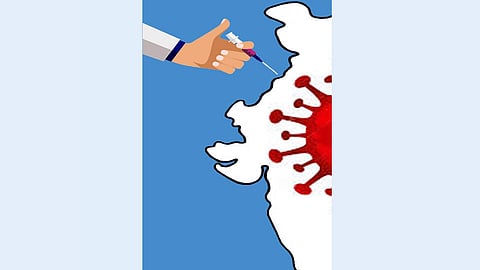
The big difference between the first wave of corona-virus pandemic, which hit the country last year and the current and more frightening second wave is that more and more young people are being impacted this time. And, young people account for 70 per cent of India’s population. Migrants are mainly young people, who are going back to their villages and taking the infection with them. Besides, the virus is more infectious and causing more severe damage this time around.
So, there are no surprises then that the virus has reached the villages. Last time, it did in pockets, that’s why it was negligible and remained un-noticed. This was also, because our frontline health workers, especially the village-level ASHAs (accredited social health activists), had the energy and enthusiasm to take on the challenge. But the Central and state governments let them down by not giving them any protection. So, many of them got Covid-19 or faced other health issues. They are now demoralised and scared.
That the virus has reached the villages will have implications for our economy. Rural demand has driven consumption growth and helped the economy remain afloat since 2018-19. FMCG companies, vehicle manufacturers, consumer durables makers – they all depend on rural demand. Last year, the farm sector, the only standout story in our economic performance, grew at 3 per cent plus. This kept the rural demand steady. Already, brokerages like Bank of America Securities are beginning to see rural demand being relatively weak into the summer of 2021.
They also expect the autumn kharif farm income growth to slow to 7.4 per cent from 10.6 per cent last year, as lower pricing power offsets a larger crop. The weak rural demand shows the pandemic is now fast progressing from a supply shock to a demand shock, given the massive jobs and income losses. This is bad news which can be offset only if the summer rabi income growth is substantially better than 8.7 per cent logged last year. This assumes an increase in sugarcane prices. So, our state governments will have to play a role in ensuring that the price increase is enforced.
There have been a slew of downward revisions in growth estimates after the emergence of the second wave, which has overwhelmed the healthcare apparatus and also led to localised lockdowns. A lot will now depend on when the second wave peaks. It if happens in the end of June, Crisil has predicted that the GDP growth can come down to 8.2 per cent.
Speaking at the release of the eighth installment of financial benefit under the PM-KISAN scheme, Prime Minister Narendra Modi made a public acknowledgement of the fact that the virus is rapidly spreading in rural areas. To tackle the challenge, he said that awareness about this among rural people and cooperation of the panchayat institutes are important. He urged farmers to be aware of this ‘invisible enemy’ and take precautions and timely medication, apart from wearing masks, maintaining social distancing and undergoing testing if there are any symptoms.
Given the state of health infrastructure in our villages, the fact that the pandemic has reached our rural areas is every government’s nightmare. There’s no point sending oxygen concentrators and fancy medication to a primary healthcare centre which has a missing doctor. The first problem the government needs to get a grip on is that of under-reporting. Given the fact that cases of infection are said to be at least ten times more than what is being reported, governments may never have a clear picture of how big the challenge is.
Stories about half-cremated bodies being dumped in rivers in UP and Bihar have already given us some idea of how the authorities are trying to hush up the pandemic deaths. It is easy to deliver homilies to farmers on not taking symptoms like cold and fever lightly and getting tests done. Where are the facilities for testing? Forget RT-PCR, even rapid antigen testing is difficult to come by in villages.
A lot will now depend on how fast the centre and the states to put in place a system for mass vaccination in the rural areas. The only thing that will save us from Covid in the long run and in the mid-run is vaccination and we need to ramp this up. India has a stellar record of doing vaccinations in rural areas – if one recalls pulse-polio (vaccinations), the governments did crores in one day, covering the whole country in two successive years and eradicating the problem. Earlier, the same success was achieved with smallpox. India should go back to its own capability and management in the field. Even if half of India’s population is vaccinated by the festivities, which will begin in October, it will be a good thing.